What I Read in November and December
December 30, 2015 § Leave a comment
Paulina & Fran, Rachel B. Glaser. Heard the author read at Odyssey Bookshop in South Hadley, and got the book signed there.
The title characters are art school students drawn into a tug of friendship, romance, fascination, sex, dismay, and manipulation. The personalities of Paulina and Fran are distinct but not perfect complements. Paulina is the dominant member of the pair—we might be tempted to call her an emotional bully if we weren’t rooting for her and Fran to grow into something more—while Fran is the more sensitive and (it is suggested) more talented artist. Paulina keeps sleeping with a boy she’s broken up with because “every house needs a house cat.” Fran “has this bedroom feeling to her … everywhere Fran went, she inhabited like her bedroom.”
Glaser fluidly shifts back and forth between characters, and she is ambitious and exact with her colorful metaphors, in part because she pins them with effect to the pair’s obsessions with fashion, image, surfaces, and exploitation. Paulina gets a design job at a Forever-21 type store; Fran paints houses upstate. A hair salon has “that plastic smell of vanity and fear. It was decorated with black-and-white photos of models.” Paulina’s fur coat “weighed on her like the next decade.” At a thrift store, “Every nightgown came with a few bad dreams.”
The book understands art school, particularly, as a milieu where people pose for one another, and are harshly judged for no other reason than the satisfaction of judgment. Paulina sleeps with a boy who “had a number of nervous tics, and looked like he animated dragons all day.” Sculpture majors “loved nothing more than taking up space.” There is a hostility expressed toward “Cooper Union graduates who’d spent their saved tuition money on designer sneakers and mopeds…The girls were dressed like new wave French philosophers.” The writing is not superficial, nor does it get lost in a melting psychological sea of abstraction.
Cassandra at the Wedding, Dorothy Baker. One of two novels by this Montana-born writer re-released by NYRB Classics, Cassandra at the Wedding was first published twenty-four years after the other one, Young Man With a Horn, which I read and enjoyed in 2013.
Cassandra has a relaxed vibe, remarkable for a book about a young woman’s neurosis. Cassandra is a Berkeley graduate student returning home to the family ranch for her twin sister’s sudden wedding. Their mother is deceased; their father, a retired professor of philosophy, seems happily disengaged; and their grandmother (on Cassandra’s late mother’s side) busies herself with projects relating to the wedding.
Apart from a section narrated by Judith, the bride-to-be, the story is Cassandra’s, and hers in an intelligent and dynamic mind to reside in. She arrives at the family home with her thesis unfinished and harboring a well-considered angst toward the nuptials. I found myself coming back to the book’s early scenes, when she was settling in and enjoying conversation with her father:
“Well, what’s he like?” I said.
My father didn’t ask whom I had in mind, but he didn’t answer the question either. He got philosophical instead and gave me a speech about how it’s not easy to say what anyone’s like, even among people you think you know well; and this hit me because, like most of papa’s propositions, it was infuriatingly true. Judith Edwards, for example, whom I once thought I knew like myself, like the back of my hand, as they say. What made her decide to try New York, alone, for a year, before we tried Paris, together? Who knows what anybody’s like?
I took an ice cube out of the bucket, closed my fist over it, and let it drip into the copper sink. This comes under the head of playing in the water, but papa apparently didn’t notice, and it had the effect of rallying my forces and not letting me give up.
“Playing in the water” takes on heavier meanings at other points in the book, between the pool in back of the family home to the bay under the bridge in San Francisco. Cassandra is coy about her personal life (she wakes up in her childhood room realizing she “was not going to be found in any of the three, or possible four, places [she] can wake up in in Berkeley”) but open about who and what she loves, and her interactions with Judith feel honest in the tension and overlap between the two sisters. There is struggle but also an aware irony in this family that is missing a mother (who died three years ago, “much too young but I’m not sure she thought so”), so when, midway through the book, Cassandra attempts to overdose on sleeping pills, it is a wrench to the heart not just of this nice family but the reader who has grown fond of her.
2 A.M. at the Cat’s Pajamas, Marie-Helene Bertino. Another book featuring characters whose lives intersect in remarkable ways. I read most of it on a plane to New Orleans. Some of the chapters are quite short, and in keeping them as such Bertino achieves an immediacy that suits the minute-by-minute narrative.
The main character is nine-year-old Madeline, and she is a bit of a cartoon—she smokes cigarettes and swears and scoffs at her classmates (“Your clinginess is embarrassing,” she tells a girl) and lives under the care of an elderly guardian. She is absent a deceased mother and her father is, for some reason, confined like a convalescent to his bedroom. Madeline’s dream is to sing jazz onstage, and so the plots rolls into motion when she learns about the existence of the establishment–a downtown Philadelphia jazz club–in the title. Madeline makes it her determination to find and infiltrate the Cat’s Pajamas in the hope she can sing there.
The other main character is Sarina, Madeline’s fifth-grade teacher, a recently divorced dreamer who has moved back with her family and been invited to a dinner party where an old boyfriend, Ben, is also said to be coming. There is also Jack, the owner of the Cat’s Pajamas, who is a little greasy, and his son Alex, who plays drums, and a subplot about a rare and expensive guitar called a Snakehead.
For a book with a bit of fluff to it, I liked the characters, particularly Sarina, who balances an urge to allow herself happiness with soberness of one who has lived through disappointment and the responsibility that she naturally assumes around children. The setting of snowy Philadelphia gives the book some life and grit, and the time-managed plot keeps things mostly clear of preciousness.
Light Years, James Salter. I am undeniably guilty of the crime of catching up on my debt to James Salter only after he has died. (I do that a lot; see also Mavis Gallant.) Light Years is the second Salter I’ve read, after A Sport and a Pastime, which was tenderly crafted and had the distraction of intervals of finely wrought sex. Light Years is about a marriage between two adults, Nedra and Viri, and its slow dissolution, and the people who fade in and out of their scene as it happens.
They are a couple who enjoy their pleasures, their social lives, their curiosities, dinners with friends and their flirtations. Salter’s tight sentences lighten the air in which the characters breathe. The way Nedra is written, I can see her graceful movements, the muscles in her arms, her involuntary scratches at her elbow. She has “a rich, naked laugh.” After an afternoon of picking tomatoes, she “looked like a woman who had once been rich.” A visiting client of Viri’s “recognized in her a woman who would not betray him.” There are affairs, sloppy ones, that end not in shocked outrage but futility. They divorce, the children grow up, and everything feels seamless: the way older daughter Franca (and younger Danny, but particularly Franca) makes appearances more and more sporadic, the way her sophistication catches up quickly to that of her mother.
Viri is an architect, and Salter inserts moments when his structure is allowed to crumble:
“Look at him, Papa, don’t you love him?”
The hen sat panicked within her arms, its small eyes blinking.
“Her,” Viri said.
“Do you want to know their names?” Franca asked.
He nodded vaguely.
“Papa?”
“Yes,” he said. “Where did you get them?”
“That’s Janet…”
“Janet.”
“Dorothy.”
“Yes.”
“And that one is Madame Nicolai.”
“That one…”
“She’s older than the others,” Franca explained. He sat on the step. Already there was a slight, bitter smell in the room. A bit of feather floated mysteriously down. Madame Nicolai was sitting as if dumped in a great, warm pile of feathers, brown, beige, becoming paler as it descended to soft tan.
“She is wiser,” he said.”
“Oh, she’s very wise.”
“A sage among hens. When do they begin to lay eggs?”
“Right away.”
“Aren’t they a little young?” He sat idly on the step watching their careful, measured movements, the jerk of their heads. “Well, if they don’t lay eggs, there are other things. Chicken Kiev…”
“Papa!”
“What?”
“You wouldn’t do that.”
“They’d understand.”
“No, they wouldn’t.”
“Madame Nicolai would understand,” he said.
She was standing now, apart from the others, looking at him. Her head was in profile, one unblinking eye black with an amber ring. “She’s a woman of the world,” he said. “Look at her bosom, look at the expression on her beak.”
“What expression?”
“She understands life,” he said. “He knows what it is to be a chicken.”
“Is she your favorite?”
He was trying to coax her to come to his half-closed hand.
“Papa?”
“I think so,” he murmured. “Yes. She is a hen among hens. A hen’s hen,” he said.
They were clinging to his arms in happiness and affection. He sat there. The chickens were clucking, making little soft sounds like water boiling. He continued to extol her—she had now turned cautiously away—this adulterer, this helpless man.
The Moviegoer, Walker Percy. A reread, one I decided to take on again because it is set in New Orleans and I took a vacation there at the end of November. It turns out that there isn’t a whole lot that is particular to that city, except for the names of streets and streetcars and descriptions like “the curlicues of iron on the Walgreen drugstore” and “the homosexuals and patio connoisseurs on Royal Street.”
A lot of people love The Moviegoer, and the narrator Binx Bolling feels like he has potential to do something fascinating—a bit young, naïve, a keen observer but perhaps too passive at this stage of his life. (Hence his fondness for going to movies.) He works as a bond trader but is regarded as an underachiever by his aunt, who wants him to go to medical school. He sleeps with his secretaries, and is in love with his childish-seeming cousin, Kate, who, it is suggested, suffers from mental illness.
It is not asking too much of the reader to be patient with the novel’s existential sensibilities, but it still feels, on second read, like it could use a few more bones in its skeleton. Of course, the lack of concrete decision and structure is the heart of Binx’s problem. Binx is a lost soul looking for a way, but unlike the French, who manage to make despair much more interesting, he doesn’t have an urgency to reduce perspective or repudiate the banal. He places currency in his sense of dream and wonder, and while this might make us root for him to find his moral purpose, it feels like a false journey to those of us who know that reality still waits around the corner.
So, for 2015: thirty-nine books, twenty-one by women. Six were re-reads. Thirteen were nonfiction. I read six books by Joan Didion, two by Salter. Among the new books I read, I particularly loved Christy Crutchfield’s How to Catch a Coyote, for its clever arrangement of characters in a nonlinear narrative against a consistent and tangible setting, as well as Cassandra at the Wedding and Light Years and Didion’s Play It as It Lays, a razor-sliced portrait of 1960s Hollywood that manages to feel current and alive. Perhaps it spoke to me because I was less than a year removed from my mother’s death, but Liz Scheid’s The Shape of Blue caught me pleasantly by surprise for its earthiness as the author responds to tragedy and loss with thoughtful questions of order.
But the best book I read, in terms of the power of its storytelling, was Atticus Lish’s Preparation for the Next Life. There was a sense, as I was reading, that I was amidst something both grand and modern, and that its characters were inhabiting the shaky, insecure, and clattering world I knew. It gets right the terror of loneliness, the loom of cities, the scatteredness of the twenty-first century landscape and the need to create one’s own reality within it. It carries forward the echo of war horror and lets it resound in the ear while landlords clomp around overhead. Few novels identify the breakdown between the interior and exterior so well.
As the year winds down, I have piles of new books around my office that I don’t know when I’ll get to read. I am seven months behind on my New Yorkers. It’s the kind of obligation that can make reading feel suffocating rather than enlightening. And while I published two stories this year and started a few essays (finishing and submitting one, still pending), I feel like I have been working on the same things for a long time, and have yet to really leap forward as a writer. I need to stop gazing at my shoes and plow through. Consider that my resolution.
Happy Golden Days
December 28, 2015 § Leave a comment
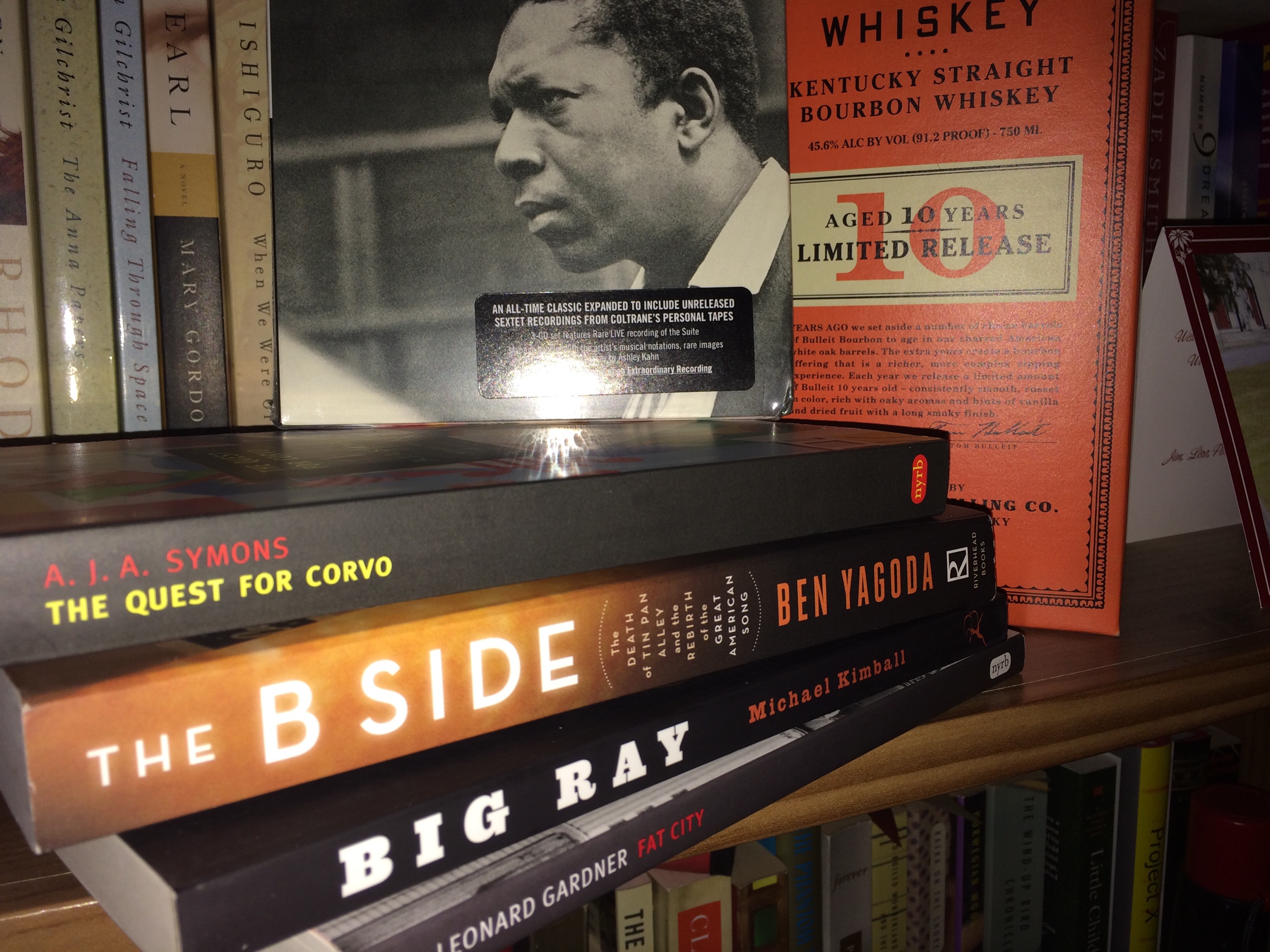
I caught a cold over Christmas, and as a consequence my voice has dropped an octave and taken on a syrupy, Clooneyesque lustre that I’ll miss once the NyQuil and Sudafed have done their work.
My wife joked about getting me a hatchet for Christmas, and though she went another route it was hard not to notice that, on the whole, my haul this year had a bit of a masculine tilt, a little noirish, a little cool. We’re expecting our first big snowstorm on Tuesday, after a stretch of disarmingly mild weather, and I forward to warming my soul with these.
Angel from Down Under
December 17, 2015 § Leave a comment

To this New Englander, New Zealand feels like the bottom of the world, about as far away a place as one can go. So when I recently watched An Angel at My Table, Jane Campion’s 1990 biopic about the writer Janet Frame (1924-2004), I tried to keep my eyes open to the landscape and other revealing aspects of location. There are rolling green hills and scenes with sheep bopping into the frame, and elementary school classrooms with New Zealand flags hanging. There are trains passing over horizons. Frame’s father worked for the railroad, though with six children the family did not have a lot of money.
At two hours and forty-five minutes, the film covers aspects of Frame’s early life in patient detail. Janet is the shy observer, overshadowed by three domineering sisters. The girls must share a bed. She practices such poor hygiene that a school nurse scolds her for having filthy ears. Her older brother suffers from epileptic seizures. In adolescence, she develops a taste for sweets, so much that she and her sister steal prized chocolates from a landlady. Her teeth go to rot.
There are slight moments when the artist with the sensitivity for language emerges (upon which the cleaning of her ears almost works as a metaphor), as when she resists her sister’s suggestion to change a word in a poem for school, one that eventually gets published. Frame’s life has parallels to that of Sylvia Plath, or more accurately, the character of Esther in The Bell Jar: In a rural community with few literary heroes, a dreamy girl who demonstrates creative talent and moments of social anxiety gets recommended by her teachers to the observation of a shrink, psychiatry being a young and perhaps oft-misapplied science at the time. She is hospitalized for schizophrenia and subjected to shock treatments. A lobotomy is scheduled, and it is cancelled only when her first collection of stories wins a major literary award.
Then the film lightens as Frame is given a chance to enjoy success. She develops mentorships at a writers’ colony, then has an affair with a married history professor who dabbles in poetry but is terrible at it; he reads it to her in bed, and for the first time in her life she must hold herself back from saying anything.
Frame’s books aren’t easy to find here in the States, apart from Amazon. She wrote an autobiography in three volumes, the material for which Campion mined for An Angel at My Table. Many critics seem to label Frame a writer of magical realism, particularly for her final novel, The Carpathains (1988). Frame’s popularity among New Zealand writers might be matched only by Katherine Mansfield (1888-1923), for whom Frame’s mother worked as a housemaid (a fact never broached in the film) and who died the year before Frame was born.
Unspeakable
December 9, 2015 § Leave a comment
I always thought it was ironic that so many Americans learned about the death of John Lennon from Howard Cosell, one of the most notorious scene-stealers in broadcast history, late on a Monday night during the fourth quarter of a sleepy football game in Miami.
Stymie is Returning
November 30, 2015 § Leave a comment
I am glad to see that Stymie Magazine will be re-launching after the first of the year, and is looking for submissions.
In an announcement published on November 20, the editors write, “the space that is serious writing about sports and games has evolved and changed – in some ways good, in other ways not so much.
“We hope it means we get inundated with thoughts on Tecmo Bowl, the 1985 World Series, that time a horse race was so much more than a horse race, and everything in between.”
With a name originating from golf—when one player’s ball blocks the path of another to the hole—Stymie uses the subject of sport to present situations of human struggle and perseverance with a nuanced, literary touch.
Stymie published my story “Hurry Someday” in 2014, one of four stories (so far) in my series about teenage ballplayers growing up in a Detroit suburb in the 1990s.
What I Read in October
November 8, 2015 § Leave a comment
Almost Famous Women, Megan Mayhew Bergman. I bought this book at a local bookshop after enjoying Bergman’s first collection of stories, Birds of a Lesser Paradise, a couple of years ago. The “almost famous women” here are real people noted for their daring and adventuresome spirit whose stories exist (certainly unfairly) on a step below most popular, male-dominated historical narratives. These fictional stories place each of these women in a dynamic new frame.
I hadn’t heard of most of them, such as motorcycle daredevil Hazel Eaton (1895-1970), featured in the story “Hazel Eaton and the Wall of Death,” or British power boat racer Marion ‘Joe’ Carstairs (1900-1993), who bought the island of Whale Cay in the Bahamas after her retirement to host celebrities such as Marlene Dietrich (“The Siege at Whale Cay”). I had heard of African-American film actress ‘Butterfly’ McQueen (1911-1995), who played the maid Prissy in Gone With the Wind but wasn’t allowed in the all-white theater to watch the premiere, but not of her decision, as an atheist, to donate her organs to science, which she did after she burned to death following the explosion of a kerosene lamp (“Saving Butterfly McQueen”).
These real, capsuled lives essentially work as prompts for Bergman, and as with many prompt-written stories they take liberties of projection, extrapolating the minutiae of a life from what biographical information is known:
It’s only when she’s afraid that she second-guesses her decision, and it’s only when she second-guesses her decisions that she thinks of her daughter, Beverly, who lives in Vermont with Hazel’s mother.
Am I a terrible person for giving her up?
“I’m cold,” she says, but her face is bandaged and she can only moan. She tries to rub her arms, but maybe one of them is broken, and then she’s out again, riding a morphine high into nothingness.
Girl in a Band, Kim Gordon. All of my favorite rock bands flourished in the nineties, and now all of them (and I mean pretty much all of them) are having twenty-year reunions. Sonic Youth was an eighties band, and as such they were the band that was already doing the kinds of things your favorite band didn’t have the adventure spirit to do. They had a grown-up, seen-it-all-before vibe going on. They played long songs with wild guitar riffs. They ripped out surf instrumentals. They created moods and ruled scenes.
Kim Gordon and Thurston Moore were the power couple that was doing it right when Kurt and Courtney were doing it tragically. For a while I rented an apartment only a few blocks from Gordon and Moore’s home in Northampton, Mass., and though I never saw them myself, I heard about people spotting Moore walking their dog on the bike trail. People’s kids knew their daughter. I could remember when she was born because I had read about it in Spin magazine.
Gordon and Moore separated in 2011, and while that event is not meant to be the culmination of her memoir of a life of New York and rock ‘n roll, Gordon gets the explanations out of the way early: their marriage ended in about the most banal, un-rock ‘n roll way possible, with Moore seeing another woman—essentially a groupie—and Gordon confronting him after discovering a revealing text message.
She writes with a wise edge, with six decades of life behind her, cooler things to worry about than being cool. She touches just enough upon her family life, in particular her schizophrenic older brother, but the juice oozes out of the apple when she and Moore move to New York City. It was there, in Greenwich Village, that they formed Sonic Youth, and Gordon quite organically surrounded herself with a coterie of urban artists each with their own unique cachet: Cindy Sherman, Larry Gagosian, Jenny Holzer, Gerhard Richter.
The middle of the book has a perfunctory feel as Gordon devotes a chapter to each of Sonic Youth’s albums, giving her recollection of the obsessions and ambitions that went behind the writing. The best parts come when she digresses. There is a gradual understanding, given away by the title, that Gordon’s role as a girl in a band puts her in a rare position of not only embracing but recreating her own ambitions out of the sexuality that her chosen genre is designed and marketed to sell.
I remember staring endlessly at the books lining the walls of my dad’s study as a little girl. I didn’t know what a sociologist did, but the books had titles like Men and Their Work. What did that even mean? Obviously, men—and boys—spent time, most of it, in fact, engaged in an activity known as work. Keller [Gordon’s brother], for example, had his rock collection, Erector set, and assorted other boy-passions. Where whatever I made up or imagined in my own head lacked that builder’s significance or invention, and the train set I presumed would someday magically appear must have died on the tracks on its way to me. Looking back, I was clearly devaluing what women did. …
Guys playing music. I loved music. I wanted to push up close to whatever it was men felt when they were together onstage–to try to link to that invisible thing. It wasn’t sexual. But it wasn’t unsexual either. Distance mattered in male friendships. One on one, men often had little to say to one another. They found some closeness by focusing on a third thing that wasn’t them: music, video games, golf, women. Male friendships were triangular in shape, and that allowed two men some version of intimacy. In retrospect, that’s why I joined a band, so I could be inside that male dynamic, not staring in through a closed window but looking out.
Jeff in Venice, Death in Varanasi, Geoff Dyer. This is the first book by Dyer that I’ve ever read, though I’ve read enough of his essays to know he’s a bit of a wag. Jeff in Venice, Death in Varanasi is divided into two parts that refer to each other only glancingly; in fact, it’s not fully established that the main character in each half is the same person, though there’s enough to reason to believe so. The separate narratives seem to have little to say to each other; they sit on polar ends, drunk and sober, giddy and somber, blithe and reverent.
In part one, we meet Jeff, a veteran British journalist traveling to Venice to report on the Biennale. Dyer’s playful self-effacement starts off with a pun: when Jeff colors his hair, it doesn’t seem worth carrying on about, until you notice that it’s a wordplay invoking the author’s name: Geoff Dyer has created Jeff, who is a dyer. What kind of meta-moral math puzzle have we gotten ourselves into here?
In part two, we are treated to a first-person narration of an unnamed journalist who has traveled on assignment to the Indian city of Varanasi, on the Ganges, where Hindu pilgrims have amassed—not for a festival, but as a holy destination. Dyer’s first-person narrator offers some wry amusements, but sets back without the dance to score the superficial rush that fills Jeff’s time in Venice.
From what I know of his nonfiction, my impression is that these bipolar narratives span the range of Dyer’s comfort as a writer: He likes to go places, be both amused and confounded by them and then be amused at his own confoundedness.
British journalist Jeff meets an American journalist, Laura, and lands in an easy, almost too casual, affair with her, one with minimal complications other than the obvious adult awareness that it will have to end. Along the way, there are grand allusions, or at least one would have to assume having not read it, to Thomas Mann’s Death in Venice. And the debauchery of the first story is blackened and diminished in shame by the sanctity of the second.
So: two waterfront cities, with English names starting with the same letter, in countries whose English names start with the same letter. The invitation to draw comparisons does not end there. Jeff downs bellinis in Venice while the hero of the second story drinks bhang lassis. There are allusions to each city in the other’s story, plopped in unlikely moments, suggesting a telegraphing of code:
What was wrong with him? Minutes after contemplating moving to L.A. he was ready, now, to go backpacking through Vietnam, Cambodia and Thailand. Lacking any larger ambition or purpose meant that you clutched at whatever straws came your way. If she’d said she was thinking of moving to Romania, he’d have signed up for that too. Or Mars, even.
He said, “Have you been to India before?”
“Once. Top Goa and Kerala. This time I want to go to Rajasthan and Varanasi, Benares.”
“They’re the same place, right?”
“Exactly.”
“From the Sanskrit, isn’t it? Nasi, place. Vara, many. Place of many names.”
She laughed. She has perfect teeth, quite large: American teeth. “I have absolutely no idea whether that is extremely impressive or complete Ben as in bull, Ares as in shit. Which means it’s probably both.”
In a way, the Varanasi story, told in the first person, has less of a filter; there are allusions to the contamination of humans and animals as the narrator takes a piss in the Ganges and observes a cow’s “shit-caked tail was as drenched in shit as an artist’s brush in paint.” And then he goes to the other side of the river:
The bank at the other side was quite steep. Walking over it was like cresting a low sand dune. As I did so, a dark bird flapped noisily into the air. To my right, in a small bay, two dogs were eating something at the river’s edge.
A dead man.
Was being chewed by two dogs. One was eating his left forearm, the other his right wrist. The dead man was intact. He was lying face down. I could see his hair and one ear. He was wearing a filthy pale blue t-shirt, torn in several places, and shorts. The dogs looked up, looked at me, then resumed their meal. It seemed a strange place to start, the arms. Maybe they started there because it was easy to get their jaws around limbs.
I could not see the dead man properly, but I recognized one of the dogs.
The Iowa Review, Vol. 42 No. 2, Fall 2012. Food is the theme for this issue, and perhaps it’s an indication that the subject is better suited for nonfiction, because I found more satisfaction in the essays in this issue than in the stories. Naomi Kimbell’s “Bounty” is a spare and honest piece about doing good in a cynical world, and I loved the opening:
The food bank is busy this morning, and the deaf man sitting next to me is a motor-mouth. A moment ago, he hit me with one of his words. I jumped and scooted away. My chair screeched across the beige vinyl floor, and people looked at me. His ASL interpreter said the man was sorry, and I smiled at her, which I realized immediately was bad form, like the waitress who stares at the parents when it’s the child ordering the food.
Elizabeth Cullen Dunn’s “A Gift from the American People” is an honest look at the inefficacies of humanitarian aid from afar in a time of war. The place is Tsmindasqali, a settlement in the Republic of Georgia to which many South Ossetians were displaced after their homes were bombed by Russian planes. A man named Temo bemoans the contents of the food aid package he has received. “What people got to eat,” Dunn writes, “was what the World Food Program distributed: 1.5 kilograms of macaroni in a food package, along with other staples like beans, salt, and cooking oil, delivered every two weeks.”
The pasta is deplored not just for its uselessness in the kitchens of Georgian families (“in the context of Georgian cuisine, which is full of spices, walnuts, pomegranates, fresh vegetables, and meats, macaroni is hardly food at all,” Dunn writes. “It is not a staple starch, as bread or corn is … Macaroni is just calories, something that only the poorest of the poor eat.”) but for what it represents: as a meager government subsidy, it is a patchwork fix offering no real solutions to the refugees’ plight, only a distancing element from their home and identity.
The Revolution of Every Day, Cari Luna. The description of this book seemed to promise a narrative of heft: set in Manhattan’s Lower East Side during the early years of the Giuliani administration, it follows the trials and tribulations of a group of squatters in a gutted-out building abandoned by its landlord. As they fix it up and make the place their own, they battle with city officials who want to seize and develop the property (and gentrify the neighborhood) while dealing with drama within their own circle.
The structure would seem to suit a television series better than it might a novel. Luna hops around to each character with a third-person limited POV: Dutch immigrant Gerrit, older Steve and his wife Anne, and Gerrit’s girlfriend Amelia, whom we learn early on is pregnant from an affair with Steve. Amelia, a former drug addict, provides the book’s moral and emotional core, a believer who up to this point has been too easily persuaded by others. Now a new target of persuasion lingers: living in another squat is Cat, a veteran of the squatter scene who is lured back into addiction and with whom Amelia is smitten.
There are a lot of angles at play, and while the book does well enough to document its breakdown of a mini-society that pits itself against the outside and commits to its own rules of survival, few of those angles feel serious. That one of the squatters is a Dutch immigrant invites a clumsy analogy to New York’s 18th-century settlers, who sought to make a home in a place they cultivated for themselves before ceding it over to the English.
The free indirect style approach doesn’t suit well here since it does little to distinguish the graces of each character, so instead the narrative is a flat language of frustration, clumsy with pejoratives and swears. Clothes in a laundromat dryer tumble like “dumb pieces of cotton”; Cat wonders “whatever happened to Sailor and Slim, those goddamn cokehead twins from Milwaukee with the violet eyes?” Perhaps because it deals with what seems a forgotten era of New York, the narration is at times distrustful, explaining situations and stakes for the reader, especially through the kind of overarching dialogue that real people who live in intimate quarters and have come to know each other’s quirks wouldn’t say. For example, when Amelia and her friend, Suzie, walk past a couple of homeless drunks, they treat the audience to a summary of their existence, as though they wouldn’t be part of the wallpaper:
“Those guys, man,” Suzie says. “I can’t remember them ever not being there.”
Amelia thinks of the deep creases in the short one’s face, his eyes small and shrouded in folds of loose skin, and the weakness of the hand that saluted her, and she thinks, not without sadness, He’ll die soon.
“The tall one was gone for a while this spring,” Amelia says. “Rehab.”
“Yeah, that’s right. I thought he’d died, but then he turned up again in the summer.”
“I saw him come back. It was something—all cleaned up. I kind of thought he’d make it.”
A Supposedly Fun Film
August 23, 2015 § Leave a comment
I don’t know if I’ll get around to seeing The End of the Tour before it leaves theaters, but after reading Rebecca Mead’s article on the The New Yorker’s web site, “How ‘The End of the Tour’ Nails an Entire Profession,” I really want to.
The film is not a standard biopic, but a look at the evolving relationship between a journalist and his subject:
What “The End of the Tour” dramatizes—why it will be added to journalism professors’ curricula—is the seduction phase of the profile-writing process. It shows what a complicated encounter that can be, when the reporter’s effort to get inside the mind and heart of his subject is professionally motivated but also personally charged. We see the skill with which Lipsky engineers Wallace’s revelations: he waits until they are strapped into adjacent airplane seats before bringing up the fact that, as a graduate student at Harvard, Wallace was committed to McLean, the psychiatric hospital—a nice cinematic representation of journalistic cunning. But he is also seen singing along to the car radio in what is represented as a genuine sense of joy in Wallace’s company. Of course, you end up becoming yourself, even when you’re a journalist.
Wallace is not my favorite writer; he is witty and entertaining, but his outsized projects seem to fall just beyond my purview. That he was chosen for the subject of a movie (not based on David Lipsky’s biography, Although of Course You End Up Becoming Yourself, but about the making of that book) shows how he is sadly lumped into the category of writers admired for their personas as much as if not more than their opera. I read Infinite Jest a number of years ago, and what I remember of its tripartite narrative is caring more about the tennis academy thread than the psychologist thread or the Quebecois separatist thread. His essays fascinate me more, particularly those in A Supposedly Fun Thing I’ll Never Do Again, though in their quests to view Middle American traditions like state fairs and luxury cruises through the lens of irony, they feel like very old jokes.
It’s Always the Drummer, Pt. 3
June 12, 2015 § Leave a comment

Chris Gorman played the drums for one of my favorite bands, Belly, in the 1990s behind lead singer Tanya Donelly. (His brother, Tom, played guitar.) Belly produced only two albums, Star (1993) and King (1995), and Gorman’s photographs were used for the album art on both.
Now, with the help of his daughter Indi, he has written and illustrated a children’s book, Indi Surfs, reviewed enthusiastically by Maria Russo in the New York Times Book Review:
The splattery, scratchy black-and-white art looks like digitally remastered photography with a touch of 1950s-style pen-and-ink illustration, rolling over the pages with a few areas of turquoise or rose washes. Gorman’s spare words, in a large, shadowy font, and the images of girl, surfboard and ocean feel united organically, as simultaneously exhilarating and meditative as surfing itself.
The Gorman brothers operate a photography studio in New York, and some of their work provides an evocative look at surfing and skateboard culture.
Although the members of Belly grew up in Newport, Rhode Island, the band was based out of Boston, so Gorman is a perfect fit for my anthology of Boston drummer literature.
Those Four Paragraphs
June 11, 2015 § Leave a comment

I had made the mistake of telling Jim Shepard that I was a writer.
He had just given a reading in South Hadley, Massachusetts, following the publication of his novel, Project X. This would have been in 2004. Only a handful of people had showed up, including my now-wife and myself.
We bought Project X and H. got her copy signed. I brought along my (used) copy of Love and Hydrogen. Authors must love it when you give them a used book to sign, with the price still penciled on the title page.
Project X was a novel about teenagers planning a Columbine-style attack on their high school. He read sections of it to us as we sat around him in a circle, storytime-style. A lot of the questions had to do with Columbine and the cottage industry of school-shooting literature that followed, such as Lionel Shriver’s We Need to Talk About Kevin.
The conversation was slowing down and I hadn’t asked anything, so I raised my hand and asked what advice he would give to someone who aspired to be a writer.
Then, almost immediately, I apologized, admitting it was a stupid (read: hackneyed, empty) question, one he must have been tired of answering.
“It’s not a stupid question,” he said. “It’s a sweet question.”
Then he asked why I was asking it. “Are you a writer?” I think he said then that I looked like a writer, I don’t remember.
And I collapsed into a pathetic show of apology, primarily to the six or so other people who had showed up; they had not come to hear about me. I said yes, I was a writer, only I hadn’t published anything. I hadn’t really written anything, either, unless you counted the four paragraphs I nursed like a lukewarm beer because I was afraid of moving forward.
(It was an exaggeration. I had written more than four paragraphs. I merely was conveying that I was far from prolific or even remotely advanced in my venture.)
And I don’t remember any of what he said after that, what advice he gave to dreamers like me. Why do we ask writers such things, if we aren’t going to remember what they say?
But he used it as he signed my book. “Best of luck with those 4 paragraphs,” he wrote.
I picked up Love and Hydrogen again recently because I remembered a story I had loved about football players, and thinking how the voice, layered in sarcasm and ruthlessness and defeat, was similar to what I tried to achieve in my Little League stories.
There’s a football story in Love and Hydrogen (“Messiah”), but it turns out that the one I had been thinking of was “Trample the Dead, Hurdle the Weak,” which was included in Shepard’s later collection Like You’d Understand, Anyway and which I must have read in Harper’s back when I subscribed.
It’s Always the Drummer, Pt. 2
April 22, 2015 § Leave a comment
Last year I wrote about David Ryan, onetime drummer for the Lemonheads, who went on to pursue a fiction-writing career and publish a collection of stories, Animals in Motion.
Lately I’ve been listening to another Boston band, the Blake Babies, after finding one of their discs in a used record shop. Their lead singer was Juliana HatfieId, whose albums as both a solo artist and with the Juliana Hatfield Three were pretty well known on Boston radio. It turns out that the Blake Babies’ drummer, Freda Love Smith, is a writer in her own right, having earned a creative writing MA from Nottingham Trent University. She has a story, “After the Thaw,” in SmokeLong Quarterly (Issue 41, 2013):
We were well stocked with cans of soup, packs of batteries, jugs of distilled water, boxes of matches, rolls of wool socks, stacks of blankets. Flashlights. Candles. Powdered milk.
In fact, the days leading up to the storm had been busy and bright. The run to the store, the teasing arguments.
“Snowpocalypse,” he said.
“Snow way,” I said.
“Snowmaggedon,” he said.
“I don’t think snow,” I said.
And we laughed, my husband and I, despite the depth of our disagreement. His sad way of believing whatever people say; my way of believing nothing.
Love Smith works as a lecturer and an advisor for undergraduates in the Department of Radio/Television/Film at Northwestern, and writes a food blog, Lovesmiths.
I expect a Boston drummers’ anthology to make its way into print soon. In the meantime, here’s “Out There,” a song I can’t get out of my head, from the album Sunburn (1990):
 Neil Serven