Rhyme Crime
April 12, 2016 § Leave a comment
Calvin Trillin’s poem in the April 4 issue of The New Yorker, titled “Have They Run Out of Provinces Yet?,” did not go over well on the Internet. It is a strange attempt at light verse expressing an elder person’s bafflement with modern food trends and a culture that refuses to cooperate with one’s western sensibilities by remaining comfortably static. Trillin is a house name at The New Yorker, and indeed the poem reads like something the magazine would only publish because it refused to turn down one of its own. Defenders say it’s making fun of foodies, but to our sensitive cosmopolitan ears, it doesn’t warp itself enough for satire. It’s racist, the kind of racism we too often ignore because it comes out of the mouths of our uncles, whom we don’t expect to know better. In The New Republic, Timothy Yu writes that the poem “comes out of a long tradition of white writers praising Chinese culture while ignoring Chinese people.”
Another aspect that seems to be generating resentment is Trillin’s use of rhyme, which sounds like something more likely to be found in the older version of The Baffler (“Then respect was a fraction of meagre / For those eaters who’d not eaten Uighur.”)
If there is a place for rhyme in twenty-first century poetry, this piece of crap didn’t do anything to help carve out the real estate. The practice does have its defenders. I think back to the earnest laments of Nicholson Baker, in the voice of his protagonist Paul Chowder, in The Anthologist:
Poetry is a controlled refinement of sobbing. We’ve got to face that. And if that’s true, do we want to give drugs so that people won’t weep? No, because if we do, poetry will die. The rhyming of rhymes is a powerful form of self-medication. All these poets, when they begin to feel that they are descending into one of their personal canyons of despair, use rhyme to help themselves tightrope over it. Rhyming is the avoidance of mental pain by addicting yourself to what will happen next. It’s like chain-smoking—you light one line with the glowing ember of the last. You set up a call, and you want a response. You posit a pling, and you want a fring. You propose a plong, and you want a frong. You’re in suspense. You are solving a puzzle.
…
Rhyming in the genius’s version of the crossword puzzle—when it’s good. When it’s bad it’s intolerable dogwaste and you wish it had never been invented. But when it’s good, it’s great. It’s no coincidence that Auden was a compulsive doer of crossword puzzles, and a rhymer, and a depressive, and a smoker, and a drinker, and a man who shuffled into Louise Bogan’s memorial service in his bedroom slippers.
What I Read in February and March
April 2, 2016 § Leave a comment
A Heart Beating Hard, Lauren Foss Goodman. Heard the author read from this book at Conversations & Connections in Washington, DC, in 2015. A Heart Beating Hard is divided into chapters alternately assigned to “Marge,” “Margie,” and “Marjorie,” and, much like Geoff Dyer’s Jeff in Venice, Death in Varanasi, at first it’s not clear whether or not these names refer to the same person, or different people, or aspects of the same person, or different ways the same person is viewed by different people.
So the reader must turn to externalities to make distinctions among the three: we learn about Marjorie through her job as a greeter in a big-box retail store, her conversations with her therapist, Dr. Goodwin, and the people at the fraternal organization where she is a regular and drinks Shirley Temples. Margie, seemingly younger than Marjorie, is in early adolescence and lives in an apartment above her friend Lucy. Our only images of Marge come by way of the drunk stepfather who is doing horrible things to her.
It’s difficult to describe this book in a way that doesn’t reveal its secret, but it’s apparent that Goodman is trying to depict the paths that a life of abuse can take—the compartmentalizations, the memories we return to, the small obsessions. The language effectively conveys the fear, restricting itself to a frightened, internal simplicity:
Lucy did the talking that Margie did not like to do. She knew all the words. Lucy could fit her body into spaces much smaller than where Margie could go. She would lie down low against the wall and squint through the grass and tell Margie what was going on down there, in there. Lucy had all the words and Lucy could see all sorts of things that Margie could not.
There’s a small hat. A very small hat. Like a boy’s hat. And I see a tiny pink dress too. Definitely a small dress, with straps, and a big bottom part, like a ballerina, like a ballerina’s dress. I can see them for sure, Margie. But no small people. I don’t see the small people but I can tell that they’re there. They’re back there, I think. Behind those dandelions, see? The grass is moving a little and I know they’re in there. The boy and the girl, and she doesn’t even have her dress on. They’re naked in there. Do you see, Margie?
Margie held herself up on her elbows and knees and tried to see what Lucy saw.
I don’t see.
You know what they’re doing in there, Margie? Do you know?
I don’t see. I don’t know.
Glaciers, Alexis M. Smith. Glaciers is a slim, exquisite story that achieves a great deal through slightness of style and patient storytelling. It has a young heroine who lives a simple life in Portland, Oregon, where she works at a library. Isabel grew up in Alaska and, at many points in the book, flashes back to her youth.
Isabel is a keen noticer, and there are numerous celebrations of artifacts and preservation: she mends old books at the library, haunts thrift shops, and ruminates over a collection of old photographs. She lives on the top floor of a ninety-year-old house, where her collected antiquities “do not look out of place” but Isabel “realizes that these things were all new, once.” Photographs turn up in the book in other ways, too: the Seattle ferry is full of “the kind of loose-minded travelers who pointed and photographed without really seeing.”
About midway through the book, we find a target toward which to build momentum: that is Spoke, a soldier returned from a tour of duty in Iraq, now an I.T. technician at the library where Isabel works, and with whom she becomes smitten.
The slightness of plot is an asset as it allows a more acute focus on the quirks of the book’s characters, appropriate for a story that seems to fetishize observation. There are moments when Glaciers feels like a mumblecore film, particularly in its insistence on reconciling the lead character’s dream with the interference of minor buzzing realities. In this case, Isabel’s dream is to visit Amsterdam:
Walking home, she thinks Amsterdam must be a lot like Portland. A slick fog of a city in the winter, drenched in itself. In the spring and summer: leafy, undulating green, humming with bicycles, breeze-borne seeds whirling by like tiny white galaxies. And in the early glorious days of fall, she thinks, looking around her, chill mist in the mornings, bright sunshine and halos of gold and amber for every tree.
Parcel, Fall/Winter 2014; Summer 2015. I loved the artwork in these issues, by Chyrum Lambert and Juliana Romano, respectively. The piece “Tampax Pearl Active Soccer Girl” by Meagan Cass eludes classification, speaking in clever, pointed language to the pain of a childhood spent trying to live up to expectations:
Tampax Pearl Active Soccer Girl, have you ever blacked out during a game ,the ninety minutes a blur of rage and fear and red and yellow cards? Did your father tell you you’d played like a bitch? Like a whore? Did he say he was mistaken, he thought you were someone else, a different kind of girl, a golden girl, a magic girl, a girl who was not a girl at all?
At the Hawthorne Diner, eating cheese fries with Debbie Costello, did you admit how you sometimes dreamed of quitting, how the game felt like a too-small aquarium? Did part of you hate the moon that was the pearl that was the ball? One afternoon in Pelham, a week of out of ACL rehab, did you ruin your left knee for good, nothing left for the surgeon to graft? Did relief and dread move through you in waves? Did your whole body flicker and go dark?
Any Deadly Thing, Roy Kesey. Another book picked up from Conversations & Connections. I’ve had the pleasure of talking with Kesey twice. The stories in Any Deadly Thing are unafraid to go places—stories are set in Peru, Uruguay, China, and even a fictional part of what sounds like northern Oceania. While these are not war zones, the pressured environments take their toll on Kesey’s characters, who have a tendency to respond to the stress of being out of their element with contentiousness and aggression. As characters wrestle with their demons, antagonists lurk. In the case of the first story, the deadly things are rattlers:
He killed thirty-one last year. He used to skin the biggest ones and tan the hides, but never really found any use. For a while he kept all the rattles, still has a box up in the rafters somewhere, a hundred at least, maybe five years’ worth. He’s heard there’s dust inside that if it gets in your eyes will blind you, and he wonders if it’s true.
In other stories, like “Wall,” the deadly thing resides inside the soul, demonstrated when a married couple tries to rebound when their anniversary plans go awry in Guatemala. These characters, as do others in the collection, are strapped with a quick rage and astonishing lack of ability to make decisions benefiting the bigger picture.
All That Is, James Salter. This is the third Salter book that I have read, and while it is just as sensual as A Sport and a Pastime and Light Years, it is more scattered, seemingly unsure of where its center is. I was astonished to see that it was published only in 2013 and was Salter’s last novel, because the book feels much, much older, with a midcentury aesthetic, employing language of tender patience and amusing things to say about the book publishing industry.
The life it depicts is a full one: Philip Bowman fights the Japanese on an American battleship in World War II, then returns home, goes to college, and begins a career as an editor at a New York publishing house. He marries a woman named Vivian, divorces her, and dips in and out of uncertain love. But the book also follows down the roads of the people in Philip’s life, such as his colleague, Neil Eddins, and his lover, Christine, and her daughter, Anet, who later works for Philip and becomes another of his lovers.
There is a thread of unsettlement running through the book, even though (for the most part) it never leaves New York, and Philip’s career is never threatened. It treats him and the other characters too gently as they shift and adjust their pursuits, but none of them ever seem pleased enough to lock themselves down. Even the title suggests a diminishment: is that all there is?
Willow Springs #77, Spring 2016. A sharp-looking issue, with a new redesign. I really liked James Kimbrell’s poem “Elegy for My Mother’s Ex-Boyfriend,” which remembers a man admired by the young narrator: “Let it be said / that Tim’s year was divided / into two seasons: sneakers / and flip flops.” The image of this heavy, lunking person occupying space and mind is weighted by well-selected, thunking nouns: “…and in / the mornings when I tiptoed / past him on my way / to school, his jowls / fat as a catcher’s mitt, I never cracked / an empty bottle across that space / where his front teeth / rotted out.”
Nick Fuller Goggins has a story called “Honeymoon Bandits” that begins, “Those of us present at the first holdup in January couldn’t let the fact be forgotten.” It’s the story of a Bonnie and Clyde-like couple who robs banks in a small town on Cape Cod, and the fascination that the community develops with them. Their intentions, it turns out, are political: they are environmental activists looking to fund their operations.
There is a delightfully calm distance in the narration, as though we are being told the story by an amused elder historian who has had time the process and put away an event that up front should seem traumatic. It also means we never get too close to the robbers themselves: we never learn their names, and the narrator only identifies them by the eccentricities that remain in his memory:
Once it became clear they weren’t leaving, we took stock of their character. We compared eyewitness accounts, noticing that they dressed sensibly. Heavy flannel shirts, wool caps, mittens, boots: signs that they respected both the winter and themselves. The girl had an athletic build, as though she’d once enjoyed competitive swimming. She did not display any unnecessary skin. Nor did she seem to apply makeup (perhaps her mask provided all the concealer she needed). She wore her dark hair in two braids that fell over her shoulders. She did have a tattoo that peeked out whenever she rolled up her sleeves, but it was modest enough: a sprig of Queen Anne’s lace tendriled around her forearm.
…
The couple wore no jewelry, only matching loops of purple thread on their ring fingers. Recently married—we suspected—saving up for proper rings. Then we laughed, for if anyone could afford genuine wedding bands, it was our Honeymoon Bandits. Yet they kept their word, or at least maintained their appearance of doing so: despite their withdrawals, they wore no glittering rings or fur coats or any such extravagances, a testament to their thrift. We examined how we ourselves might cut back. We urged our husbands to repair broken chairs rather than hauling them to the dump. We asked our wives to rig their sewing machines and mend our torn jackets. We brainstormed new ways to chip away at our credit card payments and took up the old habit of clipping coupons, unable to fathom why we’d ever stopped.
The choice of Cape Cod as a setting is astute—it is both a provincial and transient place that would seem to lock onto strangers rather quickly, and so it’s appropriate for Fuller Goggins to have his characters respond with flattery, amusement, and judgment, as well as the queer pride that small-towners adopt when they have their routines interrupted.
The Heavy Wolf
March 27, 2016 § Leave a comment
INTERVIEWER
You have a ritualistic way of going about things, don’t you?
HARRISON
It’s a bit embarrassing, isn’t it? One night in my cabin I saw a flash of light and thought somebody was entering my driveway. I was so angry that I jumped out of bed and hit my head on the iron chandelier. I heard this horrible howling and yowling and I smashed through the back door to look for the car, but it was just a lightning storm. I was covered with sweat and my nose was distended, and I had long teeth and there was hair all over me. Obviously a little attack of lycanthropy, see? My dog wouldn’t speak to me for two days. Perhaps it was all the anger finally coming out of me because I’d heard a wolf down in the delta, and three days later I saw the wolf right on my two track. Two days later, I dreamed I found the wolf on the road and her back was broken, and I hugged her and she went all the way into me, and I remember thinking humorously in the dream: God, I’ve been trying to lose weight all summer and now I have to carry this she-wolf around in my body. How can I ever hope to lose weight? But she didn’t seem too heavy.
–Jim Harrison (1937-2016), from The Art of Fiction #104, Summer 1988
A Freakish or Enchanted Kingdom: Early Impressions of Iceland Through the Writings of Halldór Laxness
February 27, 2016 § Leave a comment
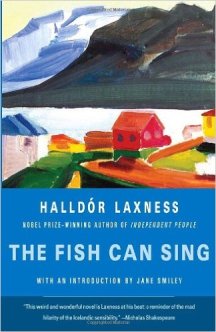
To prepare for a trip to Iceland—a country noted for, among other things, its literary culture, boasting the greatest number of books published per capita—I picked up a title by the country’s sole Nobel laureate, Halldór Laxness. There are six titles currently in print that have been translated into English (all but one by Magnus Magnusson). The Fish Can Sing (published in 1957 as Brekkukotsannáll, or “Annals of Brekkukot”) seemed one of the more accessible.
Laxness was born Halldór Guðjónsson in 1902 and took his name from Laxnes, the homestead in Mosfellsdalur where he grew up. Lax in Icelandic means ‘salmon’; nes means “cape, promontory, headland.” I am making the educated guess that Laxnes means something along the lines of “salmon cape,” i.e., a port at which salmon is caught. He did not spend his entire life in the country. By the 1920s he was in the United States, living mostly in Hollywood; he spent much of the 1930s in the Soviet Union. By the time he was awarded the Nobel Prize, in 1955, he was one of Iceland’s most famous and cosmopolitan citizens.
The narrator of the The Fish Can Sing, Álfgrímur, is an adult looking back on his orphaned childhood, living in the fishing village of Brekkukot. His grandfather is a fisherman and it is expected that Álfgrímur will follow in that tradition. Thirty years before the emergence of Björk, the most famous person from Iceland is also a world-famous singer: this time, a male opera singer named Garðar Hólm. When Garðar returns to his homeland, he strikes up a friendship with Álfgrímur, and attempts to cultivate the boy’s talent as a singer in his own right, thereby setting up a tension between the traditions of the homeland and a yearn to set out to test one’s limits.
The Fish Can Sing paints a portrait of a country aware of its smallness and coming to terms with its place in the world at large, and this is conveyed through the village’s ambivalence with which it receives Garðar. The reflective narrative feels apt to the Icelandic saga tradition. It feels as though Laxness wrote the book expecting—perhaps due to sheer dearth of countrymen—that most of the people who would read it would be those who had never lived in Iceland and would seek explanations for why and how things were done. And there is a wryness layered throughout the book, not only to allow the village to celebrate its eccentrics, but also, much like Garrison Keillor’s tales of Woebegone and its residents’ sturdy Lutheran un-apology, to position the tale as a nostalgia of the folly of national youth and parochialism:
The word “love” was never heard in our house either, except if some inebriate or a particularly stupid maidservant from the country happened to recite a verse by a modern poet; and moreover, the vocabulary of poems like these was such that if ever we heard them, cold shivers ran down our spines, and my grandfather would seat himself on his hands, sometimes out on the garden wall, and would grimace and jerk his shoulders and writhe as if he had lice and say, “Tut tut!” and “Really!” On the whole, modern poetry had the same effect on us as canvas being scratched.
Susan Sontag wrote about Halldór Laxness in one of her final essays before she died in 2005, focusing on another novel, Under the Glacier (Kristnihald undir Jökli, 1968), which she credited for its seamless spanning of multiple genres (science fiction, allegory, philosophical, visionary, fantasy) and its positioning as an epical response to Jules Verne’s Journey to the Center of the Earth.
Imagining the exceptional, which is often understood as the miraculous, the magical or the supernatural, is a perennial job of storytelling. One tradition proposes a physical place of entry — a cave or a tunnel or a hole -which leads to a freakish or enchanted kingdom with an alternative normality. In Laxness’s story, a sojourn near Snaefells does not call for the derring-do of a descent, a penetration, since, as Icelanders who inhabit the region know, the glacier itself is the center of the universe. The supernatural — the center — is present on the surface, in the costume of everyday life in a village whose errant pastor has ceased to conduct services or baptize children or bury the dead. Christianity — Iceland’s confession is Evangelical Lutheran — is the name of what is normal, historical, local. (The agricultural Viking island converted to Christianity on a single day at the Althing, the world’s oldest national parliament, in 999.) But what is happening in remote Snaefells is abnormal, cosmic, global.
The Filter of Innocence
February 25, 2016 § Leave a comment
On the occasion of the death last week of Italian author Umberto Eco, the New York Review of Books shared his 1985 essay on two institutions of American childhood, Krazy Kat and Peanuts.
They affect us because we realize that if they are monsters it is because we, the adults, have made them so. In them we find everything: Freud, mass culture, digest culture, frustrated struggle for success, craving for affection, loneliness, passive acquiescence, and neurotic protest. But all these elements do not blossom directly, as we know them, from the mouths of a group of children: they are conceived and spoken after passing through the filter of innocence.
Wonderland at Washington Square Review, Now Online
February 19, 2016 § Leave a comment
Activists walk up to Sweet Pea on the sidewalk and with garlicky breath explain that the Salvation Army is an organization that traffics in hate; those coins clinking in that little metal kettle aren’t putting poor kids in clean khakis, they’re funding the beheadings of gays in Uganda and the purchases of tiny drone helicopters used to buzz abortion clinics.
Last year I was fortunate enough to have a story published in Washington Square Review #36 (Summer/Fall 2015). Now the good folks there have put all of the content from that issue online, that including my story “Wonderland.” I’m excited and grateful to be able to share it.
Shed Those Dowdy Feathers
February 12, 2016 § Leave a comment
British writer Margaret Forster, who wrote the novel Georgy Girl and collaborated on the screenplay for the 1966 film with Peter Nichols, died on Monday at age 77.
Her New York Times obituary calls Georgy, played by Lynn Redgrave, “a precursor of Bridget Jones … big, plain and saddled with an annoyingly pretty roommate.”
I haven’t read the book, but the film struck me as having deeper moral questions than its swingy London setting and whistly theme song gave it credit for. There is the dark class commentary from the outset–Georgy is disappointed at her parents for settling to work as servants to a millionaire named Leamington, who then selects Georgy as his mistress, to the point of drawing up legal documents, as well as the shadow cast by roommate Meredith’s hedonistic lifestyle. After becoming pregnant, Meredith tells her lover, Jos, that she’s aborted two of his children previously and practically shrugs at the decision to keep the third. There is Georgy, in spite of her parents’ work, essentially volunteering herself as a servant to Jos and Meredith and nanny to their unwanted child, and ending up as the object of Jos’s seduction while Meredith is giving birth.
The behaviors are abominable, and there is no believable love in the story at all, except Georgy’s for the child in her care. And when she ultimately runs away with the newly-widowed millionaire Leamington with the infant that they’ve all but adopted, there’s a sense that the message of the movie is how conveniently people can get used as means to an end. The lyrics to the radio-friendly theme song turn deeply cynical for the end scene, and the Seekers come off as an Oompa-Loompaish Greek Chorus:
Who needs a perfect lover
When you’re a mother at heart?
Isn’t that all you wanted right from the start?
(Well didn’t you?)Hey there, Georgy girl
Now that you’re no longer on the shelf
Better try to smile and tell yourself
That you got your way
(You’ve made it!)Hey there, Georgy girl
Now you’ve got a future planned for you
Though it’s not a dream come true
At least he’s a millionaire
So don’t despair!
You’re rich, Georgy Girl!
You’re rich, Georgy Girl!
You’re rich, Georgy Girl!
What I Read in January
February 7, 2016 § Leave a comment
A slow month to start 2016, with a couple of hard biters.
Fat City, Leonard Gardner. I have written before about the literary tradition of boxing, and this novel, from 1969, re-introduced by NYRB Classics and made into a 1972 film directed by John Huston, adds another niche to the ranks, even though I wouldn’t say that the soul of the book has anything to do with boxing.
Set in the 1950s in Stockton, California, the two main characters are Billy Tully, an ex-boxer gone to seed looking to shape himself up and get back into the ring, and young hopeful Ernie Munger, who is trying to make something of himself after unexpectedly learning he will be a father.
The two men are almost too cleanly complimentary in trajectory: while Munger marries his girl and builds up swagger, Tully is divorced, alone, and uncertain about his prospects. (There’s a parallel to Bull Durham at play here.) They fall under the tutelage of the same trainer, Ruben Luna. Tully gets involved with a woman named Oma. And it becomes apparent that Stockton, with its dive bars and gyms and motels, is meant to be its own character, full of dark corners in which to search for a sliver of hope:
The posters were up along Center Street when the bus unloaded in Stockton. There was one in the window of La Milpa, where Tully laid his five-dollar bill on the bar and drank two beers, eyeing the corpulent waitress under the turning fans, before taking the long walk to the lavatory. He washed his face, blew his dirt-filled nose in a paper towel, and combed his wet hair.
On El Dorado Street the posters were in windows of bars and barber shops and lobbies full of open-mouthed dozers. Tully went to his room in the Roosevelt Hotel. Tired and stiff but clean after a bath in a tub of cool gray water, he returned to the street dressed in a red sport shirt and vivid blue slacks the color of burning gas. Against the shaded wall of Square Deal Liquors, he joined a rank of leaners drinking from cans and pint bottles discreetly covered by paper bags. Across the street in Washington Square rested scores of men, prone, supine, sitting, some wearing coats in the June heat, their wasted bodies motionless on the grass.
…
Belching under the streetlights in the cooling air, Tully lingered with the crowds leaning against cars and parking meters before he went on the Harbor Inn. Behind the bar, propped among the mirrored faces in that endless twilight was another poster. If Escobar can still do it so can I, Tully thought, but he felt he could not even get to the gym without his wife. He felt he same yearning resentment as in his last months with her, the same mystified conviction of neglect.
The term Fat City is midcentury slang for a situation of ease and comfort. How fat is the city, though, really? Gardner’s book winks with sarcasm, as though it knows the answer all along.
The Cost of Living, Mavis Gallant. I have made no secret of my love for Mavis Gallant, not just for the spark and fluidity of her prose but the fact that many of her stories are set in Montreal, a city near and dear to my heart. This batch of “early and uncollected stories” (“early” here meaning the span of years 1951-71) feels a bit more ramshackle than the ones in Varieties of Exile, but also show more of a willingness to experiment, with characters whose dissatisfactions are pushed to the forefront, loud enough to prompt them to challenge whatever expectations of grace and decorum surround them. The last story is a 40-page novella, “The Burgundy Weekend,” about a young and well-to-do Montreal couple, Lucie and Jerome Gerard, who vacation in France. They arrive to find that their hostess is away in Paris for a funeral, her granddaughter explains to them. “A resistance thing. They are old and keep on dying.”
Lucie’s discomfort throughout the stay is in sharp contrast with relaxed Jerome, who stays up late in conversation with the granddaughter, Nadine:
Lucie put the picture down. She was homesick. France was worse than any foreign country because the language was the same as her own. And yet it was not the same. It had a flat and glassy surface here. She felt better with her own people. That was where she came to life. Girls talked to each other at home—you didn’t feel this coldness, this hostility. Walking about the room, she stopped at a card table. “Would you like me to play Scrabble with you?” she asked Nadine.
“After dinner, if you want to,” said Nadine. She was remembering everything she had been told to do and say. “If you don’t object, we shall have our dinner in here instead of the dining room. My grandmother might be on the eight o’clock news. Also, Marcelle, that was Marcelle you saw—“
“With the mustache,” said Lucie. Jerome stared, Nadine stared, and Lucie told herself, It was a mistake, but not a bad one.
Language brings about a disruption with the familiar: the news in France involves “a change in French methods of teaching grammar.” Lucie, noting Nadine’s smoking habit, says that “women smokers are always making little private slums,” to which Nadine replies, “All our neutral descriptive words are masculine.” “A brute. A person. A victim. All feminine,” Jerome responds.
Billy Phelan’s Greatest Game, William Kennedy. I’ll confess to a shallow reason for choosing to read this book: I knew it had a scene involving a bowling match. It occurs early in the novel and uses terminology such as baby split and Jersey hit that made me think the author knew a thing or two about bowling. Billy Phelan’s Greatest Game (1978) is the second book of a trilogy set in Albany during the Great Depression, a trilogy beginning with Legs (1975) and ending with Ironweed (1983), which won the Pulitzer Prize.
There are a lot of games going on in Billy Phelan–bowling, poker, billiards, the hustling ways that Billy makes his means—but they’re really front-stage matter for a book that is really about moral decline and the slippery code of honor among men. Those activities are about identifying suckers, who you can use to pull yourself up. Honestly only gets you so far. Luck gets talked about a lot. Albany is under the thumb of the McCall family political machine, and when one of Billy’s childhood friends, a scion to the McCallsy, is kidnapped, Billy is caught in the middle because one of the chief suspects is the broker who backed him in the bowling match. The kidnapping in Billy Phelan is based on a real-life event, the abduction of John O’Connell Jr., nephew of Albany Democratic Party boss Dan O’Connell, in July 1933.
The other main character is journalist Martin Daugherty, a friend of Billy and the McCall family who serves as go-between and is, from the beginning, an observer—he keeps score for Billy during the bowling match. But who also uses his column to explain give justification to Billy’s actions, which he knows will be picked up by machine members who read him. Daugherty has his own demons: his father, an artist, was absent as a parent, and now his relationship with his own son has become distant. Daugherty was acquainted with Billy’s father, and there’s a suggestion of surrogacy in his dealings—much like, as others have noted, the relationship between Stephan Dedalus and another journalist, Leopold Bloom.
With its intensity meant to evoke 1930s potboiler crime fiction, Billy Phelan is, like Fat City, a very male book, and doubles down on its maleness by bringing to the surface themes of fathers, sons, honor, and legacy. The book spends a lot of time on rules and order, particularly with regard to gamesmanship, which seems like a superficial measure of honor, and the noirish narration toes the line of ridiculousness:
Lucky. The line blew up in Billy’s head. He wanted the rest of Harvey’s roll, but time was running. Nick’s card game at nine-thirty with big money possible, and Billy wanted a cold beer before that. Yet you can’t call Billy lucky, just lucky, and get away with it. Billy’s impulse was to throw the game, double the bet, clean out Harvey’s wallet entirely, take away his savings account, his life insurance, his mortgage money, his piggy bank. But you don’t give them that edge even once: I beat Billy Phelan last week. No edge for bums.
Harvey faced the table. The seven ball hung on the lip, but was cushioned, and the cue ball sat on the other side of the bunch, where Billy, you clever dog, left it. No shots, Harv, except safe. Sad about that seven ball, Harv. But it can wait. Is Harv lining up to break the bunch? Can it be? He’ll smash it? Not possible.
“What’re you doing?”
“Playing the seven.”
Billy laughed. “Are you serious?”
“Depth bomb it. The four will kiss the seven and the bunch’ll scatter.”
“Harv, you really calling that? The four to the seven?”
“I call the seven, that’s enough.”
“But you can’t hit it.” Billy laughed again. He looked again at the bunch, studying the angle the four would come off the end. No matter where you hit the bunch, the four would not kiss the seven the right way. Not possible. And Harvey hesitated.
“You don’t want me to play this shot, do you, Billy? Because you see it’s a sure thing and then I’ll have the bunch broken, a table full of shots. That’s right, isn’t it?”
Billy closed his eyes and Harvey disappeared. Who could believe such bedbugs lived in a civilized town? Billy opened his eyes at the sound of Harvey breaking the bunch. The four kissed the seven, but kissed it head on. The seven did not go into the corner pocket. The rest scattered, leaving an abundant kindergarten challenge for Billy.
“You do nice work, Harv.”
“It almost worked,” said Harv, but the arrogance was draining from his face like a poached egg with a slow leak.
“Why didn’t you play a safe shot?”
“When I’ve got a real shot?”
“A real shot? Willie Hoppe wouldn’t try that one.”
“I saw you break a bunch and kiss one in.”
“You never saw me try a shot like that, Harv.”
“If you can do it, I can do it too, sooner or later.”
Billy felt it rising. The sucker. Lowlife of Billy’s world. Never finish last, never be a sucker. Don’t let them humiliate you. Chick’s face grinned out of Harvey’s skull. Going to work, Billy? Lowlife. Humiliate the bastard.
Problems of a Subscriber
January 22, 2016 § Leave a comment

I have written before about my first-world trouble with keeping up with my New Yorker subscription, to the point of falling months behind. If you care to count, the debt is over six months, which was why, at the beginning of the new year, I made a tiny resolution to myself: instead of adding new issues to the pile when they arrived in the mail, I’d read those first, try to finish each in a week, and then use the remaining time before the next issue arrives to burn off the accumulated backlog from last year.
I’ve managed to keep up so far, while chipping away at issues from last June. The time-elapse can lead to some strange juxtapositions. There are a lot of blue-sky covers in the summer, for one thing. I am at the moment working on the Summer Fiction issue, featuring the usual New Yorker suspects: two Jonathans (Franzen and Foer), Russell, Lipsyte, Zadie Smith. Amy Davidson’s Talk of the Town comment happens to be about Jason Rezaian, the Washington Post journalist whose trial in Iran on charges of espionage and propaganda had just gotten under way. In real-time life, Rezaian and three other Americans had just been released in a prisoner swap.
It is nice to be reading up on events while they are still more or less current, for a change. The January 25 issue arrived in the mail today, so Franzen’s long story is going to have to wait.
Gang Aft Agley
January 17, 2016 § Leave a comment

Of Mice and Men is a basic and unflinching story about a friendship. It doesn’t get talked about much, even compared to Steinbeck’s other works, perhaps because of its terseness, or perhaps because of its seeming lack of alternate paths for its story to take.
It holds a bit of a special place in my heart, albeit for a strange reason. I was an unhappy mathematics major struggling through calculus when I took an elective class in Major American Authors during my sophomore year. I don’t remember the particular authors we studied, though I don’t recall that they were at all obscure, probably along the lines of Hemingway and Faulkner and perhaps a contemporary writer such as Joyce Carol Oates. For a major paper we had to select one of five short novels and write a paper on it. My paper on Of Mice and Men came back with an A and the suggestion from the professor that I might have a chance with literature should I decide to switch my major, and ultimately a shot at finding happiness within the humanities.
The story has twice been made into a film, once in 1939 (just two years after the publication of the book) with Burgess Meredith and Lon Chaney, Jr. in the roles of George and Lennie and later in 1992, starring Gary Sinise and John Malkovich. I watched the Meredith/Chaney version (directed by Lewis Milestone) the other night. It is a lean and muscular picture, and Meredith and Chaney are excellent.
It fails both the Bechdel test and the Does the Dog Die test (twice). Much like in Breakfast at Tiffany’s, a character who is unnamed in the book gets assigned a name in the film: Curley’s wife, played by Betty Field, is known as Mae. This change makes her slightly more human, I think, than even Steinbeck might have intended. Trapped in an unhappy marriage in what is a very male-oriented story, she is presented as a threat to the ranchers and the pursuit of their dreams. Lennie is instructed to stay away from her with language that suggests she is a bad person with intent to do harm. To Lennie, she is a soft animal to be petted, but her desire to be treated as a human is sinister, a weapon that would expose the men’s lack of self-control. (In one scene, the only other scene involving a woman, George follows the other ranchers to a tavern, but doesn’t want to spend too much on drink and isn’t very interested in the company of the ladies there.) In a story where independence—having one’s own place and “livin’ off the fat of the land”—is the faraway dream, lust is a crime, a truculent distraction to the weak of mind.
 Neil Serven