Wonderland at Washington Square Review, Now Online
February 19, 2016 § Leave a comment
Activists walk up to Sweet Pea on the sidewalk and with garlicky breath explain that the Salvation Army is an organization that traffics in hate; those coins clinking in that little metal kettle aren’t putting poor kids in clean khakis, they’re funding the beheadings of gays in Uganda and the purchases of tiny drone helicopters used to buzz abortion clinics.
Last year I was fortunate enough to have a story published in Washington Square Review #36 (Summer/Fall 2015). Now the good folks there have put all of the content from that issue online, that including my story “Wonderland.” I’m excited and grateful to be able to share it.
Shed Those Dowdy Feathers
February 12, 2016 § Leave a comment
British writer Margaret Forster, who wrote the novel Georgy Girl and collaborated on the screenplay for the 1966 film with Peter Nichols, died on Monday at age 77.
Her New York Times obituary calls Georgy, played by Lynn Redgrave, “a precursor of Bridget Jones … big, plain and saddled with an annoyingly pretty roommate.”
I haven’t read the book, but the film struck me as having deeper moral questions than its swingy London setting and whistly theme song gave it credit for. There is the dark class commentary from the outset–Georgy is disappointed at her parents for settling to work as servants to a millionaire named Leamington, who then selects Georgy as his mistress, to the point of drawing up legal documents, as well as the shadow cast by roommate Meredith’s hedonistic lifestyle. After becoming pregnant, Meredith tells her lover, Jos, that she’s aborted two of his children previously and practically shrugs at the decision to keep the third. There is Georgy, in spite of her parents’ work, essentially volunteering herself as a servant to Jos and Meredith and nanny to their unwanted child, and ending up as the object of Jos’s seduction while Meredith is giving birth.
The behaviors are abominable, and there is no believable love in the story at all, except Georgy’s for the child in her care. And when she ultimately runs away with the newly-widowed millionaire Leamington with the infant that they’ve all but adopted, there’s a sense that the message of the movie is how conveniently people can get used as means to an end. The lyrics to the radio-friendly theme song turn deeply cynical for the end scene, and the Seekers come off as an Oompa-Loompaish Greek Chorus:
Who needs a perfect lover
When you’re a mother at heart?
Isn’t that all you wanted right from the start?
(Well didn’t you?)Hey there, Georgy girl
Now that you’re no longer on the shelf
Better try to smile and tell yourself
That you got your way
(You’ve made it!)Hey there, Georgy girl
Now you’ve got a future planned for you
Though it’s not a dream come true
At least he’s a millionaire
So don’t despair!
You’re rich, Georgy Girl!
You’re rich, Georgy Girl!
You’re rich, Georgy Girl!
What I Read in January
February 7, 2016 § Leave a comment
A slow month to start 2016, with a couple of hard biters.
Fat City, Leonard Gardner. I have written before about the literary tradition of boxing, and this novel, from 1969, re-introduced by NYRB Classics and made into a 1972 film directed by John Huston, adds another niche to the ranks, even though I wouldn’t say that the soul of the book has anything to do with boxing.
Set in the 1950s in Stockton, California, the two main characters are Billy Tully, an ex-boxer gone to seed looking to shape himself up and get back into the ring, and young hopeful Ernie Munger, who is trying to make something of himself after unexpectedly learning he will be a father.
The two men are almost too cleanly complimentary in trajectory: while Munger marries his girl and builds up swagger, Tully is divorced, alone, and uncertain about his prospects. (There’s a parallel to Bull Durham at play here.) They fall under the tutelage of the same trainer, Ruben Luna. Tully gets involved with a woman named Oma. And it becomes apparent that Stockton, with its dive bars and gyms and motels, is meant to be its own character, full of dark corners in which to search for a sliver of hope:
The posters were up along Center Street when the bus unloaded in Stockton. There was one in the window of La Milpa, where Tully laid his five-dollar bill on the bar and drank two beers, eyeing the corpulent waitress under the turning fans, before taking the long walk to the lavatory. He washed his face, blew his dirt-filled nose in a paper towel, and combed his wet hair.
On El Dorado Street the posters were in windows of bars and barber shops and lobbies full of open-mouthed dozers. Tully went to his room in the Roosevelt Hotel. Tired and stiff but clean after a bath in a tub of cool gray water, he returned to the street dressed in a red sport shirt and vivid blue slacks the color of burning gas. Against the shaded wall of Square Deal Liquors, he joined a rank of leaners drinking from cans and pint bottles discreetly covered by paper bags. Across the street in Washington Square rested scores of men, prone, supine, sitting, some wearing coats in the June heat, their wasted bodies motionless on the grass.
…
Belching under the streetlights in the cooling air, Tully lingered with the crowds leaning against cars and parking meters before he went on the Harbor Inn. Behind the bar, propped among the mirrored faces in that endless twilight was another poster. If Escobar can still do it so can I, Tully thought, but he felt he could not even get to the gym without his wife. He felt he same yearning resentment as in his last months with her, the same mystified conviction of neglect.
The term Fat City is midcentury slang for a situation of ease and comfort. How fat is the city, though, really? Gardner’s book winks with sarcasm, as though it knows the answer all along.
The Cost of Living, Mavis Gallant. I have made no secret of my love for Mavis Gallant, not just for the spark and fluidity of her prose but the fact that many of her stories are set in Montreal, a city near and dear to my heart. This batch of “early and uncollected stories” (“early” here meaning the span of years 1951-71) feels a bit more ramshackle than the ones in Varieties of Exile, but also show more of a willingness to experiment, with characters whose dissatisfactions are pushed to the forefront, loud enough to prompt them to challenge whatever expectations of grace and decorum surround them. The last story is a 40-page novella, “The Burgundy Weekend,” about a young and well-to-do Montreal couple, Lucie and Jerome Gerard, who vacation in France. They arrive to find that their hostess is away in Paris for a funeral, her granddaughter explains to them. “A resistance thing. They are old and keep on dying.”
Lucie’s discomfort throughout the stay is in sharp contrast with relaxed Jerome, who stays up late in conversation with the granddaughter, Nadine:
Lucie put the picture down. She was homesick. France was worse than any foreign country because the language was the same as her own. And yet it was not the same. It had a flat and glassy surface here. She felt better with her own people. That was where she came to life. Girls talked to each other at home—you didn’t feel this coldness, this hostility. Walking about the room, she stopped at a card table. “Would you like me to play Scrabble with you?” she asked Nadine.
“After dinner, if you want to,” said Nadine. She was remembering everything she had been told to do and say. “If you don’t object, we shall have our dinner in here instead of the dining room. My grandmother might be on the eight o’clock news. Also, Marcelle, that was Marcelle you saw—“
“With the mustache,” said Lucie. Jerome stared, Nadine stared, and Lucie told herself, It was a mistake, but not a bad one.
Language brings about a disruption with the familiar: the news in France involves “a change in French methods of teaching grammar.” Lucie, noting Nadine’s smoking habit, says that “women smokers are always making little private slums,” to which Nadine replies, “All our neutral descriptive words are masculine.” “A brute. A person. A victim. All feminine,” Jerome responds.
Billy Phelan’s Greatest Game, William Kennedy. I’ll confess to a shallow reason for choosing to read this book: I knew it had a scene involving a bowling match. It occurs early in the novel and uses terminology such as baby split and Jersey hit that made me think the author knew a thing or two about bowling. Billy Phelan’s Greatest Game (1978) is the second book of a trilogy set in Albany during the Great Depression, a trilogy beginning with Legs (1975) and ending with Ironweed (1983), which won the Pulitzer Prize.
There are a lot of games going on in Billy Phelan–bowling, poker, billiards, the hustling ways that Billy makes his means—but they’re really front-stage matter for a book that is really about moral decline and the slippery code of honor among men. Those activities are about identifying suckers, who you can use to pull yourself up. Honestly only gets you so far. Luck gets talked about a lot. Albany is under the thumb of the McCall family political machine, and when one of Billy’s childhood friends, a scion to the McCallsy, is kidnapped, Billy is caught in the middle because one of the chief suspects is the broker who backed him in the bowling match. The kidnapping in Billy Phelan is based on a real-life event, the abduction of John O’Connell Jr., nephew of Albany Democratic Party boss Dan O’Connell, in July 1933.
The other main character is journalist Martin Daugherty, a friend of Billy and the McCall family who serves as go-between and is, from the beginning, an observer—he keeps score for Billy during the bowling match. But who also uses his column to explain give justification to Billy’s actions, which he knows will be picked up by machine members who read him. Daugherty has his own demons: his father, an artist, was absent as a parent, and now his relationship with his own son has become distant. Daugherty was acquainted with Billy’s father, and there’s a suggestion of surrogacy in his dealings—much like, as others have noted, the relationship between Stephan Dedalus and another journalist, Leopold Bloom.
With its intensity meant to evoke 1930s potboiler crime fiction, Billy Phelan is, like Fat City, a very male book, and doubles down on its maleness by bringing to the surface themes of fathers, sons, honor, and legacy. The book spends a lot of time on rules and order, particularly with regard to gamesmanship, which seems like a superficial measure of honor, and the noirish narration toes the line of ridiculousness:
Lucky. The line blew up in Billy’s head. He wanted the rest of Harvey’s roll, but time was running. Nick’s card game at nine-thirty with big money possible, and Billy wanted a cold beer before that. Yet you can’t call Billy lucky, just lucky, and get away with it. Billy’s impulse was to throw the game, double the bet, clean out Harvey’s wallet entirely, take away his savings account, his life insurance, his mortgage money, his piggy bank. But you don’t give them that edge even once: I beat Billy Phelan last week. No edge for bums.
Harvey faced the table. The seven ball hung on the lip, but was cushioned, and the cue ball sat on the other side of the bunch, where Billy, you clever dog, left it. No shots, Harv, except safe. Sad about that seven ball, Harv. But it can wait. Is Harv lining up to break the bunch? Can it be? He’ll smash it? Not possible.
“What’re you doing?”
“Playing the seven.”
Billy laughed. “Are you serious?”
“Depth bomb it. The four will kiss the seven and the bunch’ll scatter.”
“Harv, you really calling that? The four to the seven?”
“I call the seven, that’s enough.”
“But you can’t hit it.” Billy laughed again. He looked again at the bunch, studying the angle the four would come off the end. No matter where you hit the bunch, the four would not kiss the seven the right way. Not possible. And Harvey hesitated.
“You don’t want me to play this shot, do you, Billy? Because you see it’s a sure thing and then I’ll have the bunch broken, a table full of shots. That’s right, isn’t it?”
Billy closed his eyes and Harvey disappeared. Who could believe such bedbugs lived in a civilized town? Billy opened his eyes at the sound of Harvey breaking the bunch. The four kissed the seven, but kissed it head on. The seven did not go into the corner pocket. The rest scattered, leaving an abundant kindergarten challenge for Billy.
“You do nice work, Harv.”
“It almost worked,” said Harv, but the arrogance was draining from his face like a poached egg with a slow leak.
“Why didn’t you play a safe shot?”
“When I’ve got a real shot?”
“A real shot? Willie Hoppe wouldn’t try that one.”
“I saw you break a bunch and kiss one in.”
“You never saw me try a shot like that, Harv.”
“If you can do it, I can do it too, sooner or later.”
Billy felt it rising. The sucker. Lowlife of Billy’s world. Never finish last, never be a sucker. Don’t let them humiliate you. Chick’s face grinned out of Harvey’s skull. Going to work, Billy? Lowlife. Humiliate the bastard.
Problems of a Subscriber
January 22, 2016 § Leave a comment

I have written before about my first-world trouble with keeping up with my New Yorker subscription, to the point of falling months behind. If you care to count, the debt is over six months, which was why, at the beginning of the new year, I made a tiny resolution to myself: instead of adding new issues to the pile when they arrived in the mail, I’d read those first, try to finish each in a week, and then use the remaining time before the next issue arrives to burn off the accumulated backlog from last year.
I’ve managed to keep up so far, while chipping away at issues from last June. The time-elapse can lead to some strange juxtapositions. There are a lot of blue-sky covers in the summer, for one thing. I am at the moment working on the Summer Fiction issue, featuring the usual New Yorker suspects: two Jonathans (Franzen and Foer), Russell, Lipsyte, Zadie Smith. Amy Davidson’s Talk of the Town comment happens to be about Jason Rezaian, the Washington Post journalist whose trial in Iran on charges of espionage and propaganda had just gotten under way. In real-time life, Rezaian and three other Americans had just been released in a prisoner swap.
It is nice to be reading up on events while they are still more or less current, for a change. The January 25 issue arrived in the mail today, so Franzen’s long story is going to have to wait.
Gang Aft Agley
January 17, 2016 § Leave a comment

Of Mice and Men is a basic and unflinching story about a friendship. It doesn’t get talked about much, even compared to Steinbeck’s other works, perhaps because of its terseness, or perhaps because of its seeming lack of alternate paths for its story to take.
It holds a bit of a special place in my heart, albeit for a strange reason. I was an unhappy mathematics major struggling through calculus when I took an elective class in Major American Authors during my sophomore year. I don’t remember the particular authors we studied, though I don’t recall that they were at all obscure, probably along the lines of Hemingway and Faulkner and perhaps a contemporary writer such as Joyce Carol Oates. For a major paper we had to select one of five short novels and write a paper on it. My paper on Of Mice and Men came back with an A and the suggestion from the professor that I might have a chance with literature should I decide to switch my major, and ultimately a shot at finding happiness within the humanities.
The story has twice been made into a film, once in 1939 (just two years after the publication of the book) with Burgess Meredith and Lon Chaney, Jr. in the roles of George and Lennie and later in 1992, starring Gary Sinise and John Malkovich. I watched the Meredith/Chaney version (directed by Lewis Milestone) the other night. It is a lean and muscular picture, and Meredith and Chaney are excellent.
It fails both the Bechdel test and the Does the Dog Die test (twice). Much like in Breakfast at Tiffany’s, a character who is unnamed in the book gets assigned a name in the film: Curley’s wife, played by Betty Field, is known as Mae. This change makes her slightly more human, I think, than even Steinbeck might have intended. Trapped in an unhappy marriage in what is a very male-oriented story, she is presented as a threat to the ranchers and the pursuit of their dreams. Lennie is instructed to stay away from her with language that suggests she is a bad person with intent to do harm. To Lennie, she is a soft animal to be petted, but her desire to be treated as a human is sinister, a weapon that would expose the men’s lack of self-control. (In one scene, the only other scene involving a woman, George follows the other ranchers to a tavern, but doesn’t want to spend too much on drink and isn’t very interested in the company of the ladies there.) In a story where independence—having one’s own place and “livin’ off the fat of the land”—is the faraway dream, lust is a crime, a truculent distraction to the weak of mind.
What I Read in November and December
December 30, 2015 § Leave a comment
Paulina & Fran, Rachel B. Glaser. Heard the author read at Odyssey Bookshop in South Hadley, and got the book signed there.
The title characters are art school students drawn into a tug of friendship, romance, fascination, sex, dismay, and manipulation. The personalities of Paulina and Fran are distinct but not perfect complements. Paulina is the dominant member of the pair—we might be tempted to call her an emotional bully if we weren’t rooting for her and Fran to grow into something more—while Fran is the more sensitive and (it is suggested) more talented artist. Paulina keeps sleeping with a boy she’s broken up with because “every house needs a house cat.” Fran “has this bedroom feeling to her … everywhere Fran went, she inhabited like her bedroom.”
Glaser fluidly shifts back and forth between characters, and she is ambitious and exact with her colorful metaphors, in part because she pins them with effect to the pair’s obsessions with fashion, image, surfaces, and exploitation. Paulina gets a design job at a Forever-21 type store; Fran paints houses upstate. A hair salon has “that plastic smell of vanity and fear. It was decorated with black-and-white photos of models.” Paulina’s fur coat “weighed on her like the next decade.” At a thrift store, “Every nightgown came with a few bad dreams.”
The book understands art school, particularly, as a milieu where people pose for one another, and are harshly judged for no other reason than the satisfaction of judgment. Paulina sleeps with a boy who “had a number of nervous tics, and looked like he animated dragons all day.” Sculpture majors “loved nothing more than taking up space.” There is a hostility expressed toward “Cooper Union graduates who’d spent their saved tuition money on designer sneakers and mopeds…The girls were dressed like new wave French philosophers.” The writing is not superficial, nor does it get lost in a melting psychological sea of abstraction.
Cassandra at the Wedding, Dorothy Baker. One of two novels by this Montana-born writer re-released by NYRB Classics, Cassandra at the Wedding was first published twenty-four years after the other one, Young Man With a Horn, which I read and enjoyed in 2013.
Cassandra has a relaxed vibe, remarkable for a book about a young woman’s neurosis. Cassandra is a Berkeley graduate student returning home to the family ranch for her twin sister’s sudden wedding. Their mother is deceased; their father, a retired professor of philosophy, seems happily disengaged; and their grandmother (on Cassandra’s late mother’s side) busies herself with projects relating to the wedding.
Apart from a section narrated by Judith, the bride-to-be, the story is Cassandra’s, and hers in an intelligent and dynamic mind to reside in. She arrives at the family home with her thesis unfinished and harboring a well-considered angst toward the nuptials. I found myself coming back to the book’s early scenes, when she was settling in and enjoying conversation with her father:
“Well, what’s he like?” I said.
My father didn’t ask whom I had in mind, but he didn’t answer the question either. He got philosophical instead and gave me a speech about how it’s not easy to say what anyone’s like, even among people you think you know well; and this hit me because, like most of papa’s propositions, it was infuriatingly true. Judith Edwards, for example, whom I once thought I knew like myself, like the back of my hand, as they say. What made her decide to try New York, alone, for a year, before we tried Paris, together? Who knows what anybody’s like?
I took an ice cube out of the bucket, closed my fist over it, and let it drip into the copper sink. This comes under the head of playing in the water, but papa apparently didn’t notice, and it had the effect of rallying my forces and not letting me give up.
“Playing in the water” takes on heavier meanings at other points in the book, between the pool in back of the family home to the bay under the bridge in San Francisco. Cassandra is coy about her personal life (she wakes up in her childhood room realizing she “was not going to be found in any of the three, or possible four, places [she] can wake up in in Berkeley”) but open about who and what she loves, and her interactions with Judith feel honest in the tension and overlap between the two sisters. There is struggle but also an aware irony in this family that is missing a mother (who died three years ago, “much too young but I’m not sure she thought so”), so when, midway through the book, Cassandra attempts to overdose on sleeping pills, it is a wrench to the heart not just of this nice family but the reader who has grown fond of her.
2 A.M. at the Cat’s Pajamas, Marie-Helene Bertino. Another book featuring characters whose lives intersect in remarkable ways. I read most of it on a plane to New Orleans. Some of the chapters are quite short, and in keeping them as such Bertino achieves an immediacy that suits the minute-by-minute narrative.
The main character is nine-year-old Madeline, and she is a bit of a cartoon—she smokes cigarettes and swears and scoffs at her classmates (“Your clinginess is embarrassing,” she tells a girl) and lives under the care of an elderly guardian. She is absent a deceased mother and her father is, for some reason, confined like a convalescent to his bedroom. Madeline’s dream is to sing jazz onstage, and so the plots rolls into motion when she learns about the existence of the establishment–a downtown Philadelphia jazz club–in the title. Madeline makes it her determination to find and infiltrate the Cat’s Pajamas in the hope she can sing there.
The other main character is Sarina, Madeline’s fifth-grade teacher, a recently divorced dreamer who has moved back with her family and been invited to a dinner party where an old boyfriend, Ben, is also said to be coming. There is also Jack, the owner of the Cat’s Pajamas, who is a little greasy, and his son Alex, who plays drums, and a subplot about a rare and expensive guitar called a Snakehead.
For a book with a bit of fluff to it, I liked the characters, particularly Sarina, who balances an urge to allow herself happiness with soberness of one who has lived through disappointment and the responsibility that she naturally assumes around children. The setting of snowy Philadelphia gives the book some life and grit, and the time-managed plot keeps things mostly clear of preciousness.
Light Years, James Salter. I am undeniably guilty of the crime of catching up on my debt to James Salter only after he has died. (I do that a lot; see also Mavis Gallant.) Light Years is the second Salter I’ve read, after A Sport and a Pastime, which was tenderly crafted and had the distraction of intervals of finely wrought sex. Light Years is about a marriage between two adults, Nedra and Viri, and its slow dissolution, and the people who fade in and out of their scene as it happens.
They are a couple who enjoy their pleasures, their social lives, their curiosities, dinners with friends and their flirtations. Salter’s tight sentences lighten the air in which the characters breathe. The way Nedra is written, I can see her graceful movements, the muscles in her arms, her involuntary scratches at her elbow. She has “a rich, naked laugh.” After an afternoon of picking tomatoes, she “looked like a woman who had once been rich.” A visiting client of Viri’s “recognized in her a woman who would not betray him.” There are affairs, sloppy ones, that end not in shocked outrage but futility. They divorce, the children grow up, and everything feels seamless: the way older daughter Franca (and younger Danny, but particularly Franca) makes appearances more and more sporadic, the way her sophistication catches up quickly to that of her mother.
Viri is an architect, and Salter inserts moments when his structure is allowed to crumble:
“Look at him, Papa, don’t you love him?”
The hen sat panicked within her arms, its small eyes blinking.
“Her,” Viri said.
“Do you want to know their names?” Franca asked.
He nodded vaguely.
“Papa?”
“Yes,” he said. “Where did you get them?”
“That’s Janet…”
“Janet.”
“Dorothy.”
“Yes.”
“And that one is Madame Nicolai.”
“That one…”
“She’s older than the others,” Franca explained. He sat on the step. Already there was a slight, bitter smell in the room. A bit of feather floated mysteriously down. Madame Nicolai was sitting as if dumped in a great, warm pile of feathers, brown, beige, becoming paler as it descended to soft tan.
“She is wiser,” he said.”
“Oh, she’s very wise.”
“A sage among hens. When do they begin to lay eggs?”
“Right away.”
“Aren’t they a little young?” He sat idly on the step watching their careful, measured movements, the jerk of their heads. “Well, if they don’t lay eggs, there are other things. Chicken Kiev…”
“Papa!”
“What?”
“You wouldn’t do that.”
“They’d understand.”
“No, they wouldn’t.”
“Madame Nicolai would understand,” he said.
She was standing now, apart from the others, looking at him. Her head was in profile, one unblinking eye black with an amber ring. “She’s a woman of the world,” he said. “Look at her bosom, look at the expression on her beak.”
“What expression?”
“She understands life,” he said. “He knows what it is to be a chicken.”
“Is she your favorite?”
He was trying to coax her to come to his half-closed hand.
“Papa?”
“I think so,” he murmured. “Yes. She is a hen among hens. A hen’s hen,” he said.
They were clinging to his arms in happiness and affection. He sat there. The chickens were clucking, making little soft sounds like water boiling. He continued to extol her—she had now turned cautiously away—this adulterer, this helpless man.
The Moviegoer, Walker Percy. A reread, one I decided to take on again because it is set in New Orleans and I took a vacation there at the end of November. It turns out that there isn’t a whole lot that is particular to that city, except for the names of streets and streetcars and descriptions like “the curlicues of iron on the Walgreen drugstore” and “the homosexuals and patio connoisseurs on Royal Street.”
A lot of people love The Moviegoer, and the narrator Binx Bolling feels like he has potential to do something fascinating—a bit young, naïve, a keen observer but perhaps too passive at this stage of his life. (Hence his fondness for going to movies.) He works as a bond trader but is regarded as an underachiever by his aunt, who wants him to go to medical school. He sleeps with his secretaries, and is in love with his childish-seeming cousin, Kate, who, it is suggested, suffers from mental illness.
It is not asking too much of the reader to be patient with the novel’s existential sensibilities, but it still feels, on second read, like it could use a few more bones in its skeleton. Of course, the lack of concrete decision and structure is the heart of Binx’s problem. Binx is a lost soul looking for a way, but unlike the French, who manage to make despair much more interesting, he doesn’t have an urgency to reduce perspective or repudiate the banal. He places currency in his sense of dream and wonder, and while this might make us root for him to find his moral purpose, it feels like a false journey to those of us who know that reality still waits around the corner.
So, for 2015: thirty-nine books, twenty-one by women. Six were re-reads. Thirteen were nonfiction. I read six books by Joan Didion, two by Salter. Among the new books I read, I particularly loved Christy Crutchfield’s How to Catch a Coyote, for its clever arrangement of characters in a nonlinear narrative against a consistent and tangible setting, as well as Cassandra at the Wedding and Light Years and Didion’s Play It as It Lays, a razor-sliced portrait of 1960s Hollywood that manages to feel current and alive. Perhaps it spoke to me because I was less than a year removed from my mother’s death, but Liz Scheid’s The Shape of Blue caught me pleasantly by surprise for its earthiness as the author responds to tragedy and loss with thoughtful questions of order.
But the best book I read, in terms of the power of its storytelling, was Atticus Lish’s Preparation for the Next Life. There was a sense, as I was reading, that I was amidst something both grand and modern, and that its characters were inhabiting the shaky, insecure, and clattering world I knew. It gets right the terror of loneliness, the loom of cities, the scatteredness of the twenty-first century landscape and the need to create one’s own reality within it. It carries forward the echo of war horror and lets it resound in the ear while landlords clomp around overhead. Few novels identify the breakdown between the interior and exterior so well.
As the year winds down, I have piles of new books around my office that I don’t know when I’ll get to read. I am seven months behind on my New Yorkers. It’s the kind of obligation that can make reading feel suffocating rather than enlightening. And while I published two stories this year and started a few essays (finishing and submitting one, still pending), I feel like I have been working on the same things for a long time, and have yet to really leap forward as a writer. I need to stop gazing at my shoes and plow through. Consider that my resolution.
Happy Golden Days
December 28, 2015 § Leave a comment
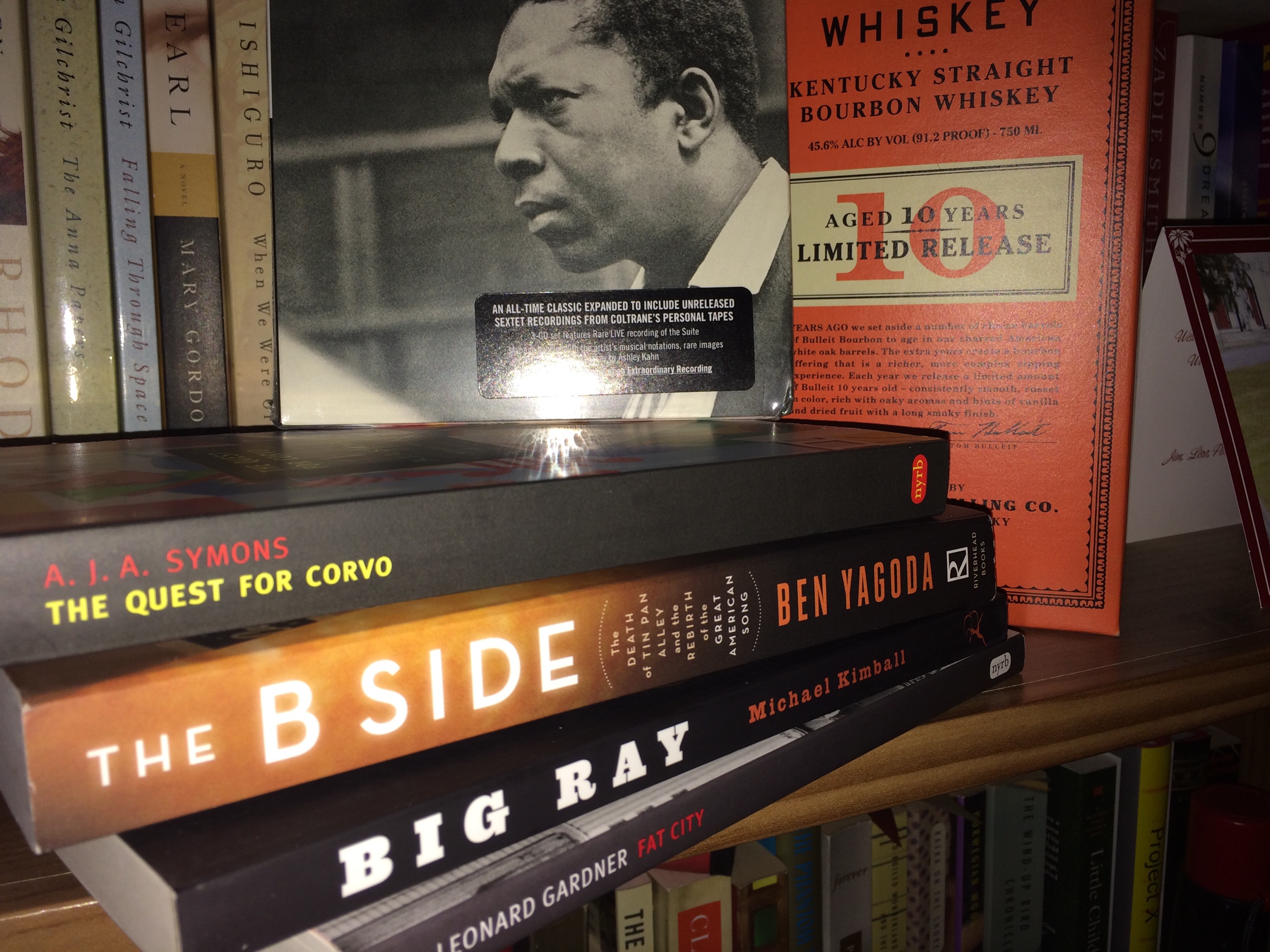
I caught a cold over Christmas, and as a consequence my voice has dropped an octave and taken on a syrupy, Clooneyesque lustre that I’ll miss once the NyQuil and Sudafed have done their work.
My wife joked about getting me a hatchet for Christmas, and though she went another route it was hard not to notice that, on the whole, my haul this year had a bit of a masculine tilt, a little noirish, a little cool. We’re expecting our first big snowstorm on Tuesday, after a stretch of disarmingly mild weather, and I forward to warming my soul with these.
Angel from Down Under
December 17, 2015 § Leave a comment

To this New Englander, New Zealand feels like the bottom of the world, about as far away a place as one can go. So when I recently watched An Angel at My Table, Jane Campion’s 1990 biopic about the writer Janet Frame (1924-2004), I tried to keep my eyes open to the landscape and other revealing aspects of location. There are rolling green hills and scenes with sheep bopping into the frame, and elementary school classrooms with New Zealand flags hanging. There are trains passing over horizons. Frame’s father worked for the railroad, though with six children the family did not have a lot of money.
At two hours and forty-five minutes, the film covers aspects of Frame’s early life in patient detail. Janet is the shy observer, overshadowed by three domineering sisters. The girls must share a bed. She practices such poor hygiene that a school nurse scolds her for having filthy ears. Her older brother suffers from epileptic seizures. In adolescence, she develops a taste for sweets, so much that she and her sister steal prized chocolates from a landlady. Her teeth go to rot.
There are slight moments when the artist with the sensitivity for language emerges (upon which the cleaning of her ears almost works as a metaphor), as when she resists her sister’s suggestion to change a word in a poem for school, one that eventually gets published. Frame’s life has parallels to that of Sylvia Plath, or more accurately, the character of Esther in The Bell Jar: In a rural community with few literary heroes, a dreamy girl who demonstrates creative talent and moments of social anxiety gets recommended by her teachers to the observation of a shrink, psychiatry being a young and perhaps oft-misapplied science at the time. She is hospitalized for schizophrenia and subjected to shock treatments. A lobotomy is scheduled, and it is cancelled only when her first collection of stories wins a major literary award.
Then the film lightens as Frame is given a chance to enjoy success. She develops mentorships at a writers’ colony, then has an affair with a married history professor who dabbles in poetry but is terrible at it; he reads it to her in bed, and for the first time in her life she must hold herself back from saying anything.
Frame’s books aren’t easy to find here in the States, apart from Amazon. She wrote an autobiography in three volumes, the material for which Campion mined for An Angel at My Table. Many critics seem to label Frame a writer of magical realism, particularly for her final novel, The Carpathains (1988). Frame’s popularity among New Zealand writers might be matched only by Katherine Mansfield (1888-1923), for whom Frame’s mother worked as a housemaid (a fact never broached in the film) and who died the year before Frame was born.
Unspeakable
December 9, 2015 § Leave a comment
I always thought it was ironic that so many Americans learned about the death of John Lennon from Howard Cosell, one of the most notorious scene-stealers in broadcast history, late on a Monday night during the fourth quarter of a sleepy football game in Miami.
Stymie is Returning
November 30, 2015 § Leave a comment
I am glad to see that Stymie Magazine will be re-launching after the first of the year, and is looking for submissions.
In an announcement published on November 20, the editors write, “the space that is serious writing about sports and games has evolved and changed – in some ways good, in other ways not so much.
“We hope it means we get inundated with thoughts on Tecmo Bowl, the 1985 World Series, that time a horse race was so much more than a horse race, and everything in between.”
With a name originating from golf—when one player’s ball blocks the path of another to the hole—Stymie uses the subject of sport to present situations of human struggle and perseverance with a nuanced, literary touch.
Stymie published my story “Hurry Someday” in 2014, one of four stories (so far) in my series about teenage ballplayers growing up in a Detroit suburb in the 1990s.
 Neil Serven