What I Read in October
November 8, 2015 § Leave a comment
Almost Famous Women, Megan Mayhew Bergman. I bought this book at a local bookshop after enjoying Bergman’s first collection of stories, Birds of a Lesser Paradise, a couple of years ago. The “almost famous women” here are real people noted for their daring and adventuresome spirit whose stories exist (certainly unfairly) on a step below most popular, male-dominated historical narratives. These fictional stories place each of these women in a dynamic new frame.
I hadn’t heard of most of them, such as motorcycle daredevil Hazel Eaton (1895-1970), featured in the story “Hazel Eaton and the Wall of Death,” or British power boat racer Marion ‘Joe’ Carstairs (1900-1993), who bought the island of Whale Cay in the Bahamas after her retirement to host celebrities such as Marlene Dietrich (“The Siege at Whale Cay”). I had heard of African-American film actress ‘Butterfly’ McQueen (1911-1995), who played the maid Prissy in Gone With the Wind but wasn’t allowed in the all-white theater to watch the premiere, but not of her decision, as an atheist, to donate her organs to science, which she did after she burned to death following the explosion of a kerosene lamp (“Saving Butterfly McQueen”).
These real, capsuled lives essentially work as prompts for Bergman, and as with many prompt-written stories they take liberties of projection, extrapolating the minutiae of a life from what biographical information is known:
It’s only when she’s afraid that she second-guesses her decision, and it’s only when she second-guesses her decisions that she thinks of her daughter, Beverly, who lives in Vermont with Hazel’s mother.
Am I a terrible person for giving her up?
“I’m cold,” she says, but her face is bandaged and she can only moan. She tries to rub her arms, but maybe one of them is broken, and then she’s out again, riding a morphine high into nothingness.
Girl in a Band, Kim Gordon. All of my favorite rock bands flourished in the nineties, and now all of them (and I mean pretty much all of them) are having twenty-year reunions. Sonic Youth was an eighties band, and as such they were the band that was already doing the kinds of things your favorite band didn’t have the adventure spirit to do. They had a grown-up, seen-it-all-before vibe going on. They played long songs with wild guitar riffs. They ripped out surf instrumentals. They created moods and ruled scenes.
Kim Gordon and Thurston Moore were the power couple that was doing it right when Kurt and Courtney were doing it tragically. For a while I rented an apartment only a few blocks from Gordon and Moore’s home in Northampton, Mass., and though I never saw them myself, I heard about people spotting Moore walking their dog on the bike trail. People’s kids knew their daughter. I could remember when she was born because I had read about it in Spin magazine.
Gordon and Moore separated in 2011, and while that event is not meant to be the culmination of her memoir of a life of New York and rock ‘n roll, Gordon gets the explanations out of the way early: their marriage ended in about the most banal, un-rock ‘n roll way possible, with Moore seeing another woman—essentially a groupie—and Gordon confronting him after discovering a revealing text message.
She writes with a wise edge, with six decades of life behind her, cooler things to worry about than being cool. She touches just enough upon her family life, in particular her schizophrenic older brother, but the juice oozes out of the apple when she and Moore move to New York City. It was there, in Greenwich Village, that they formed Sonic Youth, and Gordon quite organically surrounded herself with a coterie of urban artists each with their own unique cachet: Cindy Sherman, Larry Gagosian, Jenny Holzer, Gerhard Richter.
The middle of the book has a perfunctory feel as Gordon devotes a chapter to each of Sonic Youth’s albums, giving her recollection of the obsessions and ambitions that went behind the writing. The best parts come when she digresses. There is a gradual understanding, given away by the title, that Gordon’s role as a girl in a band puts her in a rare position of not only embracing but recreating her own ambitions out of the sexuality that her chosen genre is designed and marketed to sell.
I remember staring endlessly at the books lining the walls of my dad’s study as a little girl. I didn’t know what a sociologist did, but the books had titles like Men and Their Work. What did that even mean? Obviously, men—and boys—spent time, most of it, in fact, engaged in an activity known as work. Keller [Gordon’s brother], for example, had his rock collection, Erector set, and assorted other boy-passions. Where whatever I made up or imagined in my own head lacked that builder’s significance or invention, and the train set I presumed would someday magically appear must have died on the tracks on its way to me. Looking back, I was clearly devaluing what women did. …
Guys playing music. I loved music. I wanted to push up close to whatever it was men felt when they were together onstage–to try to link to that invisible thing. It wasn’t sexual. But it wasn’t unsexual either. Distance mattered in male friendships. One on one, men often had little to say to one another. They found some closeness by focusing on a third thing that wasn’t them: music, video games, golf, women. Male friendships were triangular in shape, and that allowed two men some version of intimacy. In retrospect, that’s why I joined a band, so I could be inside that male dynamic, not staring in through a closed window but looking out.
Jeff in Venice, Death in Varanasi, Geoff Dyer. This is the first book by Dyer that I’ve ever read, though I’ve read enough of his essays to know he’s a bit of a wag. Jeff in Venice, Death in Varanasi is divided into two parts that refer to each other only glancingly; in fact, it’s not fully established that the main character in each half is the same person, though there’s enough to reason to believe so. The separate narratives seem to have little to say to each other; they sit on polar ends, drunk and sober, giddy and somber, blithe and reverent.
In part one, we meet Jeff, a veteran British journalist traveling to Venice to report on the Biennale. Dyer’s playful self-effacement starts off with a pun: when Jeff colors his hair, it doesn’t seem worth carrying on about, until you notice that it’s a wordplay invoking the author’s name: Geoff Dyer has created Jeff, who is a dyer. What kind of meta-moral math puzzle have we gotten ourselves into here?
In part two, we are treated to a first-person narration of an unnamed journalist who has traveled on assignment to the Indian city of Varanasi, on the Ganges, where Hindu pilgrims have amassed—not for a festival, but as a holy destination. Dyer’s first-person narrator offers some wry amusements, but sets back without the dance to score the superficial rush that fills Jeff’s time in Venice.
From what I know of his nonfiction, my impression is that these bipolar narratives span the range of Dyer’s comfort as a writer: He likes to go places, be both amused and confounded by them and then be amused at his own confoundedness.
British journalist Jeff meets an American journalist, Laura, and lands in an easy, almost too casual, affair with her, one with minimal complications other than the obvious adult awareness that it will have to end. Along the way, there are grand allusions, or at least one would have to assume having not read it, to Thomas Mann’s Death in Venice. And the debauchery of the first story is blackened and diminished in shame by the sanctity of the second.
So: two waterfront cities, with English names starting with the same letter, in countries whose English names start with the same letter. The invitation to draw comparisons does not end there. Jeff downs bellinis in Venice while the hero of the second story drinks bhang lassis. There are allusions to each city in the other’s story, plopped in unlikely moments, suggesting a telegraphing of code:
What was wrong with him? Minutes after contemplating moving to L.A. he was ready, now, to go backpacking through Vietnam, Cambodia and Thailand. Lacking any larger ambition or purpose meant that you clutched at whatever straws came your way. If she’d said she was thinking of moving to Romania, he’d have signed up for that too. Or Mars, even.
He said, “Have you been to India before?”
“Once. Top Goa and Kerala. This time I want to go to Rajasthan and Varanasi, Benares.”
“They’re the same place, right?”
“Exactly.”
“From the Sanskrit, isn’t it? Nasi, place. Vara, many. Place of many names.”
She laughed. She has perfect teeth, quite large: American teeth. “I have absolutely no idea whether that is extremely impressive or complete Ben as in bull, Ares as in shit. Which means it’s probably both.”
In a way, the Varanasi story, told in the first person, has less of a filter; there are allusions to the contamination of humans and animals as the narrator takes a piss in the Ganges and observes a cow’s “shit-caked tail was as drenched in shit as an artist’s brush in paint.” And then he goes to the other side of the river:
The bank at the other side was quite steep. Walking over it was like cresting a low sand dune. As I did so, a dark bird flapped noisily into the air. To my right, in a small bay, two dogs were eating something at the river’s edge.
A dead man.
Was being chewed by two dogs. One was eating his left forearm, the other his right wrist. The dead man was intact. He was lying face down. I could see his hair and one ear. He was wearing a filthy pale blue t-shirt, torn in several places, and shorts. The dogs looked up, looked at me, then resumed their meal. It seemed a strange place to start, the arms. Maybe they started there because it was easy to get their jaws around limbs.
I could not see the dead man properly, but I recognized one of the dogs.
The Iowa Review, Vol. 42 No. 2, Fall 2012. Food is the theme for this issue, and perhaps it’s an indication that the subject is better suited for nonfiction, because I found more satisfaction in the essays in this issue than in the stories. Naomi Kimbell’s “Bounty” is a spare and honest piece about doing good in a cynical world, and I loved the opening:
The food bank is busy this morning, and the deaf man sitting next to me is a motor-mouth. A moment ago, he hit me with one of his words. I jumped and scooted away. My chair screeched across the beige vinyl floor, and people looked at me. His ASL interpreter said the man was sorry, and I smiled at her, which I realized immediately was bad form, like the waitress who stares at the parents when it’s the child ordering the food.
Elizabeth Cullen Dunn’s “A Gift from the American People” is an honest look at the inefficacies of humanitarian aid from afar in a time of war. The place is Tsmindasqali, a settlement in the Republic of Georgia to which many South Ossetians were displaced after their homes were bombed by Russian planes. A man named Temo bemoans the contents of the food aid package he has received. “What people got to eat,” Dunn writes, “was what the World Food Program distributed: 1.5 kilograms of macaroni in a food package, along with other staples like beans, salt, and cooking oil, delivered every two weeks.”
The pasta is deplored not just for its uselessness in the kitchens of Georgian families (“in the context of Georgian cuisine, which is full of spices, walnuts, pomegranates, fresh vegetables, and meats, macaroni is hardly food at all,” Dunn writes. “It is not a staple starch, as bread or corn is … Macaroni is just calories, something that only the poorest of the poor eat.”) but for what it represents: as a meager government subsidy, it is a patchwork fix offering no real solutions to the refugees’ plight, only a distancing element from their home and identity.
The Revolution of Every Day, Cari Luna. The description of this book seemed to promise a narrative of heft: set in Manhattan’s Lower East Side during the early years of the Giuliani administration, it follows the trials and tribulations of a group of squatters in a gutted-out building abandoned by its landlord. As they fix it up and make the place their own, they battle with city officials who want to seize and develop the property (and gentrify the neighborhood) while dealing with drama within their own circle.
The structure would seem to suit a television series better than it might a novel. Luna hops around to each character with a third-person limited POV: Dutch immigrant Gerrit, older Steve and his wife Anne, and Gerrit’s girlfriend Amelia, whom we learn early on is pregnant from an affair with Steve. Amelia, a former drug addict, provides the book’s moral and emotional core, a believer who up to this point has been too easily persuaded by others. Now a new target of persuasion lingers: living in another squat is Cat, a veteran of the squatter scene who is lured back into addiction and with whom Amelia is smitten.
There are a lot of angles at play, and while the book does well enough to document its breakdown of a mini-society that pits itself against the outside and commits to its own rules of survival, few of those angles feel serious. That one of the squatters is a Dutch immigrant invites a clumsy analogy to New York’s 18th-century settlers, who sought to make a home in a place they cultivated for themselves before ceding it over to the English.
The free indirect style approach doesn’t suit well here since it does little to distinguish the graces of each character, so instead the narrative is a flat language of frustration, clumsy with pejoratives and swears. Clothes in a laundromat dryer tumble like “dumb pieces of cotton”; Cat wonders “whatever happened to Sailor and Slim, those goddamn cokehead twins from Milwaukee with the violet eyes?” Perhaps because it deals with what seems a forgotten era of New York, the narration is at times distrustful, explaining situations and stakes for the reader, especially through the kind of overarching dialogue that real people who live in intimate quarters and have come to know each other’s quirks wouldn’t say. For example, when Amelia and her friend, Suzie, walk past a couple of homeless drunks, they treat the audience to a summary of their existence, as though they wouldn’t be part of the wallpaper:
“Those guys, man,” Suzie says. “I can’t remember them ever not being there.”
Amelia thinks of the deep creases in the short one’s face, his eyes small and shrouded in folds of loose skin, and the weakness of the hand that saluted her, and she thinks, not without sadness, He’ll die soon.
“The tall one was gone for a while this spring,” Amelia says. “Rehab.”
“Yeah, that’s right. I thought he’d died, but then he turned up again in the summer.”
“I saw him come back. It was something—all cleaned up. I kind of thought he’d make it.”
The Continuation of PANK
November 1, 2015 § Leave a comment
A little more than three months after announcing that the journal was closing up shop, the editors at PANK have announced that they have found a buyer, and that it will continue.
Then, a few weeks ago, we dropped that maybe we’d be willing to sell PANK, hand it over to new hands, new blood. We were a little surprised to see so many line up to the challenge. And we are so very pleased to announce our little magazine has, indeed, been purchased, and will live on under new, energetic, competent, and very capable management.
This is outstanding news. PANK takes risks that many other journals do not, and I was not ready to see it go.
The Old Apple at Cobalt
October 6, 2015 § Leave a comment
Just in time for the postseason, Cobalt has released its annual All-Star Baseball Issue, and I’m batting ninth and playing second base with a new story, “The Old Apple.”
My teammates this year are Sarah Moran (CF), Anthony Moll (SS), Frank Morelli (1B), Walker Harrison (3B), Joanna White (C), Matt Hohner (LF), Ray Morrison (RF), and Leo Ryan (P).
Big thanks to Andrew Keating for this one.
What I Read in Summer
October 5, 2015 § Leave a comment
[Not a complete list. I’ve skipped a bunch, including a few re-reads.]
Bring the Noise: The Best Pop Culture Essays From Barrelhouse Magazine. This was the first book I purchased at my first (and only) AWP. Barrelhouse prides itself on cultivating a quirky brand of Gen-X pop culture awareness, and these essays from its early years bring an ethic of bro-centricity: Adrian Grenier, Magnum, P.I., pro wrestling characters, The Hills. It is an indictment of the ephemerality of fame that the book was published in 2013, yet some of the subjects already feel out of date in terms of pop culture relevance.
But it is welcoming to read a book that returns to the basic principle of writers writing passionately about the subjects they care about. There isn’t much showboating here, no nerd gloating of trivia that shuts off a reader’s chance to engage. To write with fair criticism about something is to give it a chance to matter and last, and the authors treat their subjects with respect for their seriousness of intent toward that end.
Jill Talbot’s “Lost Calls” takes as an angle a disappearing phenomenon: the use of pay telephones as plot devices in movies. She juxtaposes scenes from her own memories of a relationship with an ex-lover, conducted over pay telephone calls. There is a sense that the impulse to call from a public phone is done when one is lost out in the world, calling out to be found before a deadline hits, and the essay rejuvenates what would otherwise be dismissed as a narrative trope.
Netherland, Joseph O’Neill. This novel was lauded by James Wood and others upon its publication in 2008 as one of the better serious works of post-9/11 fiction. It carries a humane wit that does not try to solve the impossible problem of talking about the September 11 attacks in terms that make any sense. It allows itself room for irony and enough air to breathe.
A Dutch-American professional, Hans van der Broek, separates from his British-born wife, who moves to London with their child to shield the boy not just from the possibility of future terrorism but the rhetoric of war that has enraptured the Bush administration. Afterward, while living in the Chelsea Hotel, Hans befriends an ambitious Trinidadian man named Chuck Ramkissoon, who plays in the Staten Island Cricket Club. Chuck has dreams of starting a professional New York-based cricket league that brings the international sport front and center to the world, and he shares his plans with Hans while conducting some unspoken, shady-seeming business. This activity gets close scrutiny as we learn near the beginning of the novel that Chuck ends up dead, his handcuffed corpse found floating in the Gowanus Canal.
You cannot read a book set in New York about a narrator’s curious infatuation with a new male friend who harbors a mysterious past and a particular obsession and not think of Fitzgerald; indeed, the New York Times blurb on the cover called Netherland “Stunning…with echoes of The Great Gatsby.” Indeed, it is Hans’ willingness to hear out Chuck on his plans that drives the book. (We hear little of Hans’ experience actually playing cricket, which, to this American reader, would have been educational.)
Hans is a well-educated and reflective narrator, and there is a fluidity to the book that is helped by his calm choice of the right word. O’Neill writes with a gentleness that makes even Hans’ trip to the DMV feel humanly evocative.
A Sport and a Pastime, James Salter I decided to re-read this after Salter died; so far it’s the only Salter I’ve read. (I bought All That Is over the summer.) A Sport and a Pastime combines two things an aesthete loves: sex and Paris. It probably integrates Paris into the narrative better than any book that purports to be about Paris, despite the fact that so much of the plot takes place indoors.
The eroticism of the novel is carefully managed by Salter’s deft use of the present tense and a pristine awareness of sense:
In the bathroom he watches her putting up her hair. Her arms are raised. In the hollows there is a shadow of growth, short and soft, and to this belongs a damp, oniony odor which he loves.
The book’s graces are its language and imagery, so much that it disappoints when read linearly. The survival of Philip and Annemarie is secondary to the immediacy of their coexistence. The scenes are so sharply and precisely set out that a writer should keep the book handy if only to consult it when his own writing feels clumsy:
They eat with the rain coming straight down, smoking across the pavements. Dean is excited. His whole mood has changed. Great bands of water move through the darkened air and beat on the cloth of his car.
“Isn’t that beautiful?” he cries.
He is hunched over the table, looking out.
“Tiens,” she says, “are you happy now, seal? There is water.”
He nods, ashamed of how he has been, which seems childish. The storm is the first of spring. It turns one’s thoughts ahead. Her freckles—she does not know the word—will come back, she says. Not everywhere, just here, she circles her eyes and nose.
“Ah,” he says. “You’ll be like a raccoon.”
“A what?”
“A raccoon. A raccoon,” he says. “Don’t you know what that is? It’s an animal.”
“Oh, yes?” she says blankly.
Suddenly he bursts into laughter. He cannot contain it. He tries to tell her: c’est trés joli, but he can’t say it, and she begins laughing, too. He starts to draw one for her on a scrap of paper. First the feet, but they are absurd. He collapses in laughter.
“It’s a rat,” she says.
“No, it’s not.”
However, he cannot keep it from becoming that. Its ears. Even its tail. The nose grows very pointed.
“It’s a rat,” she says.
They need only glance at each other to start laughing again.
I read the book around the same time as Didion’s Play It As It Lays, and there is a feeling that the two books belong together on the shelf, side by side.
Preparation for the Next Life, Atticus Lish. There are books that go out of their way to understand things that we already know, and there are books that make the effort to understand the humans we likely don’t know, because those people live hidden in the margins, fearful for their lives in this crowded and hypersped twenty-first century. What makes Preparation for the Next Life an incredible book is the full investment it makes in two difficult characters pushed around by their environments and the author’s dexterous ability to orient them on the same plane.
We learn about Muslim immigrants through the eyes of Zou Lei, a half-Uighur, half-Han living in the United States illegally and scraping by working under barked orders and without guaranteed hours in the kitchen of a Chinese restaurant. We learn about the afterlives of soldiers through Brad Skinner, an army veteran returned to the U.S. after three tours in Iraq. Like Zou Lei, Brad is alone; it’s not really clear where his family is, or where he had been before the war, but he is an unstable wreck, traumatized by his own injuries and the death of his best friend in combat:
In his bed, he bucked and started struggling.
He was trying to do something—he could feel it hurting his hands—but he didn’t know what it was yet, because he was disoriented. He knew it mattered more than anything else, and he knew he was going to fail at it. He had a feeling of love and anguish in his heart. He was clawing in the sand. He heard himself screaming for Jake.
He felt him, the chest was canvas over steel, the head was bare. He could not find his face, just sand. He had to get him up. He grabbed him by his harness, climbed to his feet and tried to lift him up.
They were carrying ninety pounds of gear per man, give or take, and Skinner could barely stand up on his own he was so fatigued. He strained with everything he had, and for a second he raised him up, but there was no way to hold him up. His back gave out, he got pulled down, and fell on him.
He fell face first in the sand, breathed it in, and coughed it up and spat it out. His own gear weight threatened to suffocate him. He pushed himself up. Big bench press. Their hands reached for each other. Skinner was trying get his balance and took his hand away. He got his knees under him. Something metal bit his knee and sand was hanging in the shorts he wore, as if he had shit his pants, swaying between his legs, heavy pulling them off. Sconyers was dying and he was reaching with his hand. They gripped hands. The feeling of the rough sand and the rough unmistakable live feeling of the man’s hand was what shocked Skinner awake—feeling as if his friend had literally reached out from the other side and grabbed his hand. Do it now or else. They gripped like two guys saying hey, and he felt the other’s weight and the great immovable weight of their combined battle rattle and pulled, and he woke up physically straining, clutching the edge of the mattress, as if he was going to put his arms around it and bend it in half against the steel springs and fold it around himself. Life his entire bed into the air. The house out of its foundations.
He had a wild, drugged, unslept, disoriented feeling. He talked to the room. He checked his phone, looked out the window, listened to the house. It was five-thirty and he hadn’t slept. I can’t do anything, he thought, even sleep. His urine striking the water in the toilet in the small bright bathroom. Turning away from the sight of his own face in the mirror. He snapped the light off. Stunned and stupid in the dark. His head ached.
The deserts of Iraq and northwestern China do not portend any cultivation that suggests hope, and, on this shore, neither do the strip-mall restaurants where Zou Lei works, nor the dollar stores where she buys her shoes, nor the shabby plywood camp where she sleeps. Skinner scrabbles by in his own emotional desert, where he takes painkillers for his shrapnel wound and a cocktail of antianxiety drugs for the blasts and hollers that resound in his head. He rents a room in an unfinished basement from an Irish immigrant family in Queens, a family whose mother is obese and immobile, whose father is an absent union plumber, and whose son, midway through the book, has just been let out after ten years in prison.
Skinner and Zou Lei find themselves in a moonscape of cheap storefronts with signs calling out in a mixture of languages. They adjust to accepting joy with each other in place of the fear of being caught, captured, or killed. They discover a shared love for exercise and fitness and a shared desire to squelch the static:
They were surrounded in neon and headlights, striding through the darkness, going in and out of darkness and light among the Chinese signs and lights, Skinner almost shouting. Asians went around them. Zou Lei was marching with her arms crossed across her chest and her hair blowing around her face and she was laughing.
It’s funny story!
I’m like no, dude!
This animal.
I’m like, do not do it! I’m like, think again!
Their combined momentum moved people out of the way. Or people didn’t move and Zou Lei and Skinner went around them and rejoined on the other side, Skinner saying:
I’m like, take a breath!
–continuing to talk through the silhouettes of people like paper targets who got between them.
Lish composes visual scenes with a human, gasping vector, unafraid to repeat words when new ones would only risk confusion (“in and out of darkness and light among the Chinese signs and lights”; “arms crossed across her chest”; “he felt the other’s weight and the great immovable weight of their combined battle rattle’), and in doing so nails down the brokenness of the alone and overlooked, and the tininess of the miracle that keeps them going.
Remembering America: A Voice From the Sixties, Richard N. Goodwin. I received this book for Christmas last year. It was on my wish list because one of its chapters happened to be the basis for Quiz Show, one of my favorite films. As one of the events that launched Goodwin’s career, the investigation into the quiz-show scandals turns out to be a tiny and early chapter in this 792-page tome.
Goodwin is well-positioned to tell an insider’s story. He clerked for U. S. Supreme Court Justice Felix Frankfurter and became a speechwriter for Senator (and later President) John F. Kennedy. He was front and center in the Alliance for Progress, the economic development program for Latin American nations, and met face-to-face with Che Guevara. He became a special assistant to Lyndon Johnson and is credited with writing the “We Shall Overcome” speech given by Johnson in support of the Voting Rights Act of 1965. He was in Dallas when President Kennedy was assassinated in 1963 and in the Ambassador Hotel when Bobby was killed five years later. We meet a whole roster of cabinet members and advisers: McGeorge Bundy, Jack Valenti, Sargent Shriver, Dean Rusk, Robert McNamara. It’s an informative tour of the political weights of the mid-20th century.
Goodwin’s recall of events, including whole conversations, is presented in vivid and sometimes dry detail. We are treated to the revelation, the reaction, and more than one occasion on which Kennedy or Johnson feel out the author on some idea or another. At times there seems like a fondness for the experience gets in the way of Goodwin’s ability to distill what it is important from what is not.
Wonderland in Washington Square Review
September 26, 2015 § Leave a comment

I have a short story called “Wonderland” in the new Washington Square Review #36 (Summer/Fall 2015). It’s about college students and cold-weather cities and the seamy underworld of Salvation Army bell-ringing. This is the second time I’ve been fortunate enough to work with this excellent journal, produced by the Creative Writing Department at New York University, and I’m grateful to Fiction Editor Jacob Brower for the chance to be in WSR’s pages again.
A Supposedly Fun Film
August 23, 2015 § Leave a comment
I don’t know if I’ll get around to seeing The End of the Tour before it leaves theaters, but after reading Rebecca Mead’s article on the The New Yorker’s web site, “How ‘The End of the Tour’ Nails an Entire Profession,” I really want to.
The film is not a standard biopic, but a look at the evolving relationship between a journalist and his subject:
What “The End of the Tour” dramatizes—why it will be added to journalism professors’ curricula—is the seduction phase of the profile-writing process. It shows what a complicated encounter that can be, when the reporter’s effort to get inside the mind and heart of his subject is professionally motivated but also personally charged. We see the skill with which Lipsky engineers Wallace’s revelations: he waits until they are strapped into adjacent airplane seats before bringing up the fact that, as a graduate student at Harvard, Wallace was committed to McLean, the psychiatric hospital—a nice cinematic representation of journalistic cunning. But he is also seen singing along to the car radio in what is represented as a genuine sense of joy in Wallace’s company. Of course, you end up becoming yourself, even when you’re a journalist.
Wallace is not my favorite writer; he is witty and entertaining, but his outsized projects seem to fall just beyond my purview. That he was chosen for the subject of a movie (not based on David Lipsky’s biography, Although of Course You End Up Becoming Yourself, but about the making of that book) shows how he is sadly lumped into the category of writers admired for their personas as much as if not more than their opera. I read Infinite Jest a number of years ago, and what I remember of its tripartite narrative is caring more about the tennis academy thread than the psychologist thread or the Quebecois separatist thread. His essays fascinate me more, particularly those in A Supposedly Fun Thing I’ll Never Do Again, though in their quests to view Middle American traditions like state fairs and luxury cruises through the lens of irony, they feel like very old jokes.
In the Here and Now
August 6, 2015 § Leave a comment
At The Lit Hub, Alexander Chee offers praise for the present tense in fiction:
In the present tense, you aren’t stuck to the moment—you can go forward and backward in time. In fiction, the demands of the present tense are in some ways the opposite of that exploration of uncertainty—the tense places a demand for the elimination of all other possibilities in the writer’s imagination—this is what happened and is what is still happening whenever this memory returns to this character or whenever this moment matters.
The present tense encourages a sitting, an observing, a letting things come to us. How often do we use it when we relay things that are comfortably secured and locked in the past? Think of how we share stories among friends, the way we talk as though the audience member is present at the scene: Tommy sees the snake and comes bursting out the bathroom with his pants around his ankles and the rest of us are just sitting there, dying laughing. Or: I’m driving down Route 6 minding my own business when this cop comes up behind me, and I’m thinking oh shit, what the fuck does he want? We use the present tense to tell narrative jokes: A man walks into a bar…
Critics often use the present tense to summarize movies, as though the audience is following along in the moment: Sonny stops at the toll booth, and there’s a delay as the toll booth operator drops the change. Then the movie goes silent, and that’s the moment when he knows he’s doomed.
Sports color commentators use the present tense to rehash a play that just happened. Archer throws a changeup on the outer half of the plate and Ortiz does a nice job of keeping his hands back on the ball and lifting it to the opposite field.
I have used present tense a few times myself, including for my baseball stories, even though they are set in the 1990s. It should come as no surprise that some of my favorite fiction uses the present tense, including John Updike’s Rabbit tetralogy.
The End of PANK
July 30, 2015 § Leave a comment
The editors at PANK magazine announce they are closing up shop (via Facebook):
Dear friends and family,
Please accept this brief note as PANK’s formal notification of resignation, effective as of the end of this calendar year, 2015. We’ll publish one last print issue and two final online issues of PANK Magazine; look for those in the months ahead. We are immeasurably proud of our publications and have boundless gratitude for all the staff, contributors, and each and every reader who has labored alongside us over the last decade. It’s been an immensely gratifying ride. PANK loves you.
Yours sincerely
M. Bartley Seigel & Roxane Gay
I will remember PANK as a fun journal with sass and bite, the fiction about intense characters with few fucks to give, as in Meghan Cass’s “The Hawthorne Dynasty” from Issue Eight:
“Get a load of this chick from my super soccer star days,” Alana said, looking me up and down and laughing again. “Look how cute she is.”
I was suddenly aware of the ridiculousness of my flowered vintage dress, purple tights, and patent leather shoes in a place like this, the clothes of a little girl playing dress-up.
“We’ve got to go,” the man said again. “Set-up’s in thirty minutes, show’s at eight, Taconic’s a shit show.”
“Jesus, Mary, can I finish my drink?” Alana said, sounding for an instant like her mother. Then she pounded the rest of her first vodka tonic, dropped some cash on the bar, stood up, and stretched her arms behind her back. She was taller than I remembered, in her platform shoes. She smelled of smoke and a complicated perfume I couldn’t identify, a combination of sage and lavender and some men’s cologne.
It appears that this also marks the end for Tiny Hardcore Press, which had published Sheila Squillante’s collection Beautiful Nerve, Myfanwy Collins’s I Am Holding Your Hand, James Tadd Adcox’s The Map of the System of Human Knowledge and Robb Todd’s Steal Me for Your Stories.
Kids at Twenty
July 19, 2015 § Leave a comment

Kids was the first movie I ever trekked to see. Unrated and saddled with a reputation (“racy”; “controversial”; “provocative”) out of the gate, there was no way it would fly at the mall theaters. I eventually found the listing in the Boston Phoenix. I had to leave the suburbs to see it, and so I dragged a friend to Cambridge with me.
At that time, I was a few years older than the kids in Kids, and I had never been to New York. The actors were younger than me, amateurs pulled off the street. It was an authentic move: the characters talked like they lived there on the Upper East Side. Leo Fitzpatrick, who plays Telly, was picked for his role when Larry Clark saw him skateboarding in Washington Square. It wasn’t long before Chloë Sevigny was showing up in streetwear ads in Spin magazine and Rosario Dawson was appearing in mainstream films like Josie and the Pussycats.
Why was I so interested in seeing Kids? I was a sophomore in college at the time, trying to cram a part-time job into a full-time schedule. I was frustrated and bitter. Merrimack was a lonely place, its square campus pinned between highways, and sickly proud of its apartness from alt-culture. It was Irish Catholics drinking Bud Ice and listening to Neil Young and Pearl Jam and smoking weed and losing money at cards and Sega.
There was also a lot of hooking up, or at least attempts to hook up, which wasn’t a new thing but was still difficult for me to reconcile. Hooking up meant posturing, lying about yourself, scoring points and throwing people away. I was guilty of posturing too, but I took the insolent defeatist loner route, the route that allows you to avoid having to engage. If Kids was going to take a probing look at the moral vacuity of young people and their shame-free vices, I wanted to see how closely it reflected the attitudes I saw.
Kids was released in 1995, near the beginning of the Giuliani administration, and it is interesting to estimate how much of the New York that Telly and Casper and Jenny walk through has since been cleaned up or gentrified away. The movie buries itself in the underground: amongst the ravers, the skaters, and the freakers—but we also see the households, the collectibles, and the childhood bedrooms as bases from which the kids operate.
The opening scene has antihero Telly open-mouth kissing a 12-year-old girl in her room: the audio gets right in on the teeth and wet suck. “You know what I wanna do?” Telly barely enunciates. “You want to fuck me,” she says, practically resigned to the fact. They are in their underwear. In the space between them, we can see the girl’s collection of stuffed animals and awards displayed against the far wall.
Telly collects his quarry, then races downstairs, where his friend Casper waits on the stoop. They shoplift malt liquor forties from a convenience store; they watch skater videos and do nitrous oxide in a friend’s apartment; they steal money from Telly’s mother, who is preoccupied with her newborn. They skate in Washington Square Park and join a crowd in pummeling a black man who bumps into Casper, not stopping until the man is left unconscious on the pavement.
In taking the virginities of girls, Telly is the only character in Kids with a professed interest. Sexual conquest is his means of keeping score, of knowing he is alive. There is a whole method behind it, which he lays out to Casper:
TELLY
I want to knock her guard down. I mean there’s a whole
philosophy behind it. Having a virgin suck your dick, that’s
basic because there’s nothing lost.
CASPER
It’s no big deal, right?
TELLY
Right. But when you deflower a girl, that’s it. You did it.
You were the one. No one else can ever do it.
The nameless 12-year-old from the first scene is never seen again. (Not only in the movie: the actress’s name is Sarah Henderson, and Kids was her only film; she never appeared in another.)
Harmony Korine was 19, barely a kid himself, when he wrote the script for Kids. A transplant from Nashville to New York, he had befriended Larry Clark while Clark was photographing the skaters in Washington Square. As he explains in Eric Hynes’ excellent and comprehensive “’Kids’: The Oral History of the Most Controversial Film of the Nineties”:
I was trying to entertain myself, to crack myself up, to invent new ways to get in trouble, new ways to mess with people, new ways to make people angry. You can’t discount how excited I was, and we were, with the idea of making people — and grown-ups specifically — angry.
Critics, even today, watch Kids and come away with the sense that Clark’s real objective was to made a documentary of New York youth culture. As Adam Taylor wrote in the Awl in 2010, that portrayal ended up selling the city as glamorous to outsiders:
These kids were the “real deal.” I clearly was not. New York City was a playground for them, full of drink, drugs and sex. My life, in suburban London, was the definition of leafy, and my social life revolved largely around the Nintendo 64. I wore glasses and I couldn’t skateboard. In fact, no one I knew could really skateboard. I was sold on the New York City exported by the film.
Ten years later I now live in New York, and I barely recognize it from the film. There are no skateboarders in Washington Square Park, just NYU students. The East Village is full of bars with beer pong tables in the back, Ivy educations and Japanese restaurants. I still don’t know anyone who skateboards.
A question to be asked is why Korine felt the need to imbue Kids with a moralistic tinge. The hype that the movie received—“a wake-up call to the world,” boasted the trailers—seemed to expect Kids to frighten children away from such behavior, and alert parents to what their kids were doing when they weren’t looking.
I remember not being shocked at all by the actions in Kids, but thinking, yes, this is exactly where kids want to go. I recognized the slick workarounds, the slurred rhetoric of manipulation; I recognized Telly’s bony, freckly shoulders; I recognized Casper’s squint and saunter, his bringing up of phlegm, and his habit of idly shoving his hand down his shorts. I recognized the looks in the faces of the girls, both frightened and impressed by the audacity of the boys.
Jennie learns she is HIV-positive, and Telly is the only boy she has slept with. Knowing his predilection for virgins ripe for the picking, she goes on a hunt to find him. It is the one act of responsibility in a movie that documents the perils of its avoidance, and it ends with passed-out Jennie bent in half and raped by Casper on the squishy Naugahyde sofa next to three shirtless, passed-out preteen Latino boys.
Meanwhile, Telly has decided that he wants to take the virginity of a girl named Darcy. There is the scene where Telly calls up to Darcy’s window, trying to lure her to join them at the public pool. A few friends have joined them from the park, including two girls, and while Telly works to convince Darcy, Casper spoons a girl who leans back into him, allowing him to caress her bare stomach; another rubs his hand up and down a girl’s bare thigh. These subtle maneuvers epitomize the ritual of the scheme that Korine and Clark want to bring to the fore.
Twenty years later, the fears and attitudes that drove the film no longer carry the same propulsion. AIDS does not have the same specter it did then, and the race-against-the-clock narrative (Jenny trying to find Telly before he can harm Darcy) doesn’t have any value in a generation with cell phones and Internet at hand. As a result, the film has become somewhat more of a documentary than it had been when it was released; when you re-watch Kids, you find new places where the lens lingers. It takes time to admire young torsos (a subject that comes up again in Larry Clark’s photography), watches as Telly and Casper manage the streets and subway lines, and admires the oddities of city culture; there is a transitional scene towards the end where we are taken on a ride through the streets, with stops to look at the odd homeless character or park curiosity, against the swirls of Folk Implosion’s “Raise the Bells,” an aural oddity that is reminiscent of a classroom filmstrip complete with off-key fuzzy cassette soundtrack. It is a sobering juxtaposition, as it comes just after the traumatic extended scene of Casper raping Jennie, and just before Casper wakes up again to utter the final line: “Jesus Christ, what happened?”
The drama in Kids is almost Shakespearean, in that the majority of the characters end up silently doomed. It ends with a visual body count: the passed-out young people piled up in the apartment, all over the floors and the furniture. And while Fitzpatrick, Sevigny, and Dawson have gone on to become stars, it’s almost tragically appropriate that both Justin Pierce, who played Casper, and Harold Hunter, who played one of the skater kids from the park, died young. The rough New York in which the kids were allowed to wreak havoc is also gone, scrubbed clean. Korine has said that it’s not possible to make a film like Kids anymore, and it’s not just due to the access of technology that would easily allow Jennie to get ahold of Telly. It’s that the romantic underground that Kids is all about no longer exists.
Fasting Worth
July 9, 2015 § Leave a comment
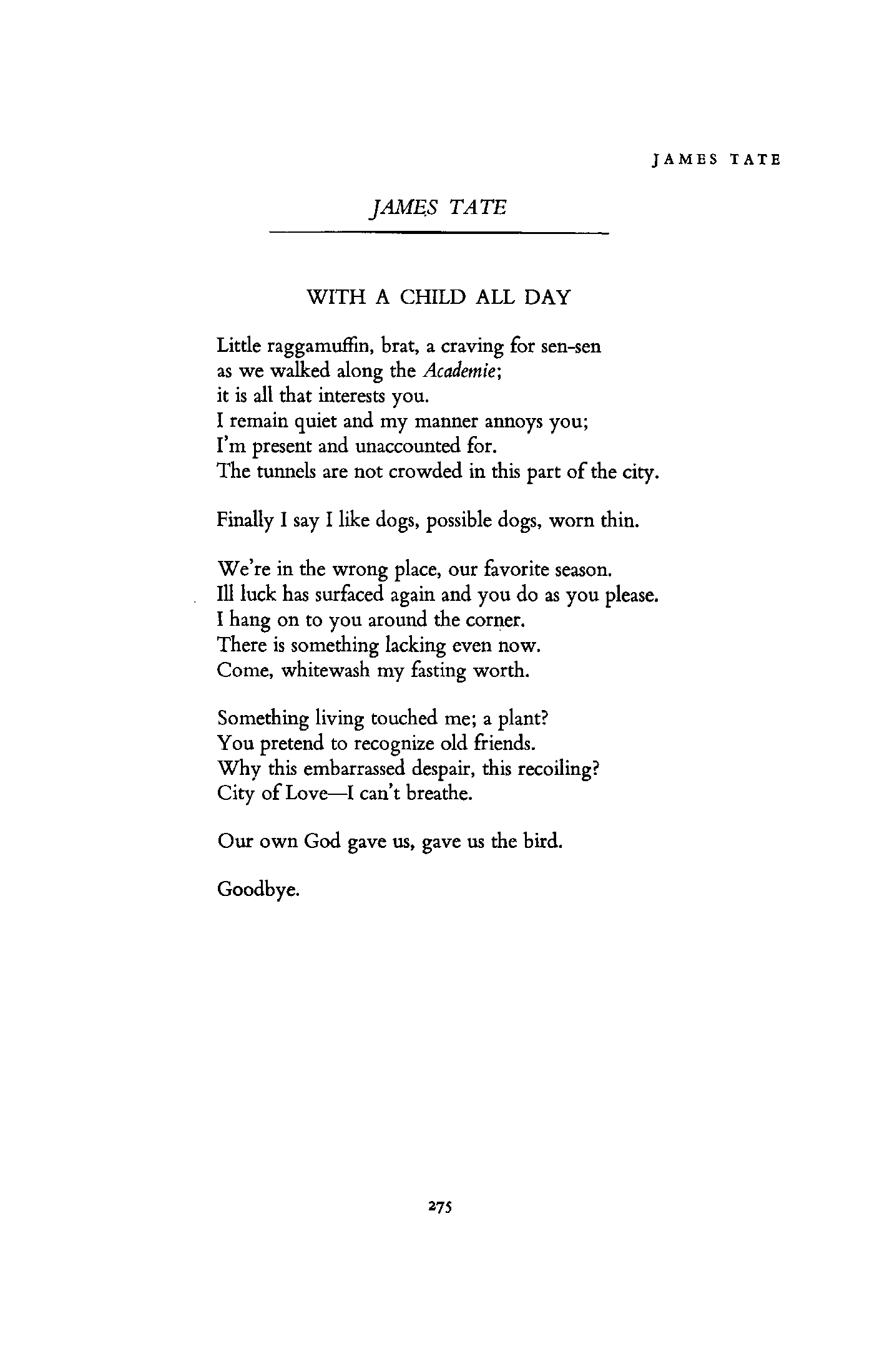
Via Poetry Magazine: http://www.poetryfoundation.org/poetrymagazine/browse/132/5#!/20593137. RIP.
 Neil Serven