Ayris Contributor’s Copy
December 19, 2013 § Leave a comment


In the mail yesterday: Issue 03 of Ayris, the magazine of literature and art published by the New Hampshire Institute of Art. My story “In the Whore’s Style” is featured among an array of work by other talented writers. Nicely produced, I love the font choice, and the art opposite my story’s first page aligns well with the story’s themes.
Also in the package: a bonus frame-worthy selection of larger-format art prints (pre-cropped versions of the images that appear in the magazine).
Many thanks to past and present editors, Jenn Monroe and Ryan Flaherty.
On Networking, the Etiquette of Submitting, and Being a Good Literary Citizen
December 16, 2013 § Leave a comment
For writers, December runs hot and cold—a lot of rejection notices come in as the semester winds up, and a few acceptances, too. Everyone shares their end-of-year lists and nominations for prizes, like the Pushcart. I wasn’t nominated for anything this year, and I wasn’t expecting to be, but one editor did take the time to tell me that I was “a smidgen” away from making the cut for a Pushcart nod. Since it’s been a slow year otherwise, in terms of writing and publishing, it made me feel good for a few days, and I appreciated it.
A couple months ago, Roxane Gay, one of the most generous writers out there in terms of sharing advice to fellow writers, published a piece called “The Eight Questions Writers Should Ask Themselves” for the AWP site. The whole article is worth a read, but the first question, in particular, has stayed with me:
1. Are you a good literary citizen?
I don’t want to be overly prescriptive but while writing matters most, how we move through the literary world also matters. Literary citizenship is certainly not being disingenuous, uncritical, or falsely affirming about everything you read and every writer you encounter.
Instead, literary citizenship can involve being a consumer as well as a producer of the written word. Subscribe to a literary magazine or two. Attend readings once in a while. Volunteer at a literary magazine. Do what you want, so long as you are doing something to contribute to the literary community, beyond simply offering your writing.
Don’t burn bridges you may want to cross in the future. The writing world is as small as it is big; most everyone is connected in some way. Again, this is not to suggest you should be disingenuous but you never know when seemingly casual connections will end up leading to professional opportunities to participate in a reading series, or read at a university, or teach at a writing workshop.
Good literary citizenship can also extend to how you comport yourself when participating in social networks. Are you relentless in promoting your own writing, sharing the same link more than two or three times? Do you send direct messages or private Facebook messages to strangers, promoting your latest project? Of course you should promote your work but take care in how you promote your work and consider sharing the good news about the writing of others, if you are so moved.
Mostly, literary citizenship is the importance of remembering that no one is alone in the writing world. Conduct yourself as such.
This has been on my mind lately as I make more friends and connections in the literary world. Social media tends to have a snowball effect when it comes to these things. I am connected to people—writers, editors, program directors—who don’t really know who I am, and I don’t really know them, but, as with any other field of interest, it is useful and rewarding to stay in touch with other practitioners, share ideas and frustrations about our choice of craft, and spread news about achievements and opportunities.
But it is not lost on me that many of the people with whom I interact can also give me something I want. I want to be read by them, be published by them, be promoted by them and invited to read with them. I want to be mentioned in the same conversations as them. There is a fine line that must be trod in how I interact with them. When I submit a story to a journal, and then share a link to another story published in that journal while my submission is being considered, or like news of an editor’s book deal, am I greasing the skids? Am I complicit in a fraud if that action is interpreted as such?
And if an acceptance or other opportunity were to come about from a journal I have promoted, or an editor whose work I have shared or liked, is it somehow less of an achievement if those interactions helped the editor or publisher to remember my name?
I haven’t been submitting much lately, mainly because I have only a handful of pieces that are ready to see the light of day. But I have been sharing links, reading up on other writers’ career milestones and new projects, liking and encouraging as a way of staying abreast of what others are doing. In one way it feels like a way to participate in the conversation of writing, for lack of anything of my own to contribute. And it is always great to know talented and creative people. Having them close at hand, and paying attention to how they conduct themselves, can be a bit of a tacit, poor-man’s mentorship. But there are also times when it feels as though I am exposing myself, because for all the energy I spend fostering relationships with other writers I know I should be spending more on improving my craft.
Earlier this week, one accomplished writer I follow and respect posted his list of favorite books of the year for The Millions’ Year in Reading, and the first commenter—anonymous, naturally—accused him of shilling for his friends. It was true, the writer admitted—a lot of the authors he mentioned were his friends. Some of them he had known for a while and others he had gotten to know only after enjoying their books. A few other commenters piled on, rather cruelly, accusing the writer of abusing his position as part of a circle-jerking enclave, which seemed to suggest a disdain not for the promotion of friends’ books but for the seeming impenetrability of that circle, a smugness among those who belonged to it, and the perception from outsiders that membership in that circle made it impossible to treat each other’s work with the same critical honesty expected in the writing community at large.
On the one hand, this kind of accusation doesn’t say much; in any business, even one purportedly transacting in merit, one establishes a coterie of people one trusts, and those are the people one is naturally eager to work with.
But I think there is also a responsibility to consider how things look from afar. The Internet gives writers a streaming, 24-hour opportunity to get their names in front of the people they seek to impress, and unlike the work of drafting, revising, critiquing and polishing, a lot of electronic networking takes place out in the open. We retweet, share, and like with no lack of awareness that we might be seen doing it and get paid back for it down the road. That’s only human nature. But it is also human nature to be cynical, and a writer who trumpets the work of another writer who has done that person a favor is going to appear disingenuous to some.
Community is a valuable thing. I am very grateful for the many friendships I have made in such a short time since I started sending my work out. But true friendship needs distance and honesty at times, and I wonder if the Internet has made the writing community too snug for its own good.
Books That Shaped Work in America
December 13, 2013 § Leave a comment
Via Atticus Books, the U.S. Department of Labor, of all places, in conjunction with the Center for the Book in the Library of Congress, is putting together a working list of Books That Shaped Work in America.
It is fascinating to toggle through the titles compiled so far, which range in theme from the struggle to find one’s footing in industrial America (The Jungle, On the Waterfront; How the Other Half Lives) to portrayals of modern office hell (The Devil Wears Prada) to indictments of race and class warfare (To Kill a Mockingbird, The Help) to the science of labor and getting ahead (Studs Terkel’s Working, How to Win Friends and Influence People). Children’s titles are not forgotten, from Mo Willems to the MacGuffie Reader, nor are plays (Death of a Salesman, August Wilson’s Pittsburgh Cycle).
A few are perhaps questionable: Peggy Noonan’s tribute to Ronald Reagan seems like a waggish commentary on the subject, and I have no idea how The Guinness Book of World Records fits into the conversation. Fortunately, it is meant to be a working list, and there’s a form for people to suggest their own additions.
I haven’t submitted any, but here are a few that come to mind:
- Post Office (or Factotum), Charles Bukowski: protrayals of drudgery of the working stiff in which the individual is a meaningless cog with no motivation for responsibility
- Bad Behavior, Mary Gaitskill: a collection that includes the short story on which the film Secretary was based, a stark take on subordination in both work and sex
- The Rise of Silas Lapham, William Dean Howells: one of the first looks at entrepreneurship and the efforts of new wealth to fit in 19th c. America
- The Theory of the Leisure Class, Thorstein Veblen
- Ragged Dick, Horatio Alger (although Mark the Match-Boy is already represented)
- John Updike’s Rabbit series: A biased choice, I realize, but a portrayal of a man moving up in the ranks primarily due primarily to marrying the boss’s daughter
- Mike Mulligan and His Steam Shovel, Virginia Lee Burton: a story of obsolescence and the fight to stand up for one’s work in the machine age
- Shop Class as Soulcraft, Matthew Crawford: an argument for reinvestment in craftmanship skills in an age that strives to insulate us from how things work
- Microserfs, Douglas Coupland: one of the first office-as-cubicle-hell novels (a precursor to Joshua Ferris’s Then We Came to the End), perhaps not eligible since Coupland is Canadian.
What I Read in October and November
November 29, 2013 § Leave a comment
October’s reading was light due to the baseball playoffs, so I’m bundling it with November.
By Grand Central Station I Sat Down and Wept, Elizabeth Smart. I can’t remember why I bought this book—it may have been the title, which promised some kind of magic urban realism (you’ve noticed, I have a fondness for books about women living in the city). And what flickers of information we get toward the plot does provide that. But since this is prose poetry, a term that I had never really considered until I gave this book a try, the effort of forwardness is meant to be secondary to image and language, even though there is an inchoate plot based on the author’s life (Smart’s affair with the poet George Barker, with whom she bore four children). Smart is more interested in taking us down routes where the lights are so bright they distract us from where we are going, but I found it hard to enjoy the journey without some clue as to where I was being taken. There was a point where I gave up and just imagined I was closing my eyes in my balcony seat, listening to a symphony.
Green Mountains Review, Vol. 26, No. 1. Picked this up at the Brattleboro Literary Festival; I had been meaning to check out an issue, and this one happened to include a number of familiar names. There is a special feature on Tony Hoagland, presenting 14 new poems and critical appreciations by Mark Halliday and Tony Hart.
The square page dimensions of GMR are well suited for flash fiction, and there are good selections here by Sean Lovelace and Lou Beach (who also designed the cover and an eight-page selection of Surrealist artwork). Among the longer stories, the two I particularly liked were “A Kind of Extinction” by Jaimee Wriston Colbert and “Breakup Blog” by Lee Ann Roripaugh.
Colbert’s story is about the preteen daughter of Tea Party activists (aptly named Fortune Hopewell), who is also a petty thief (of all things aquamarine, her favorite color). She considers herself a neighborhood spy and is somewhat enchanted by her beatnik neighbor and her science teacher, who each present opportunities for thought challenging to the family doctrine. She has a job taking care of her convalescent grandmother. Her eldest sister was killed in a motor-scooter accident; her other sister has taken to meth addiction, and her parents’ activism seems born less out of reflexive anger to these developments than a wish to deny the necessity of personal interrelationship in their healing (they refuse casseroles from the neighbors). Colbert is great at filtering the buzz through Fortune’s limited third-person POV:
Fortune’s Dad calls him the Beatnik on the Hill and Mum says, For crying out loud, there’s no more beatniks, you think it’s the fifties? Then Dad points out that he looks like a beatnik, with those billowy white pants and his pointed beard, and he wears jewelry, Dad says. Plus he’s a jazz player, which as far as Dad is concerned is no kind of music and certainly no kind of work. Their property abuts the Beatnik’s only his goes up the hill and theirs is flat downhill, which means the Beatnik gets the view of the Susquehanna River and the hills beyond while the Hopewell house is hunkered in the trees where not even enough sunlight beams in to melt the ice from their driveway in the winter.
Lee Ann Roripaugh’s “Breakup Blog” follows a trend I’ve been seeing lately of second-person present-tense narratives, with the ‘you’ not as an agent so much as a kind of absorptive reactor. The ‘you’ in this case is the subject of a slander perpetrated by an ex (here called The Plagiarist) in her electronic journal:
You have to hand it to the Plagiarist. Despite the icky title, it’s a pretty snappy format. First the plagiarist talks a lot about her feelings with both hair-shirt verve and martyred solipsism … And then—either the best or the worst part, depending on how you want to look at it—the post concludes with a zippy little featurette called Reasons to Get Over Her, in which the Plagiarist catalogues one new thing each day that’s wrong with you … You need to stop reading The Plagiarist’s blog. Need. To. Stop. You know this. Your friends agree. So does your therapist. But it’s like looking into the distorted mirror of the funhouse effect on your MacBook’s Photo Booth: fascinating/horrifying/ fascinating/horrifying.
Slice #13, Fall ‘13/Winter ’14. Every issue of Slice has a theme, and this issue’s theme is “The Unknown.” I probably would have taken this to mean “unknown” in an ostensible, Time Life Mysteries of the variety, and its attendant themes: outer space, the supernatural, death and the afterlife. Rather, many of the stories here are about people embarking on new stages of their lives with uncertainty: new motherhood, a childhood spent in Poland. It feels like somewhat of a safe interpretation, especially given the publisher’s note at the beginning:
New writers are often urged to write what they know. The suggestion, of course, is that you shouldn’t start with writing about the foibles of 18th-century French aristocracy if you grew up on a farm in North Dakota. This is good advice, though if we never wrote anything but what we knew for sure, we’d be writing nothing but blogs about what we had for dinner.
Among the fiction, Helen Phillips’ “The Wedding Stairs” plays with a fun premise, the forbidden access to the downstairs room where caterers at a wedding reception carry out their operations. My favorite story was Scott Lambridis’ “Laurent,” about a prostitute and her client-cum-lover, using their fascination with a local serial killer of prostitutes to cover up their bleaker terror at their uncertain futures. The prose sings with urban shoe scrapes and hints at the characters’ evident pasts:
“Look at them,” said J. She sipped the cheap coffee, watching one of the girls, a young one with a clip in her hair. “How cliché, a whore and a policeman in love. They’re all talking about how sweet her relationship is, they might even have the child, he’s going to leave his wife.” The others put their arms around the girl, drew her into their cocoon of bodies until she disappeared. She watched the men now—the ones she knew, the ones she didn’t, reading newspapers of their own. “Do you think that could be him? Do you think he reads about himself?” she asked, pointing to a man with legs folded and only a green hat visible above his newspaper.
“Look at that headline, blaring loud as day,” said M. (Laurent had strangled another on the footbridge between the four theatres of the Flats.) When the man snapped his newspaper down, J. folded into M.’s armpit.
“We have to leave,” she said. M. laughed.
There are some silver-tuna interviews as well, with Rick Moody, Francine Prose, and Penguin editor Allison Lorentzen, among others.
Varieties of Exile, Mavis Gallant. Many of the stories in this collection are set in Montreal, where Gallant was born, though she lived most of her life in Paris. Montreal is one of my favorite destination cities, and at four and a half hours from where I live, one of the most accessible to me. Its bilingualism and independence from the rest of North America, its proto-European streak (on one trip they had a film festival with Godard movies projected, without subtitles, on the side of a warehouse), the fact that everyone there is somehow young and beautiful and tireless, give it a feeling of exoticness at a reasonable price.
The stories in Varieties of Exile were selected by the American novelist Russell Banks, who, due to his part-Canadian heritage, admits of “an abiding affection if not an outright preference for the North American stories, if only because Gallant has attended there to lives that are familiar and matter greatly to me and rarely make it into literature.” Interestingly, Gallant writes of the city as though expecting an American audience, or at least, an audience that would not be very familiar with Montreal and its outsider identity. We are reminded when conversations shift between French and English, that hockey players are considered celebrities, and that, in one particular instance, Quebec is unique in that its blue laws allow grocers to sell beer.
Gallant often wrote multiple stories about the same characters at different stages of their lives, and Banks has taken care to group several of them together. I was most drawn to the stories of Madame Carette and her daughters, intelligent Berthe and flighty, naïve Marie. Berthe is written off early as a spinster, and in “A Chosen Husband,” the family anxiously awaits a marriage proposal for Marie by an awkward visitor:
His French was slow and muffled, as though strained through wool. He used English words, or French words in an English way. Mme. Carette lifted her shoulders and parted her clasped hands as if to say, “Never mind, English is better than Greek.” At least, they could be certain that the Driscolls were Catholic.
…
Of course he was at a loss, astray in an armchair, with the Carettes watching like friendly judges. When he reached for another chocolate, they looked to see if his nails were clean. When he crossed his legs, they examined his socks. They were fixing their first impression of the stranger who might take Marie away, give her a modern kitchen, children to bring up, a muskrat coat, a charge account at Dupuis Frères department store, a holiday in Maine. Louis continued to examine his bright Driscoll hair, the small nose along which his glasses slid. Holding the glasses in place with a finger, he answered Mme. Carette: his father was a dental surgeon, with a degree from Pennsylvania. It was the only degree worth mentioning. Before settling into a dentist’s chair the patient should always read the writing on the wall.
Gallant’s writing is alive with subtlety while showing off its cosmopolitan awareness, with dialogue that dresses characters in layers of complexity and skepticism. Varieties of Exile is one of three collections of Gallant’s stories brought back into print by NYRB Classics.
The Perks of Being a Wallflower, Stephen Chbosky. Second read, in anticipation of the film, currently sitting in our TiVo queue. The first time I read it was just after it was published, in 1999, and without all the references to mix tapes, the apparent lack of Internet (it’s set in the early nineties), photofinishing shops, and gay characters preferring to remain closeted, it would be hard to believe the book is fourteen years old. But teenagers are still reading it, the book has been banned from not a few high schools, and now it’s a film, directed by the author.
Does it read differently the second time around? As an older reader, I think I am more accepting of the blurriness of message; that Chbosky is willing to give his hero a fair chance from the start. Charlie is a freshman who comes under the wings of two very accepting seniors, a brother and a sister who appreciate his intelligence, sensitivity, and yearnings, as well as an English teacher who cultivates his writerly potential with extra reading assignments. He comes with a lot of demons: a close friend recently deceased, a sister suffering abuse at the hands of her boyfriend, an aunt with a troubled past, and some hints at mental illness. These are revealed in a series of letters to an unknown friend that is supposed to be us, but that, due to their searching internality, read more as diary entries. His perceived isolation tends to make him magnify these demons.
Which is to say that for a wallflower, Charlie isn’t exactly getting trounced. Even from the beginning, things seem to progress for him on a social level that probably would have made the high-school me envious. I was seven years out of high school when I first read Perks, with a lot of lingering resentment, and I suspect I wanted the book then to be something it wasn’t, perhaps be a little more defeatist and angry. The pressure put on the book to be the MTV Generation’s answer to The Catcher in the Rye (MTV Books is the imprint that published Perks) might have inflamed that. Chbosky resisted those temptations, and the result is a nuanced book with lasting heart.
R.I.P. Doris Lessing
November 17, 2013 § Leave a comment
INTERVIEWER
Were you around a lot of storytelling as a child?
LESSING
No . . . the Africans told stories, but we weren’t allowed to mix with them. It was the worst part about being there. I mean I could have had the most marvelously rich experiences as a child. But it would have been inconceivable for a white child. Now I belong to something called a “Storytellers’ College” in England. About three years ago a group of people tried to revive storytelling as an art. It’s doing rather well. The hurdles were—I’m just a patron, I’ve been to some meetings—first that people turn up thinking that storytelling is telling jokes. So they have to be discouraged! Then others think that storytelling is like an encounter group. There’s always somebody who wants to tell about their personal experience, you know. But enormous numbers of real storytellers have been attracted. Some from Africa—from all over the place—people who are still traditional hereditary storytellers or people who are trying to revive it. And so, it’s going on. It’s alive and well. When you have storytelling sessions in London or anywhere, you get a pretty good audience. Which is quite astonishing when you think of what they could be doing instead—watching Dallas or something.
From The Art of Fiction #102, in The Paris Review 106, Spring 1988
All of Knowledge as One’s Province
November 9, 2013 § Leave a comment
On the release of Susan Sontag’s complete and unexpurgated (as in 168-page) Rolling Stone interview from 1978, Mark O’Donnell cannot help but marvel at Sontag’s ability to keep up with the sense of boundlessness and insatiability she projected in her approach to reading, her wish to have her assumptions challenged and the euphoria she evinced at the discovery of the new, and “the way in which she positions curiosity as not just a primary critical value, but a primary human value”:
There’s always the sense, with Sontag, of reading as a process of acquisition and assimilation, as a kind of territorial expansionism of the self. All those itemized resolutions in the journals, all those lists of things to be read and absorbed; her project was, as she put it, “taking all of knowledge as my province.” And this is one of the most striking things about her, this conquistadorial spirit brought to bear on a basically democratic sensibility—the famous imperative to be interested in everything.
It is hard not to think that Sontag decided to invest in the responsibility of her image early in her life, what from the boasts of reading translations of Mann and Gide as a teenager to the lists and self-absorptions she committed to her journals in those years (Age 15: “It is useless for me to record only the satisfying parts of my existence.”). Such pressure to keep feeding both the self and the public image of the self could have easily led to madness.
Fittingly, here is what she wrote, at age 16, about Gide’s The Counterfeiters:
I am fascinated but not moved … Here; a novel by Gide called The Counterfeiters dealing with a small chronological slice of life around a man called Edouard, who is planning to write a book called The Counterfeiters, but is now preoccupied with keeping a journal of his life while his life is colored by the idea of writing this book (as Hopkins sees the wreck of the Deutschland through a drop of Christ’s blood)–and he thinks this journal will be more interesting than the proposed book, so that he now plans to publish the journal and never write the book. Edourard is Gide, beginning and ending in medias res.
Medium Cool
November 8, 2013 § Leave a comment
Albert Camus was perhaps admired as much for his façade of masculinity as he was his writing. It was not just for his handling of the subjects of absurdity, suicide, or politics that he inadvertently made it a normal thing for philosophers to be featured on dorm room posters. (Nietzsche joined him, retroactively.) The resemblance to James Dean in both vulnerable pose and tragic death via automobile seems an undue pressure on his life’s narrative.
In her 1963 essay “The Ideal Husband,” Susan Sontag found an explanation for the allure: Camus was able to “assume the responsibilities of sanity” while having to “traffic in the madmen’s themes” of suicide, affectlessness, guilt, and paranoia worn out by his contemporaries:
But he does so with such an air of reasonableness, mesure, effortlessness, gracious impersonality, as to place him apart from the others. Starting from the premises of a popular nihilism, he moves the reader—solely by the power of his own tranquil voice and tone—to humanist and humanitarian conclusions in no way entailed by his premises. This illogical leaping of the abyss to nihilism is the gift for which readers are grateful to Camus. This is why he evoked feelings or real affection on the part of his readers. Kafka arouses pity and terror, Joyce admiration, Proust and Gide respect, but no modern writer that I can think of, except Camus, has aroused love.
Camus channeled affection in his personal relationships as much as he evoked it in his writing, as demonstrated by his tender 1957 letter to his former teacher upon his being awarded the Nobel Prize for Literature.
(Hat tip: Alex Pruteanu.)
A Rapping at the Door
October 31, 2013 § Leave a comment
I had scarcely laid the first tier of my masonry when I discovered that the intoxication of Fortunato had in a great measure worn off. The earliest indication I had of this was a low moaning cry from the depth of the recess. It was not the cry of a drunken man. There was then a long and obstinate silence. I laid the second tier, and the third, and the fourth; and then I heard the furious vibrations of the chain. The noise lasted for several minutes, during which, that I might hearken to it with the more satisfaction, I ceased my labours and sat down upon the bones. When at last the clanking subsided, I resumed the trowel, and finished without interruption the fifth, the sixth, and the seventh tier. The wall was now nearly upon a level with my breast. I again paused, and holding the flambeaux over the mason-work, threw a few feeble rays upon the figure within.
Edgar Allan Poe, “The Cask of Amontillado” (1846)
When I was in tenth grade, we were assigned Poe for Halloween. Mrs. Baletsa always assigned us more reading than I could manage to fit in with my other homework, but they were good books: To Kill a Mockingbird; Steinbeck’s The Pearl; Sir Gawain and the Green Knight.
At the time, I wasn’t an avid reader. I read for the assignment, for the answers to the questions. This was where I always had difficulty; in retrospect, I think I was so interested in language that the oddness of words often distracted me from the story I was being told.
We had elderly neighbors who were still rather sprightly (they had a yellow Lab they walked themselves) living next door. On Halloween that year, their granddaughter went into labor. Since they wanted to be at the hospital to meet their new great-grandchild, they asked me to house-sit for them and hand out their candy.
I had nothing else to do but my homework.
So it was in an unfamiliar house, on Halloween night, interrupted by neighborhood kids every three minutes, that I attempted to read “The Murders in the Rue Morgue,” “The Cask of Amontillado,” and “The Tell-Tale Heart” for the first time.
It was not an old or drafty house, no strange hideaways or player pianos, no unannounced lightning storm, but I think I left the TV off (they didn’t have cable), and against Poe’s description of voices buried deep within walls, hearts beneath floorboards, bodies shoved up into chimneys, the irregular settling creak managed to make itself known.
Besieged Consciousness
October 25, 2013 § Leave a comment
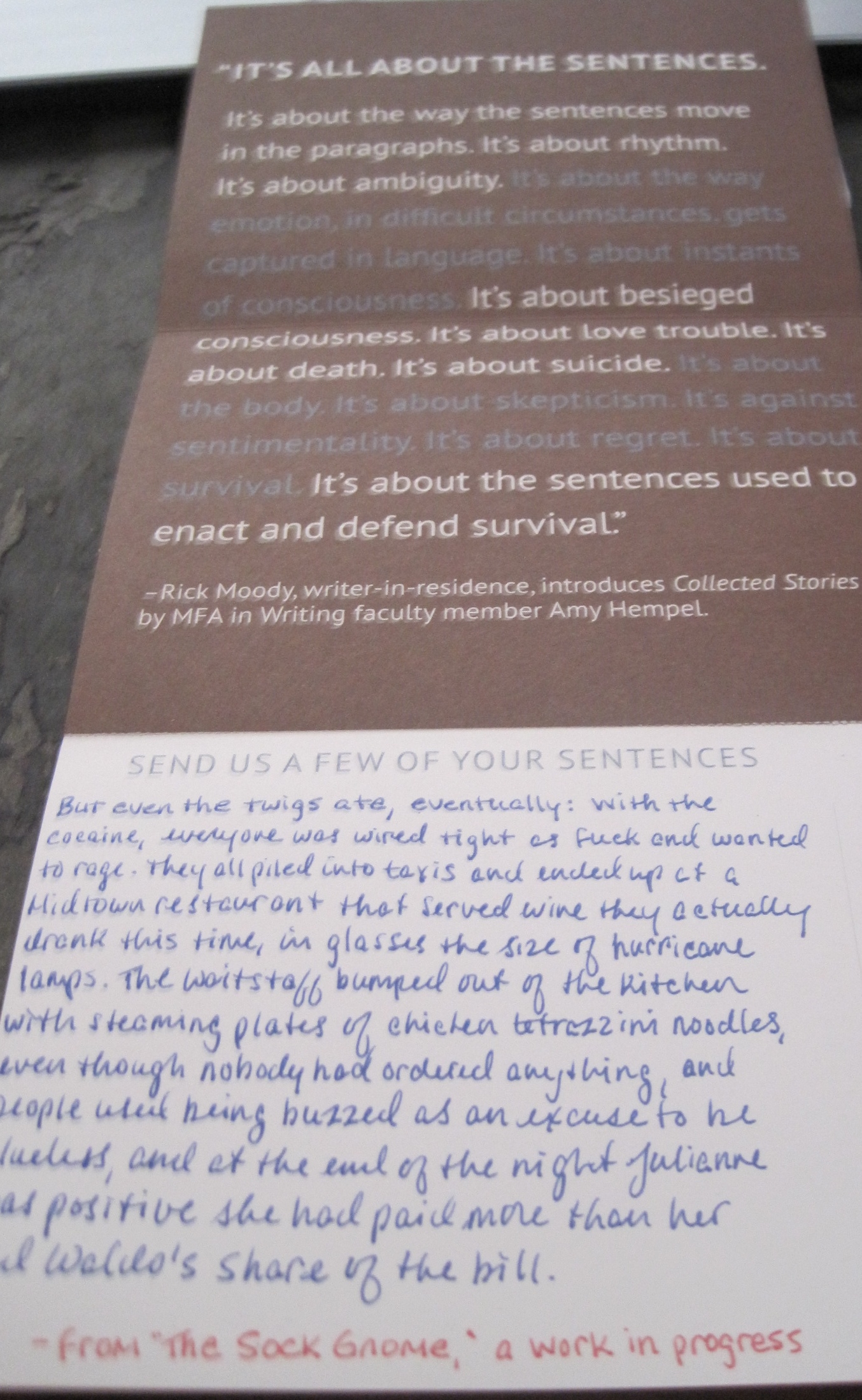
Bennington’s promotional mailer for its low-residency MFA program quotes Rick Moody’s introduction to Amy Hempel’s Collected Stories, on the importance of the sentence as a narrative unit. (“It’s about besieged consciousness. It’s about love trouble.”) The reply card asks you to send a few sentences of your own. I don’t know what they plan to do with them, but here are mine, from a work in progress.
If anything, it reminded me that the exercise of writing down (or even rewriting) my words by hand is one I should undertake more often.
The Literary Magazine in Popular Culture
October 22, 2013 § Leave a comment
At The Millions, Nick Ripatrazone writes about the cultural influence of literary magazines and their relatively scarce presence in film and television. Ripatrazone asked around for some examples where lit mags are referenced in these media, and I chimed in with a couple.
 Neil Serven