What I Read in April and May
June 6, 2016 § Leave a comment
A Brief History of Seven Killings, Marlon James. This 688-page tome won the Man Booker prize last year, the first ever winner from Jamaica. It wipes away all of the tourism-perpetuated myths of that island and replaces them with new, more complex myths, the characters spanning all classes and corners: the drug dealers, the gang enforcers, the politicians, the CIA officers and informants, and even American journalists–in this case, the ambitious Alex Pierce, Rolling Stone and New Yorker writer whose angle into how the Caribbean drug trade infects the streets of Brooklyn and the Bronx essentially translates that which gets lost in the other guarded first-person accounts.
James manages the tricky task of educating his readers on the intricacies of corruption and power in another country without being didactic to those readers who are not already well read on Jamaican history. He achieves this through seamless tactics of immersion and an ensemble of well-rounded, calculating characters, most notably Pierce and the drug lord Raymond “Papa-Lo” Clarke and the self-dubbed enforcer, Josey Wales:
People think that I have animosity towards Papa-Lo. Me have nothing but love for the man and I would say the same to anybody who ask. But this is ghetto. In the ghetto there is no such thing as peace. There is only this fact. You power to kill me can only be stop by my power to kill you. You have people living in the ghetto who can only see within it. From me was a young boy all I could see was outside it. I wake up looking out, I go to school and spend the whole day looking out the window, I go up to Maresceaux Road and stand right at the fence that separate Wolmer’s Boy’s School from Mico College, just a zinc fence that most people don’t know separate Kingston from St. Andrew, uptown from downtown, those who have it and those who don’t. People with no plan wait and see. People with a plan see and wait for the right time. The world is not a ghetto and a ghetto is not the world. People in the ghetto suffer because there be people who live for making them suffer. Good time is bad time for somebody too.
James also wisely gives the book a concrete, somewhat well-known hinge event: the attempted assassination of Bob Marley, here only identified as The Singer, on December 3, 1976, two days before he was to play the Smile Jamaica peace concert in Kingston. There are a lot of politics that unspool from that event, as well as what Marley represents to the different classes in the country. All of the chapters are first person accounts, and James arms each character with a legitimately unique vocabulary that empowers the dialogue to carry the plot forward. It reminded me, at various points, of Roberto Bolaño’s The Savage Detectives for the push and pull of its alternate narrations, Irvine Welsh’s Trainspotting for the spit and grossness of its patois, and Atticus Lish’s Preparation for the Next Life for its genuine immersiveness in the sea of a broken culture.
From Here, Jen Michalski. The title of this collection suggests a struggle of location and disorientation, of homes and being away from what one calls home. The characters are generally at crossroads, deciding whether to stay or flee. In the story “The Substitute,” a young teacher returns home to take over his father’s English class while his father gets treated for cancer. There’s an ambivalence established right away, as Patrick, the substitute, doesn’t want to get too attached to the kids in his charge, nor to the drama teacher, Anne, who takes an interest in him. In “You Were Only Waiting for This Moment to Arrive,” a father takes the daughter he has not seen in two years to Disney World, an environs that goes out of its way to bubble itself from the outside world.
The characters in “The Safest Place” are the children of Chechen- and Polish-Americans, struggling at the bottom of the economic ladder. Narrator Basha falls under the spell of Andnej, whom she has known since elementary school, and who now earns a living dealing drugs. He takes Basha and her little sister on dates with the expectation that Basha act as a courier for her friends who are his customers. Basha’s moral conscience battles with her need for money and desire for Andnej’s attention.
The equations are drawn up promisingly, and Michalski effectively evokes the lack of grip and aim that can take hold, but the characters don’t cooperate on the cashing in. For young people caught in a moral struggle, with ulterior motives, there is surprisingly little archness in their dialogue, and almost too much patience. The words are more functional than shape-giving, unconvincingly filling space:
“Why did you start smoking?” Basha gripped the door handle, although Andnej was not driving fast.
“I don’t know. It’s just something to do,” he laughed, and Basha glanced at his face, noticed how the skin stretched over his cheeks, the half-moon dimples by his lips. “There’s not much to do sometimes, you know?”
“No, I don’t.” She shook her head. The boys who dealt drugs in the neighborhood roamed the streets for hours. Sometimes they got drunk in the parking lot, sitting on their cars and blaring music so loud out of their stereos Basha’s heart felt like it was floating down a bumpy river.
“She’s mean to me, too,” Kamilia said from the back seat.
“Don’t worry.” Andnej winked at Basha, and he turned backward in his seat to parallel park. “When you become a big girl, you’ll get mean, too.”
Zoetrope: All-Story, Spring 2015. I bought this issue at my local bookshop during a Cash Mob event. Designed by Ryan McGinness, it’s a smaller format than past Zoetropes have been, and features artwork consisting of black cutouts, including the cover image of the geometric form of a snake swallowing its own tail.
There are only three stories in the issue, and one is a reprint: Robert Heinlein’s “All You Zombies—,” from 1959. Naomi J. Williams’ “Permission” is the story of Madame Lapérouse, an elderly French woman in the early 19th century who was the brother of a famous navigator and wishes for her family to carry over part of his name now that he is deceased. Government documentation, however, has misspelled the name, and what issues forth is an odd tale that seems to be about the frustrating lack of control that one feels when one is unable to tell one’s own story. It’s very dry and feels too pedantic a subject for sixteen pages of fiction, but there is, at least, a little character in Madame’s bitterness:
“Yes,” I say. “Not so much a name change as a name…enhancement, as it turns out. And they’ve misspelled ‘Lapérouse.’ I try to say this lightly, but my voice unaccountably catches.
“Oh, madame.”
The sympathy in his tone nearly brings me to tears.
“It’s nothing,” I say, as briskly as I can manage. “What can one expect, after all? We had our little revolution, but they killed all the wrong people. The bureaucrats remain our oppressors.”
F 250, Bud Smith. The title of this small-press novel refers to the pickup truck driven by the lead character, Lee, who makes money under the table as a stonemason and landscaper in his New Jersey hometown. It’s a telling way to pin the character’s identity: Lee is not emotionally invested in his work, but he’s good at it, it’s stable, and it gives him a more substantial baseline than many of the other people in his circle. Lee is also an artist, to an extent: he is an ex-guitarist for a noise band called Ottermeat, and his ex-bandmates hold him to blame for walking away right when the band had a chance to win a record deal.
The writing in F 250 reminds me very much of Bukowski in that the characters, particularly Lee, tend to react more than act to the situations presented to them, perhaps because they lack the vocabulary or the forward thought to do anything else. They fight, spit, and rage, and aren’t really equipped to improve themselves through any kind of verbal ingenuity. This seems to be the trap to which Lee is lured, and there is the suggestion that the town brings down its residents as much as the residents tear down the town. But the problem with idleness is that it doesn’t leave much of a narrative motor. The trap becomes more complex in the second half of the book, when Lee hooks up with a pair of young women with the spacy names of June Doom and K Neon, and a tragedy befalls one of his ex-bandmates.
What Belongs to You, Garth Greenwell. This novel received rave reviews when it was published, not least among them from James Wood, who called it “brilliantly self-aware.” For a short book it is a thick read: the paragraphs go long and sink deep, matching the tunneling thoughts of the unnamed American narrator, a bit lost and on an emotional wander in the foreign city (Sofia, Bulgaria), where he lives and teaches English. There is a middle part that consists of one long, unbroken paragraph spanning forty-two pages.
Wood compares Greenwell to W. G. Sebald, noting that he “thinks and writes, as Woolf or Sebald do, in larger units of comprehension; so consummate is the pacing and control, it seems as if he understands this section to be a single long sentence.” I thought of Sebald more than once when reading What Belongs to You. (I also was reminded of Teju Cole’s Open City and Joseph O’Neill’s Netherland.)
The narrator spends a night with a hustler named Mitko, who then hangs around, essentially taking advantage of the lonely narrator’s generosities. The narrator becomes smitten with Mitko, in spite of what the latter gives off as a guarded aloofness. They maintain a tethery romantic relationship and correspondence, the narrator eventually following Mitko to the resort city of Varna, on the Black Sea.
Mitko goes away, but comes back when he discovers that he has syphilis and warns the narrator that he should get tested. The reunion of sorts opens us new desires and infuriations, all of which feel naked and throttling and honest. There is a beautiful, angsty stubbornness to this book, the kind that comes about purely when one is obsessed with another person:
I didn’t respond to his smile. I came all the way from Sofia, I said, and I’ve paid for the room, for our meals, for everything, I came to be with you, to have sex with you—and here Mitko broke in, catching the scent of something he could exploit. Is it just about sex then, he said, you’re my friend, and he used again that word priyatel. I found the hotel, he said, I waited for you at the bus stop, even though it was raining, and now my throat hurts, I’m starting to get sick. A ne e li vyarno, he said, isn’t that right, challenging me to deny it. He paused to drink, as though bracing himself for a confrontation he knew he couldn’t avoid. I did all that because we’re friends, he said, those are things friends do, it isn’t just sex for me. He stopped then, as if he realized he had gone too far, had leaned too hard on the fiction of our relationship and felt the false surface give way. But we aren’t friends like that, I said as Mitko took another long drink. We both get something from it, I went on, and the bluntness of the language was now the tool I wanted: I get sex, I said, and you get money, that’s all. But now I was the one who had gone too far, and so I softened what I had said, or tried to: I like you, I said, I like being with you, skup si mi, I said, you’re dear to me, you’re beautiful.
The B-Side: The Death of Tin Pan Alley and the Rebirth of the Great American Song, Ben Yagoda. Yagoda’s book is an extensive and patiently told history of American popular music in the 20th century, all the richer because it has a plainly stated objective, attempting to pin the moments and reasons behind the music industry’s decision to move away from the classical standards of what is known as the Great American Songbook—the work of Cole Porter, the Gershwins, Duke and Ella and Bing and, of course, Frank Sinatra–which had defined the early part of the century, in favor of novelty songs and other, less artfully arranged recordings that had little staying power. There are a number of instances along the timeline at which one can point to identify the instance when this shift began to occur, but “(How Much Is) That Doggie In the Window?,” the novelty song first recorded by Patti Page in 1952, comes up more than once as what would seem to be the most egregious example.
Yagoda seems more interested in recultivating an interest both for standards and the thoughtful arrangements that went into standards in the hopes of celebrating their presence in contemporary songwriting. He claims neither to hate nor blame rock ‘n roll for the decline. Instead he centers on changes in the recording industry during and after World War II, the chief aggressor being Mitch Miller, he of the sing-along records fame, who as a producer steered away from the complex rhythms of jazz to less sophisticated fare that would find an agreeable postwar audience. Throughout The B Side, Miller is referred to disparagingly as “The Beard,” and described as a micromanager impacting decisions that outlied his talent sphere. Yagoda writes:
The Beard had expanded the traditional role of the A & R man beyond just signing artists and selecting their songs. He was involved in every aspect of the recording process, from orchestration and arrangments to setting the sound levels; beyond that, he was the first music man (the term “producer” hadn’t yet been adopted by the industry) to think of recordings in terms of production values, or sound effects. Miller told Will Friedwald: “What makes you want to dig in your pocket and buy a record? It’s got to be something you want to play over and over again. You look for qualities to make somebody buy it. I was trying to put stuff in records that would tighten the picture for the listener.”
If there is a problem with Yagoda’s book, it is that the reader has no choice but to ride along with his subjective insistences: that what he regards as timeless is deservedly so labeled, and that what is chintzy should be universally regarded as such. You aren’t going to find a lot of traction in the book if you happen to think that “Tiptoe Through the Tulips” is a better song than “All or Nothing at All.” For filling in the gaps of one’s musical knowledge, the book is indispensable. And it just so happens that readers who don’t feel up to snuff on the American Songbook can find Yagoda’s introductory playlist on YouTube.
A Manual for Cleaning Women, Lucia Berlin. Cheers to editor Stephen Emerson for collecting all of these out-of-print stories from Berlin, spanning all of her life but mostly the 80s and 90s, and jacketing them in this handsome salmon-colored volume. I hadn’t heard of Lucia Berlin before this book came out. Her culty following makes me wonder if she somehow inspired the name of Lucy Berliner, the name of Ally Sheedy’s reclusive photographer character in Lisa Cholodenko’s High Art.
Berlin worked a number of odd jobs in between marrying three times and raising four sons, and she lived in a number of different places, including Santiago, Chile; Colorado; New Mexico; and Mexico City. Her life informed her fiction, so we get a lot of stories from the points of view of charge nurses, physician’s assistants, switchboard operators, and, as the title indicates, cleaning ladies. They are delightfully vast, existing on a sort of hyperplane, and Berlin allows her characters to be inserted into roles where they can blow up other characters’ crises, steered alternately by impulse, overwork, neurosis, desire, alcohol dependency, and depression. This also means that little room is left for surprise, and so much character is revealed in what one allows oneself to take for granted.
So many of Berlin’s stories are autobiographical, and here they’ve been arranged so that they reflect the arc of her life—even up to the end, when her narrators are tethered to oxygen tanks (Berlin had a spine ailment that punctured her lung).
I’ve worked in hospitals for years now and if there’s one thing I’ve learned it’s that the sicker the patients are the less noise they make. That’s why I ignore the patient intercom. I’m a ward clerk, my priorities are ordering meds and IVs, getting patients to surgery or X-ray. Of course I answer the calls eventually, usually tell them, “Your nurse will be there soon!” Because sooner or later she’ll show up. My attitude toward nurses has changed a lot. I used to think they were rigid and heartless. But it’s sickness that’s what’s wrong. I see now that nurses’ indifference is a weapon against disease. Fight it, stamp it out. Ignore it, if you will. Catering to a patient’s every whim just encourages him to like being sick and that’s the truth.
At first, when a voice on the intercom would say, “Nurse! Quick!” I’d ask, “What’s the matter?” That took too much time; besides, nine times out of ten it’s just that the color’s off on the TV.
The only ones I pay attention to are the ones who can’t talk. The light comes on and I push down the button. Silence. Obviously they have something to say. Usually something is the matter, like a full colostomy bag. That’s one of the only other things I know for sure now. People are fascinated by their colostomy bags. Not just the demented or senile patients who actually play with them but everyone else who has one is inevitably awed by the visibility of the process. What if our bodies were transparent, like a washing machine window? How wondrous to watch ourselves. Joggers would jog even harder, blood pumping away. Lovers would love more. God damn! Look at that old semen go! Diets would improve—kiwi fruit and strawberries, borsch with sour cream.
Young Once, Patrick Modiano. When Modiano won the Nobel Prize in Literature in 2014, very few of his writings were available in English. In the race to acquire American rights, NYRB Classics picked up a pair of similar-sounding titles, Young Once (translated by Damion Searls) and In the Café of Lost Youth (translated by Chris Clarke).
Young Once was originally published as Un jeunesse in 1981. It portrays a married couple, Odile and Louis, who live happily with their children in a French village. She is turning thirty-five, he about to do the same. As though to provide a contrast against this bucolic ideal, we flash back to when they meet, in their late teens, shortly after the war: their courtship, Odile’s efforts to launch a singing career, and Louis’ installation in a post doing work for a suspicious fellow named Bejardy, whose questionable enterprise (it is explained as having to do with cars) is never explicitly made known.
Bejardy is only one of a line of shady dealers with which Odile and Louis must cooperate. There is the talent scout who demands sexual favors from Odile in exchange for helping her record a flexidisc. There is Brossier, an acquaintance from the army who sets Louis up with Bejardy, and checks in over the shoulder throughout the book, his relationship with Bejardy being a tricky net in which Louis and Odile find themselves entangled.
The book promises something like Salter’s Light Years, in its study of the graceful anthropology of a marriage, but Young Once veers away into something less about the couple and what made them and more about the holes they had to skip over to reach where they ended up. There’s a bit of a disconnect there, and a lot of noise in the middle.
Frog and Toad in a New Light
June 1, 2016 § Leave a comment
At The New Yorker’s Page-Turner blog, Colin Stokes has a delightful remembrance of the Frog and Toad books by Arnold Lobel, with a revelation from Lobel’s daughter, Adrianne:
Adrianne suspects that there’s another dimension to the series’s sustained popularity. Frog and Toad are “of the same sex, and they love each other,” she told me. “It was quite ahead of its time in that respect.” In 1974, four years after the first book in the series was published, Lobel came out to his family as gay. “I think ‘Frog and Toad’ really was the beginning of him coming out,” Adrianne told me. Lobel never publicly discussed a connection between the series and his sexuality, but he did comment on the ways in which personal material made its way into his stories. In a 1977 interview with the children’s-book journal The Lion and the Unicorn, he said:
You know, if an adult has an unhappy love affair, he writes about it. He exorcises it out of himself, perhaps, by writing a novel about it. Well, if I have an unhappy love affair, I have to somehow use all that pain and suffering but turn it into a work for children.
My experience of Frog and Toad came via one of those read-along record books. I know one of the stories was “A Lost Button,” from Frog and Toad Are Friends (1970). Toad loses a button off his coat and Frog and some friends try to help him find it, but he grows frustrated with them when the buttons they turn up are not the thick, white, round four-holed button that he lost—only to find it on the floor when he returns home.
Frog and Toad felt timeless to me even then, so that even now it’s hard to believe that they were still relatively new, a 1970s creation. I believe the record was voiced entirely by Mr. Lobel himself, and he rendered the two characters distinctly, portraying Toad the more high-maintenance of the pair, irked by Frog’s inappropriate measure of chillness. There was, I sensed, the insinuation of wonderment and spiral of questioning that takes off when the other member does something perplexing, the kind of reaction that tends to gets doused in straight platonic friendships. I find it wholly believable that Lobel intended for the characters to evoke a subtle and complex intimacy, creatures of grace wading through moments of fear, pain, and longing.
Low-Flying Panic
May 6, 2016 § Leave a comment
Radiohead made sure that the release of their new single, “Burn the Witch,” was an event, by going dark on all of their social media platforms and then posting two samples of the video on Instagram before the whole video went up on Youtube on Tuesday.
Today saw the release of another single and video, “Daydreamer,” and the announcement of the release of a new album, the band’s ninth, on Sunday.
“Burn the Witch” has apparently been in the vault since the days of Kid A, which was released the month before George W. Bush was elected, and it absolutely continues some of the themes of fear, isolationism, and oppression that the band’s best music from that era evoked. At The New Yorker, Amanda Petrusich finds in the song’s lyrics (e.g., “this is a low-flying panic attack”) a humanistic critique of the mob mentality that Internet culture perpetually rewards:
Yorke once gave wild voice to the dispossessed (“I’m not here, this isn’t happening,” he moans on “How To Disappear Completely,” from “Kid A,” a lyric so suffused with grief it’s hard not to press your hands over your ears), but now he’s assumed the point of view of the autocrat, the bully: “Avoid all eye contact, do not react, shoot the messengers.” The stop-motion video for “Burn the Witch” is set in a whimsical village where ordinary-seeming human beings do horrifying things to each other for reasons that remain largely unclear, except that they appear to be following the guidance of a demagogue-like figure, dressed in a uniform and medallion. The clip seems inspired, in equal parts, by the British children’s series “Trumpton” (the name of which does not feel coincidental), and the horror film “The Wicker Man,” from 1973.
The video’s allusions are coy. The whimsical village is pre-industrial, complete with a model of itself that would seem to be able to be manipulated in the way any user wishing to be in control would want. The visiting character makes notes on his clipboard; he is, essentially, a commenter from the outside. And it’s probably not an accident that the clip begins with a shot of a bird in a tree, literally twittering.
While “Trumpton” may be the more likely inspiration, to me the animation in “Burn the Witch” more accurately resembles the short midcentury animated films of Karel Zeman, starring the character known as Mr. Prokouk.
Mr. Prokouk became such an iconic character in pre-Prague Spring Czechoslovakia that he appeared in the title cards for the government film archive during what became known as the Czech New Wave.
Remembering Jenny Diski
April 28, 2016 § Leave a comment
The thing is, nobody is better at having cancer than me, in the sense that I like nothing more than sitting on the sofa doing fuck all and trying to write. – interview with the Observer.
I’d been impossible from the start. Asking questions that shouldn’t have been asked, thinking they had an answer. I’d sulked: I don’t remember about what, but I’m sure I did. I brought men home. I fucked men in Doris’s house. I wasn’t doing enough work at school (my new school) and for a while I had a boyfriend whose main wish was that I wore a uniform and who met me for a little fellatio before the school bell rang. I skipped lessons I thought didn’t matter and sat in the coffee bar across from the school smoking and drinking coffee, reading or sometimes with a friend. I didn’t work hard enough to fulfil my potential. I wasn’t grateful to Doris for the opportunity she had given me. – on her time with Doris Lessing in the London Review of Books.
The Guardian shares favorite quotes from the late Jenny Diski, who has died at the age of 68 after a battle with cancer.
Beverly Cleary Turns 100
April 12, 2016 § Leave a comment
In childhood, the humor that results from your actions—making a NO SMOKING sign that looks like NOSMO KING, or singing about the dawnzer lee light instead of the dawn’s early light, or getting burrs stuck in your hair and not wanting to explain why you put them on your head—is very often the result of your best efforts to get along in the world as you understand it. If people laugh, it can step on your dignity a bit. Ramona bore these slights sometimes with reserve and sometimes with indignation.
At The New Yorker, Sarah Larson celebrates Beverly Cleary on the author’s 100th birthday.
Rhyme Crime
April 12, 2016 § Leave a comment
Calvin Trillin’s poem in the April 4 issue of The New Yorker, titled “Have They Run Out of Provinces Yet?,” did not go over well on the Internet. It is a strange attempt at light verse expressing an elder person’s bafflement with modern food trends and a culture that refuses to cooperate with one’s western sensibilities by remaining comfortably static. Trillin is a house name at The New Yorker, and indeed the poem reads like something the magazine would only publish because it refused to turn down one of its own. Defenders say it’s making fun of foodies, but to our sensitive cosmopolitan ears, it doesn’t warp itself enough for satire. It’s racist, the kind of racism we too often ignore because it comes out of the mouths of our uncles, whom we don’t expect to know better. In The New Republic, Timothy Yu writes that the poem “comes out of a long tradition of white writers praising Chinese culture while ignoring Chinese people.”
Another aspect that seems to be generating resentment is Trillin’s use of rhyme, which sounds like something more likely to be found in the older version of The Baffler (“Then respect was a fraction of meagre / For those eaters who’d not eaten Uighur.”)
If there is a place for rhyme in twenty-first century poetry, this piece of crap didn’t do anything to help carve out the real estate. The practice does have its defenders. I think back to the earnest laments of Nicholson Baker, in the voice of his protagonist Paul Chowder, in The Anthologist:
Poetry is a controlled refinement of sobbing. We’ve got to face that. And if that’s true, do we want to give drugs so that people won’t weep? No, because if we do, poetry will die. The rhyming of rhymes is a powerful form of self-medication. All these poets, when they begin to feel that they are descending into one of their personal canyons of despair, use rhyme to help themselves tightrope over it. Rhyming is the avoidance of mental pain by addicting yourself to what will happen next. It’s like chain-smoking—you light one line with the glowing ember of the last. You set up a call, and you want a response. You posit a pling, and you want a fring. You propose a plong, and you want a frong. You’re in suspense. You are solving a puzzle.
…
Rhyming in the genius’s version of the crossword puzzle—when it’s good. When it’s bad it’s intolerable dogwaste and you wish it had never been invented. But when it’s good, it’s great. It’s no coincidence that Auden was a compulsive doer of crossword puzzles, and a rhymer, and a depressive, and a smoker, and a drinker, and a man who shuffled into Louise Bogan’s memorial service in his bedroom slippers.
What I Read in February and March
April 2, 2016 § Leave a comment
A Heart Beating Hard, Lauren Foss Goodman. Heard the author read from this book at Conversations & Connections in Washington, DC, in 2015. A Heart Beating Hard is divided into chapters alternately assigned to “Marge,” “Margie,” and “Marjorie,” and, much like Geoff Dyer’s Jeff in Venice, Death in Varanasi, at first it’s not clear whether or not these names refer to the same person, or different people, or aspects of the same person, or different ways the same person is viewed by different people.
So the reader must turn to externalities to make distinctions among the three: we learn about Marjorie through her job as a greeter in a big-box retail store, her conversations with her therapist, Dr. Goodwin, and the people at the fraternal organization where she is a regular and drinks Shirley Temples. Margie, seemingly younger than Marjorie, is in early adolescence and lives in an apartment above her friend Lucy. Our only images of Marge come by way of the drunk stepfather who is doing horrible things to her.
It’s difficult to describe this book in a way that doesn’t reveal its secret, but it’s apparent that Goodman is trying to depict the paths that a life of abuse can take—the compartmentalizations, the memories we return to, the small obsessions. The language effectively conveys the fear, restricting itself to a frightened, internal simplicity:
Lucy did the talking that Margie did not like to do. She knew all the words. Lucy could fit her body into spaces much smaller than where Margie could go. She would lie down low against the wall and squint through the grass and tell Margie what was going on down there, in there. Lucy had all the words and Lucy could see all sorts of things that Margie could not.
There’s a small hat. A very small hat. Like a boy’s hat. And I see a tiny pink dress too. Definitely a small dress, with straps, and a big bottom part, like a ballerina, like a ballerina’s dress. I can see them for sure, Margie. But no small people. I don’t see the small people but I can tell that they’re there. They’re back there, I think. Behind those dandelions, see? The grass is moving a little and I know they’re in there. The boy and the girl, and she doesn’t even have her dress on. They’re naked in there. Do you see, Margie?
Margie held herself up on her elbows and knees and tried to see what Lucy saw.
I don’t see.
You know what they’re doing in there, Margie? Do you know?
I don’t see. I don’t know.
Glaciers, Alexis M. Smith. Glaciers is a slim, exquisite story that achieves a great deal through slightness of style and patient storytelling. It has a young heroine who lives a simple life in Portland, Oregon, where she works at a library. Isabel grew up in Alaska and, at many points in the book, flashes back to her youth.
Isabel is a keen noticer, and there are numerous celebrations of artifacts and preservation: she mends old books at the library, haunts thrift shops, and ruminates over a collection of old photographs. She lives on the top floor of a ninety-year-old house, where her collected antiquities “do not look out of place” but Isabel “realizes that these things were all new, once.” Photographs turn up in the book in other ways, too: the Seattle ferry is full of “the kind of loose-minded travelers who pointed and photographed without really seeing.”
About midway through the book, we find a target toward which to build momentum: that is Spoke, a soldier returned from a tour of duty in Iraq, now an I.T. technician at the library where Isabel works, and with whom she becomes smitten.
The slightness of plot is an asset as it allows a more acute focus on the quirks of the book’s characters, appropriate for a story that seems to fetishize observation. There are moments when Glaciers feels like a mumblecore film, particularly in its insistence on reconciling the lead character’s dream with the interference of minor buzzing realities. In this case, Isabel’s dream is to visit Amsterdam:
Walking home, she thinks Amsterdam must be a lot like Portland. A slick fog of a city in the winter, drenched in itself. In the spring and summer: leafy, undulating green, humming with bicycles, breeze-borne seeds whirling by like tiny white galaxies. And in the early glorious days of fall, she thinks, looking around her, chill mist in the mornings, bright sunshine and halos of gold and amber for every tree.
Parcel, Fall/Winter 2014; Summer 2015. I loved the artwork in these issues, by Chyrum Lambert and Juliana Romano, respectively. The piece “Tampax Pearl Active Soccer Girl” by Meagan Cass eludes classification, speaking in clever, pointed language to the pain of a childhood spent trying to live up to expectations:
Tampax Pearl Active Soccer Girl, have you ever blacked out during a game ,the ninety minutes a blur of rage and fear and red and yellow cards? Did your father tell you you’d played like a bitch? Like a whore? Did he say he was mistaken, he thought you were someone else, a different kind of girl, a golden girl, a magic girl, a girl who was not a girl at all?
At the Hawthorne Diner, eating cheese fries with Debbie Costello, did you admit how you sometimes dreamed of quitting, how the game felt like a too-small aquarium? Did part of you hate the moon that was the pearl that was the ball? One afternoon in Pelham, a week of out of ACL rehab, did you ruin your left knee for good, nothing left for the surgeon to graft? Did relief and dread move through you in waves? Did your whole body flicker and go dark?
Any Deadly Thing, Roy Kesey. Another book picked up from Conversations & Connections. I’ve had the pleasure of talking with Kesey twice. The stories in Any Deadly Thing are unafraid to go places—stories are set in Peru, Uruguay, China, and even a fictional part of what sounds like northern Oceania. While these are not war zones, the pressured environments take their toll on Kesey’s characters, who have a tendency to respond to the stress of being out of their element with contentiousness and aggression. As characters wrestle with their demons, antagonists lurk. In the case of the first story, the deadly things are rattlers:
He killed thirty-one last year. He used to skin the biggest ones and tan the hides, but never really found any use. For a while he kept all the rattles, still has a box up in the rafters somewhere, a hundred at least, maybe five years’ worth. He’s heard there’s dust inside that if it gets in your eyes will blind you, and he wonders if it’s true.
In other stories, like “Wall,” the deadly thing resides inside the soul, demonstrated when a married couple tries to rebound when their anniversary plans go awry in Guatemala. These characters, as do others in the collection, are strapped with a quick rage and astonishing lack of ability to make decisions benefiting the bigger picture.
All That Is, James Salter. This is the third Salter book that I have read, and while it is just as sensual as A Sport and a Pastime and Light Years, it is more scattered, seemingly unsure of where its center is. I was astonished to see that it was published only in 2013 and was Salter’s last novel, because the book feels much, much older, with a midcentury aesthetic, employing language of tender patience and amusing things to say about the book publishing industry.
The life it depicts is a full one: Philip Bowman fights the Japanese on an American battleship in World War II, then returns home, goes to college, and begins a career as an editor at a New York publishing house. He marries a woman named Vivian, divorces her, and dips in and out of uncertain love. But the book also follows down the roads of the people in Philip’s life, such as his colleague, Neil Eddins, and his lover, Christine, and her daughter, Anet, who later works for Philip and becomes another of his lovers.
There is a thread of unsettlement running through the book, even though (for the most part) it never leaves New York, and Philip’s career is never threatened. It treats him and the other characters too gently as they shift and adjust their pursuits, but none of them ever seem pleased enough to lock themselves down. Even the title suggests a diminishment: is that all there is?
Willow Springs #77, Spring 2016. A sharp-looking issue, with a new redesign. I really liked James Kimbrell’s poem “Elegy for My Mother’s Ex-Boyfriend,” which remembers a man admired by the young narrator: “Let it be said / that Tim’s year was divided / into two seasons: sneakers / and flip flops.” The image of this heavy, lunking person occupying space and mind is weighted by well-selected, thunking nouns: “…and in / the mornings when I tiptoed / past him on my way / to school, his jowls / fat as a catcher’s mitt, I never cracked / an empty bottle across that space / where his front teeth / rotted out.”
Nick Fuller Goggins has a story called “Honeymoon Bandits” that begins, “Those of us present at the first holdup in January couldn’t let the fact be forgotten.” It’s the story of a Bonnie and Clyde-like couple who robs banks in a small town on Cape Cod, and the fascination that the community develops with them. Their intentions, it turns out, are political: they are environmental activists looking to fund their operations.
There is a delightfully calm distance in the narration, as though we are being told the story by an amused elder historian who has had time the process and put away an event that up front should seem traumatic. It also means we never get too close to the robbers themselves: we never learn their names, and the narrator only identifies them by the eccentricities that remain in his memory:
Once it became clear they weren’t leaving, we took stock of their character. We compared eyewitness accounts, noticing that they dressed sensibly. Heavy flannel shirts, wool caps, mittens, boots: signs that they respected both the winter and themselves. The girl had an athletic build, as though she’d once enjoyed competitive swimming. She did not display any unnecessary skin. Nor did she seem to apply makeup (perhaps her mask provided all the concealer she needed). She wore her dark hair in two braids that fell over her shoulders. She did have a tattoo that peeked out whenever she rolled up her sleeves, but it was modest enough: a sprig of Queen Anne’s lace tendriled around her forearm.
…
The couple wore no jewelry, only matching loops of purple thread on their ring fingers. Recently married—we suspected—saving up for proper rings. Then we laughed, for if anyone could afford genuine wedding bands, it was our Honeymoon Bandits. Yet they kept their word, or at least maintained their appearance of doing so: despite their withdrawals, they wore no glittering rings or fur coats or any such extravagances, a testament to their thrift. We examined how we ourselves might cut back. We urged our husbands to repair broken chairs rather than hauling them to the dump. We asked our wives to rig their sewing machines and mend our torn jackets. We brainstormed new ways to chip away at our credit card payments and took up the old habit of clipping coupons, unable to fathom why we’d ever stopped.
The choice of Cape Cod as a setting is astute—it is both a provincial and transient place that would seem to lock onto strangers rather quickly, and so it’s appropriate for Fuller Goggins to have his characters respond with flattery, amusement, and judgment, as well as the queer pride that small-towners adopt when they have their routines interrupted.
The Heavy Wolf
March 27, 2016 § Leave a comment
INTERVIEWER
You have a ritualistic way of going about things, don’t you?
HARRISON
It’s a bit embarrassing, isn’t it? One night in my cabin I saw a flash of light and thought somebody was entering my driveway. I was so angry that I jumped out of bed and hit my head on the iron chandelier. I heard this horrible howling and yowling and I smashed through the back door to look for the car, but it was just a lightning storm. I was covered with sweat and my nose was distended, and I had long teeth and there was hair all over me. Obviously a little attack of lycanthropy, see? My dog wouldn’t speak to me for two days. Perhaps it was all the anger finally coming out of me because I’d heard a wolf down in the delta, and three days later I saw the wolf right on my two track. Two days later, I dreamed I found the wolf on the road and her back was broken, and I hugged her and she went all the way into me, and I remember thinking humorously in the dream: God, I’ve been trying to lose weight all summer and now I have to carry this she-wolf around in my body. How can I ever hope to lose weight? But she didn’t seem too heavy.
–Jim Harrison (1937-2016), from The Art of Fiction #104, Summer 1988
A Freakish or Enchanted Kingdom: Early Impressions of Iceland Through the Writings of Halldór Laxness
February 27, 2016 § Leave a comment
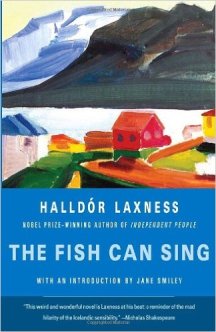
To prepare for a trip to Iceland—a country noted for, among other things, its literary culture, boasting the greatest number of books published per capita—I picked up a title by the country’s sole Nobel laureate, Halldór Laxness. There are six titles currently in print that have been translated into English (all but one by Magnus Magnusson). The Fish Can Sing (published in 1957 as Brekkukotsannáll, or “Annals of Brekkukot”) seemed one of the more accessible.
Laxness was born Halldór Guðjónsson in 1902 and took his name from Laxnes, the homestead in Mosfellsdalur where he grew up. Lax in Icelandic means ‘salmon’; nes means “cape, promontory, headland.” I am making the educated guess that Laxnes means something along the lines of “salmon cape,” i.e., a port at which salmon is caught. He did not spend his entire life in the country. By the 1920s he was in the United States, living mostly in Hollywood; he spent much of the 1930s in the Soviet Union. By the time he was awarded the Nobel Prize, in 1955, he was one of Iceland’s most famous and cosmopolitan citizens.
The narrator of the The Fish Can Sing, Álfgrímur, is an adult looking back on his orphaned childhood, living in the fishing village of Brekkukot. His grandfather is a fisherman and it is expected that Álfgrímur will follow in that tradition. Thirty years before the emergence of Björk, the most famous person from Iceland is also a world-famous singer: this time, a male opera singer named Garðar Hólm. When Garðar returns to his homeland, he strikes up a friendship with Álfgrímur, and attempts to cultivate the boy’s talent as a singer in his own right, thereby setting up a tension between the traditions of the homeland and a yearn to set out to test one’s limits.
The Fish Can Sing paints a portrait of a country aware of its smallness and coming to terms with its place in the world at large, and this is conveyed through the village’s ambivalence with which it receives Garðar. The reflective narrative feels apt to the Icelandic saga tradition. It feels as though Laxness wrote the book expecting—perhaps due to sheer dearth of countrymen—that most of the people who would read it would be those who had never lived in Iceland and would seek explanations for why and how things were done. And there is a wryness layered throughout the book, not only to allow the village to celebrate its eccentrics, but also, much like Garrison Keillor’s tales of Woebegone and its residents’ sturdy Lutheran un-apology, to position the tale as a nostalgia of the folly of national youth and parochialism:
The word “love” was never heard in our house either, except if some inebriate or a particularly stupid maidservant from the country happened to recite a verse by a modern poet; and moreover, the vocabulary of poems like these was such that if ever we heard them, cold shivers ran down our spines, and my grandfather would seat himself on his hands, sometimes out on the garden wall, and would grimace and jerk his shoulders and writhe as if he had lice and say, “Tut tut!” and “Really!” On the whole, modern poetry had the same effect on us as canvas being scratched.
Susan Sontag wrote about Halldór Laxness in one of her final essays before she died in 2005, focusing on another novel, Under the Glacier (Kristnihald undir Jökli, 1968), which she credited for its seamless spanning of multiple genres (science fiction, allegory, philosophical, visionary, fantasy) and its positioning as an epical response to Jules Verne’s Journey to the Center of the Earth.
Imagining the exceptional, which is often understood as the miraculous, the magical or the supernatural, is a perennial job of storytelling. One tradition proposes a physical place of entry — a cave or a tunnel or a hole -which leads to a freakish or enchanted kingdom with an alternative normality. In Laxness’s story, a sojourn near Snaefells does not call for the derring-do of a descent, a penetration, since, as Icelanders who inhabit the region know, the glacier itself is the center of the universe. The supernatural — the center — is present on the surface, in the costume of everyday life in a village whose errant pastor has ceased to conduct services or baptize children or bury the dead. Christianity — Iceland’s confession is Evangelical Lutheran — is the name of what is normal, historical, local. (The agricultural Viking island converted to Christianity on a single day at the Althing, the world’s oldest national parliament, in 999.) But what is happening in remote Snaefells is abnormal, cosmic, global.
The Filter of Innocence
February 25, 2016 § Leave a comment
On the occasion of the death last week of Italian author Umberto Eco, the New York Review of Books shared his 1985 essay on two institutions of American childhood, Krazy Kat and Peanuts.
They affect us because we realize that if they are monsters it is because we, the adults, have made them so. In them we find everything: Freud, mass culture, digest culture, frustrated struggle for success, craving for affection, loneliness, passive acquiescence, and neurotic protest. But all these elements do not blossom directly, as we know them, from the mouths of a group of children: they are conceived and spoken after passing through the filter of innocence.
 Neil Serven