R.I.P. Maggie Estep
February 12, 2014 § Leave a comment
Maggie Estep has apparently died, of complications from a heart attack she suffered on Sunday.
If you are like me you first learned of her through her ranty, caffeinated promotional skits on MTV. That was in my late-teen years, and it was through Estep (and, to a lesser extent, Henry Rollins) that I discovered that poetry slams and spoken word performance and coffeehouses were a thing. They just weren’t a thing in the suburbs, where I lived.
She had released two records (1994’s No More Mr. Nice Girl and 1997’s Love Is a Dog From Hell) and wrote several books, including the darkly comic novels Diary of an Emotional Idiot and Hex. Her last blog post was on Friday, her last tweet Saturday.
Run Story
February 7, 2014 § Leave a comment
I went to bed already and my stomick was gralling . I just didn’t want to hear my stomick gralling.
At Booth, read an excerpt of my friend Daniel Hales’ novel Run Story, set at a home for behaviorally challenged teenagers. A longer excerpt appears in Booth #6, print issue.
William S. Burroughs, One Hundred Years and a Day
February 6, 2014 § Leave a comment
It wasn’t until late last night that I realized yesterday was William S. Burroughs’ 100th birthday.
While it’s not exactly what he was known for, here’s one of my favorite projects of his, recorded in 1996 for a project called Songs in the Key of X: Music From and Inspired by the X-Files.
What I Read in January
February 1, 2014 § Leave a comment
The Laughter of Strangers, Michael J Seidlinger. The Laughter of Strangers is a novel about boxing, which made me think two things: how few novels these days, it seems, want to be about something, and two, how few novels there have been about boxing. Much of the literature that has stood the test of time is of the nonfiction variety: Joyce Carol Oates and Norman Mailer have written books about it, and there are classic autobiographies like Raging Bull that have made into feature films.
I say this as I’ve tried to write a story about an ex-boxer: The sport itself seems to have been outfoxed in the cultural conversation by mixed martial arts, as though regulations, punching, and gentlemen’s rules were dragging us down the whole time. But given its structure, it makes an ideal frame on which to draw out the intricacies of primal and inner conflict.
Seidlinger’s book takes us inside the mind of Willem Floures, a veteran heavyweight boxer who may be nearing the end of the line. (The title alludes to the public humiliation that comes with defeat; Morrissey’s song “Boxers” comes to mind here.) After Willem loses his top ranking, his trainer, Spencer, develops a scheme to win back public sentiment while Willem works to regain his crown. It is then that we are let in on a twist: all of Willem’s opponents are also named Willem Floures, distinguished only by their aliases (Executioner, Dynamite, etc.), suggesting they are merely figurative extensions of the protagonist’s psyche. At this point it is hard not to make comparisons here to another boxing-related book-turned-film about a man confronting a figurative extension of himself: Fight Club.
Seidlinger uses an interesting manner of first-person storytelling that interjects mental “shouts” in all capitals that seem to mimic a trainer’s yelling advice from the corner. They work for Willem’s thought processes as he operates in the ring:
X has me pinned against the ropes for a third of the round.
BLOCK
HOLD
SHORT LIFELESS HOOKS TO THE BODY
It’s what I do to survive.
They also work as a kind of demonic hallucination interfering with his ability to process:
How many times have I hit the canvas at the expense of myself but to bolster what this is, the betterment of the brand?
ARE YOU ASKING?
Lately, it’s been a lot.
So what I’m saying is—
I COULD TAKE A PUNCH
Nowadays every punch feels like glass cutting skin, earth quaking up my spine, calling me collect, telling me to stay down.
END IT NOW
I’ve got a few fights left in me, thank you.
The story takes a somewhat sinister twist around the three-quarter mark with a device that envelops, among other things, Spencer’s young daughter and her imaginary friend. Seidlinger’s use of rhythmic jablike sentences and short chapters make for fluid and engaging reading.
Check out Seidlinger’s interview at Other People With Brad Listi, Episode 246, and Jim Ruland’s dynamite review of the book in the Los Angeles Times.
The Wes Anderson Collection, Matt Zoller Seitz. A Christmas gift from my wife. Seitz, longtime film & TV critic and Editor-in-Chief at RogerEbert.com, has put together a hefty and exquisite coffee-table-sized full-color tribute to the director of charming films about eccentric characters trying to exert control their own micro-worlds.
One chapter is devoted to each film in the Anderson oeuvre thus released (not The Grand Budapest Hotel) with insightful introductory comments by Seitz and an extensive interview with Anderson. The interviewer and interviewee have been acquainted since the days when Anderson was seeking a distributor for his first feature, Bottle Rocket, and so Seitz is comfortable enough to do away with straightforward question-and-answer and instead try out his own theories and interpretations of Anderson’s films on the director himself. (On more than a few occasions, Anderson replies to Seitz’s remarks with a coy, “Hmmm.”) What makes the book eminently browsable are the collected storyboards and set photos as well as the whimsical Chris Ware-esque illustrations by Max Dalton, the intentional flatness of which pay homage to Anderson’s diorama-like stage aesthetics.
Flying at Night, Ted Kooser. A Christmas gift from a couple years back, signed by the author the year he was named Poet Laureate of the United States. This collection assembles poems from Kooser’s volumes Sure Signs and One World at a Time covering the years 1965-85.
The imagery juxtaposes the rustic with the rusted, the domestic with the exotic. As on-spot as his description is, I think I enjoy Kooser the most when he injects a wry sidelong note of persuasion:
There’s a click like a piece of chalk
tapping a blackboard, and the furnace
starts thinking: Now, just where was I?
(“Furnace”)
(Those k’s in the first two lines ignite the whole poem.)
At the end of a freight train rolling away,
a hand swinging a lantern.
The only lights left behind in the town
are a bulb burning cold in the jail,
and high in one house,
a five-battery flashlight
pulling an old woman downstairs to the toilet
among the red eyes of her cats.
(“Late Lights in Minnesota”)
I would say Kooser reminds me of Frost, with the caveat that as a novice poetry reader I only have a surface knowledge of Frost, but how does a poem called “Snow Fence” not remind you of Frost?
Voices From the Past
January 21, 2014 § Leave a comment
The New York Times reports on the re-release of the catalog of Calliope Records, a 1963 project launched by Harry and Lynne Sharon Schwartz featuring up-and-coming writers of the day reading 15-minute excerpts of their work.
The roster of writers included in the re-release are William Styron, John Updike, James Baldwin, Bernard Malamud, James Jones, Philip Roth, and Nelson Algren.
Back in 1963, public readings weren’t as common (or as YouTube-able) as they are today, and the preservation of these writers’ voices takes on additional import now that all of them (with the exception of Roth) are deceased.
The Schwartzes are still alive, and in the article they recall the challenges of getting the writers to present their work out loud, a responsibility that would seem to be automatic with the territory nowadays:
The writers who agreed tackled an unfamiliar medium in a variety of styles. “Baldwin was a natural,” Ms. Schwartz said in an interview in the couple’s apartment near Columbia University. “Malamud did not seem to have such a good time, but he did fine. Updike was self-effacing and unpretentious.”
Jones found it difficult to get through the lyrical, elegiac passage in “From Here to Eternity” in which Robert E. Lee Prewitt plays “Taps” for his dead friend, Angelo Maggio. “He was almost on the verge of tears,” Mr. Schwartz said. “It was very emotional, that reading.”
The Forgotten Father
January 10, 2014 § Leave a comment
In contrast, Dubus’s fiction scratches and tears. His stories document the sexual and violent collisions between men and women. Manipulation, jealousy, and revenge: these fictive men are often terrible. They are shadows of the male archetypes chiseled by his similarly Catholic predecessor, Ernest Hemingway.
At The Millions, Nick Ripatrazone writes about Andre Dubus, one of the first writers I studied as an undergrad English major, yet who has received little critical inquiry since his death in 1999 and who has earned no kind of legacy for himself outside of his son, novelist Andre Dubus III (House of Sand and Fog) and a couple of cinematic treatments of his novellas (In the Bedroom; We Don’t Live Here Anymore).
Ripatrazone describes the elder Dubus as a chronicler of male moral turmoil brought about by the conflicts of impulse and faith:
When [Vivian Gornick] writes that his “work describes with transparency a condition of life it seems, almost self-consciously, to resist making sense of,” she recognizes the almost rubber tendency of Dubus’s fiction. His characters are trapped in worlds timed by their immediate needs: “they drink, they smoke, they make love: without a stop.” Because “sexual love is entirely instrumental,” relationships fail again and again. Marriage falls into adultery, adultery into loneliness, and then the cycle repeats.
Two Dubus stories that stood out to me (from Dubus’ 1983 collection, The Times Are Never So Bad) were “Bless Me, Father,” in which a man is confronted by his college-freshman daughter about his extramarital affair, and, interestingly, one in which a father’s influence is imparted through his absence, “The New Boy,” about a teenager who, once emboldened by a new friend from the neighborhood, acts out by interfering with the sex lives of his divorced mother and older sisters:
They rarely said anything he wanted to know, but he liked hearing their voices and watching their faces and hands: they spoke of clothes, and he looked with tender amusement at their passionate eyes, their lips closing on cigarettes with sensuous pouts he knew they had practiced; hair fell onto their cheeks, and their hands rose to it and lightly swept it back, as if stroking a spider web. From the house behind him, his mother came with a broad tray: a bottle of white wine in an ice bucket, a bowl of fruit, four plates with crepes, a glass of milk, and ringed napkins. He believed Julie—but maybe Stephanie—had asked one Sunday: What did you do with Dad’s napkin ring?
A Fulbright Scholar in Montreal
January 5, 2014 § Leave a comment
Writer Cam Terwilliger is spending the year in Montreal, one of my favorite cities, on a Fulbright Scholarship, researching his novel on the French and Indian War. At Electric Literature , in a post from September, Terwilliger offers his impressions of the city in the first of what I hope is a regular feature.
Montréal is a city that embraces the protean, the heterogenous, the strange. The most obvious example of this is the language issue. Even something as banal as standing in line at the post office becomes an exercise in controlled chaos as the clerks respond to one person in French then, a split second later, jump into English for the next in the queue. Of course most Americans think of this duality whenever they think of Montréal, a town that makes the list of the world’s most bilingual cities (Miami, Barcelona etc.). But what many forget is that in Montréal these two languages are only the start. Wandering through downtown, you’re just as likely to hear Chinese, Arabic, Italian, or Haitian Creole. And immediately outside the city you’ll find not one but two reservations of the Mohawk people, a group reinvigorating their own language with regular classes on how to speak Kanien’kéha. Really: it’s the Tower of Babel up here.
What I Read in December
January 1, 2014 § Leave a comment
Battleborn, Claire Vaye Watkins. Watkins’ collection has already reaped a ton of awards and accolades, and after reading it, I can see why. Her writing is evocative, well-paced, and nuanced. But I wonder if the regular focus of these articles of praise—the landscape and folklore of the American west, the past-generation dreamers and modern derelicts—is too short and simple, and unfair. It’s certainly a clear writer’s lesson about paying attention to your surroundings and writing what you know, but I also think focusing on that part alone ignores Watkins’ real strength, which is the layeredness of her characters.
My first taste of Watkins’ fiction was “Graceland,” in Hobart 12, and I was lukewarm about it. Something about the ambivalence and inaction of the protagonist bugged me—she seemed to be able to exercise greater control than she was allowing herself. Compared to “Graceland,” the other stories in Battleborn show more spirited determination in the face of lawless environments, the impulse to freedom and stretching human limits.
My three favorite stories were “Rondine al Nido,” “Wish You Were Here,” and “Man-O-War.” They are the most acute in their head-on effect of tension and placing their protagonists in positions to make uncomfortable decisions. Watkins favors what might be called, for lack of a better term, the third-person anthropological point of view—perhaps fitting for one observing desert creatures in their native habitat—as though the characters are specimens at which we are spying from bushes with binoculars, with a tour guide’s cache of historical information kept at hand:
This happens every summer. A tourist hikes into the desert outside Las Vegas without enough water and gets lost. Most of them die. This summer it’s an Italian, a student, twenty years old, according to the Nye Country Register. Manny, the manager of the Cherry Patch Ranch, reads the story to Darla, his best girl, while they tan beside the pool in the long late sun. (“The Past Perfect, the Present Continuous, the Perfect Past”)
It begins with a man and a woman. They are young, but not as young as they would like. They fall in love. They marry. They have a child. They buy an adobe house in a small town where all the houses are adobe. The McDonald’s is adobe. The young man is named Carter. Carter often points to the adobe McDonald’s as proof of what a good decision they made in moving away from the city. (“Wish You Were Here.”)
Lena sucks a little saliva from her over-large teeth and asks if it is okay if they turn the radio off. She has never driven in the city. Our girl says, cool, because the radio is suddenly nothing compared to the billboards and limos and rented convertibles and speakers embedded in the sidewalks emitting their own music into the air, and because she’ll say anything to soothe Lena, to keep her driving.
Our girl directs Lena to park on the top floor of the parking garage at the New York New York. It is June 2001. This is the Las Vegas that has recently given up on becoming what they were calling family-friendly vacation destination. The waterslides and roller coasters and ice-skating rinks that were once part of the megaresorts have been torn down to make room for additional hotel towers, floor space, and parking garages like this one. (“Rondine al Nido”)
The appellations used (“an Italian,” “the young man,” “our girl”) have the effect of case-study labels, which would seem to discourage a reader’s intimacy with a character, but here they have a way of enhancing narrative trust. I can’t see the technique having much mileage for a writer, but it works here.
I Was a Fat Drunk Catholic School Insomniac, Jamie Iredell. I met the author at a reading in Northampton in November, and knew of him before that through his capacity as Fiction Editor at Atticus Review. This collection of nineteen memoir-essays confronts the frightening realities and questionable decisions of Iredell’s formative years. The tone is rueful candor, an army of colorful anecdotes invoking vice, questionable health choices, and their consequences: obesity, alcohol, hard drug use, racism, abusive relationships, smoking, sex. We learn about old girlfriends, teachers, schoolmates, drinking buddies, and influences good and bad, and we can presume all names have been changed:
Our fights got so bad that Karen grabbed my suits out of the closet and, bare-handed, ripped them to shreds. All of my guitars splintered, smashed against walls, smashed against the concrete of the sidewalk, tossed into Ralston Street’s sad traffic. I took a butcher knife to Karen’s gowns, one an Oleg Cassini, beaded and beautiful. And Karen had looked beautiful in it too, that night before Christmas when we danced to jazz in that restaurant at Lake Tahoe.
The essays are ordered in an enlightening way, almost but not exactly chronological, leading us to precipice and back again on more than one occasion. The reckoning of these tales, I think, is not meant to be boastful—there is nary a mischievous wink or back-slap—but to present stark contrast to Iredell’s life now, happily married to a successful woman with a young daughter. Iredell seems to realize with sobering acuity that any misstep or stroke of bad luck along the way could have placed him in much different circumstances. The book’s avoidance of irony gives it a much different feel from anything else I’ve read in the last several years.
The Autobiography of Mark Van Doren. The Van Doren family fascinates me. There’s the involvement of son Charles in the quiz show scandals of the fifties, for one thing, but even more so, the Van Dorens thrived at a time when writers and intellectuals carried a legitimate air of celebrity, a dynamic that feels so foreign and impossible now, buried under the mudslide of popular culture.
Mark Van Doren was 64 years old when this book was published, more or less fully retired from Columbia, his family name not yet tarnished by the Congressional investigation that would implicate Charles. (There is a brief, proud mention of Charlie’s appearance as a contestant on Twenty-One on page 334.) Van Doren père’s life was not one of stress. He grows up as the fourth of five brothers under supportive parents, attends school, and serves in the military during World War I but does not see combat. He matriculates at the University of Illinois and later Columbia. He has a writing mentor in older brother Carl. He begins publishing poems, much of it formalist verse that plays on the rhythm and image of nature, even many that rhyme (alert Nicholson Baker!), none of it unchallenging but rather dry and dowdy to this reader’s ear. He earns a teaching position at Columbia and becomes a scholar of Dryden and Shakespeare. He meets his wife Dorothy, who herself goes on to publish several novels. They do a lot of traveling. Sons Charles and John are born. The family splits their time between New York and the family homestead in Cornwall, Connecticut, where Mark and Dorothy move full-time after he retires.
The poet shares over 50 of his poems (including excerpts) as a way of measuring out the chapters of his life. In the gaps, however, there is a surprising absence of contact with his American poet peers. There are no rivalries, friendly or otherwise. Van Doren let the classics be his influence. Perhaps that is why there is almost no sharing of letters (though a separate volume exists that I have yet to pick up); no mention of contemporaries Sandburg, Auden, Lowell, or Marianne Moore; Frost (twenty years his senior) gets mentioned only once. It was through his teaching at Columbia that Van Doren cultivated many of his friendships, mostly former students: Thomas Merton, James Thurber, Lionel Trilling—none known primarily for their poetry—along with classmate Joe Krutch and his colleague at The Nation, Scott Buchanan. If a halo of elitism even ringed itself around Van Doren, it would be easy to see why, given how little of the contemporary poetry world he deemed worthy of engagement. He was a poet, but poets, or at least the poet lifestyle, bored him compared to the life of the mind.
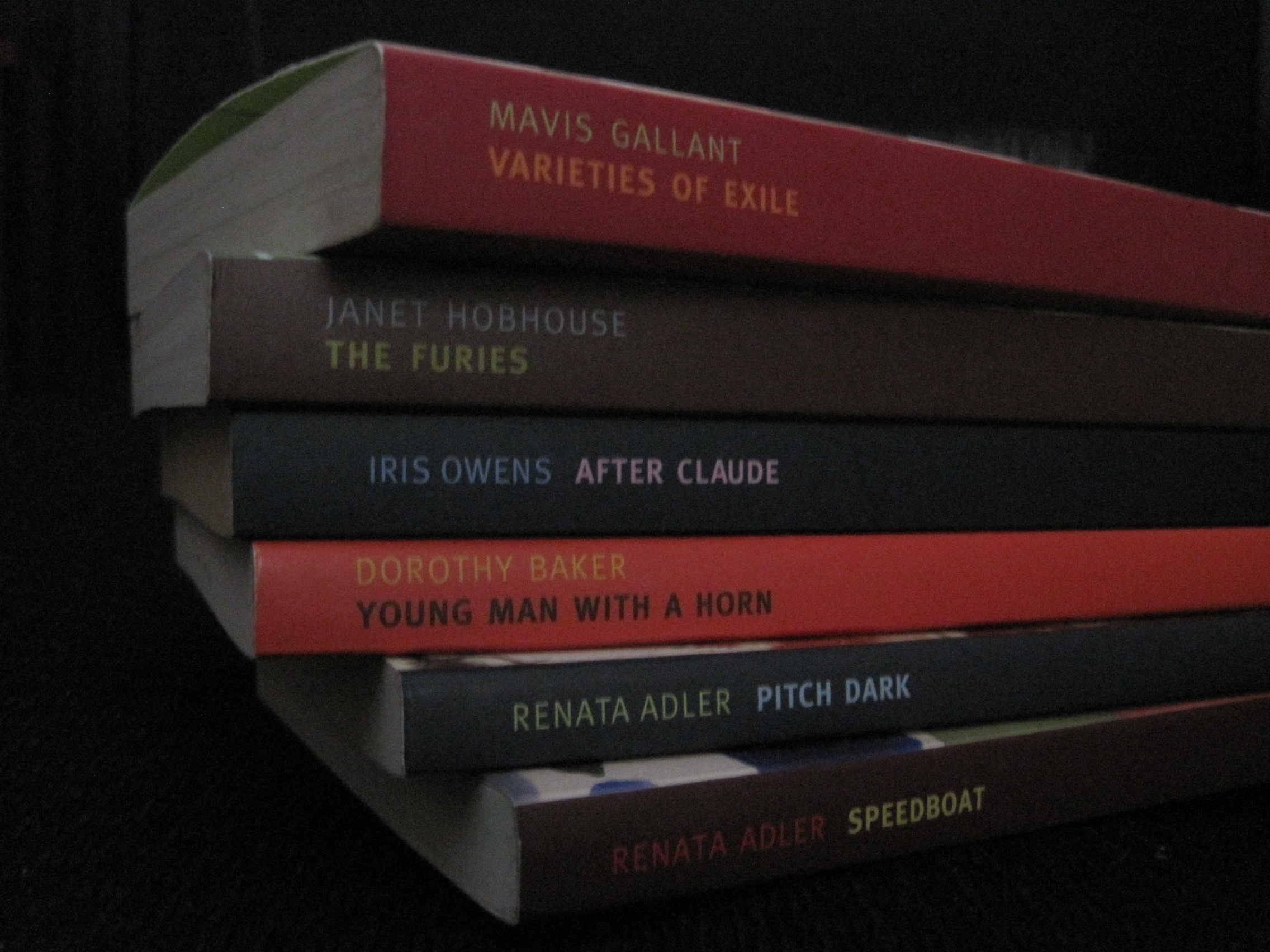
So ends 2013, and by no accident, short story collections dominated the year: of the thirty-five books I read, twelve were either first-run collections or anthologies of fiction, or in a couple of cases, the emerging genre of novel-in-stories. It was a good year for short stories, and short stories are what I write. I also made an effort to read more books by women, though they ended up comprising only 40 percent of the total and only a handful were by contemporary writers. I was glad to discover Renata Adler, Dorothy Baker, Iris Owens, Mavis Gallant, and Sana Krasikov; I look forward to more by Pauls Toutonghi, Claire Vaye Watkins, Karl Taro Greenfield, and Megan Mayhew Bergman; and, partly thanks to AWP, a greater number of books were from writers I have come to know personally (Mike Young, Jamie Iredell, Andrew Keating), adding an extra layer of closeness to the reading experience.
It’s never easy to choose a favorite, but if I had to pick a favorite book for this year, it might be Mavis Gallant’s Varieties of Exile. The stories in Varieties, though selected in tribute fashion specifically for this edition by Russell Banks, were richly textured, with a nuanced wit barely grazing the edge of satire, and made me hungry to read more of Gallant’s lyrical and metropolitan prose. Second and third place go to two collections noted for their evocation of setting, Karl Taro Greenfeld’s Triburbia and Claire Vaye Watkins’ Battleborn, with honorable mentions to Mike Young’s Look! Look! Feathers and Renata Adler’s Speedboat.
My eyes and ears were opened this year to a lot of breathtaking talent, and I can’t wait to see what the next year brings.
The Writer as Soldier
December 28, 2013 § Leave a comment
What to know about pain is how little we do to deserve it, how simple it is to give, how hard to lose. I’m a plumber. I dig for what’s wrong. I should know. (“Widow Water”)
So glad am I to see the late Frederick Busch’s short fiction collected into one volume for the first time, and I am just as glad that Katie Arnold-Ratliff’s review in this week’s New York Times Book Review turns the back-handed praise Busch has received as a master of minimalism and acolyte of Carver on its side:
Consider, once more, the writer as a soldier. Because Busch’s work dealt in covert ops, its unshowy aptitude saddled him with yet another label: “writer’s writer.” These stories are taught in M.F.A. programs because Busch’s fellow professionals appreciate prose that manages to be both moving and restrained, and they understand the risk involved in asking a reader to wring meaning from scant suggestion. Busch’s narratives provide the raw material, leaving the conclusions to us. Which makes you wonder if “minimalist” is just code for an author who trusts his audience more than most, just as “writer’s writer” simply means that not enough people have read him.
I fell in love with Busch’s writing when I read Girls, where he managed to turn a dopey old dog into a lovable supporting character playing off a depressed campus security cop in a strained marriage. Read the stories “Extra Extra Large,” “Berceuse” and the aforementioned “Widow Water.” Then go out and read Girls, Sometimes I Live in the Country, and Too Late American Boyhood Blues.
Zelda Sayre, Writer
December 27, 2013 § Leave a comment
Cornelia gazed out of the window and sighed, not because she was particularly unhappy, but because she had mortified her parents and disappointed her friends. Her two sisters, younger than she, were married and established for life long ago; yet here she remained at thirty years of age, like a belated apple or a faded bachelor’s button, either forgotten or not deemed worth the picking. Her father did not scold. He kindly suggested that perhaps Neilie would do more for herself if the rest of the family would leave her alone. Her brother said, “Cornie’s a fine girl and good looking enough, but she’s got no magnetism. A fellow might as well try to tackle an iceberg.”
The New Yorker turns up a story written by Zelda Sayre—then a Montgomery, Alabama teenager, and soon to become wife to F. Scott Fitzgerald—for her high school literary journal. “The Iceberg” was written circa 1917 and concerns an unmarried Southern woman who, without her family’s knowledge, goes to business school and secures a job taking dictation for a multimillionaire, whom she later marries.
For a slight story (just under 1,100 words) by a writer yet to reach adulthood, it is pointed in its messages about wealth, ambition, and status, and its themes, appropriately, speak of a spirited young woman looking to free herself from the hot, mannered South.
Zelda did a good deal of her own writing during the early part of her marriage to Scott, before succumbing to breakdown (and the apparently stifling criticism, plagiarism, and likely envy on the part of her husband), and even published a novel, Save Me the Waltz, still in print as part of The Collected Writings of Zelda Fitzgerald. Marion Meade’s fascinating book, Bobbed Hair and Bathtub Gin: Writers Running Wild in the Twenties, gives Zelda a fair contextual evaluation alongside peers Edna Ferber, Dorothy Parker, and Edna St. Vincent Millay.
 Neil Serven