Suddenly New Books
December 26, 2013 § Leave a comment
Film was a running theme throughout Christmas this year, in terms of gift exchange. I got my wife the Alfred Hitchcock Masterpiece Collection on Blu-Ray, and she got me Matt Zoller Seitz’s exquisite The Wes Anderson Collection, a hefty full-color ode to the director’s entire oeuvre, with over 300 pages of commentary, interviews, and illustrations, along with scene breakdowns, allusions (there are tons), and influences, and a warm and laudatory introduction by Michael Chabon. This one will take me a while to pore through, and then I’ll want to watch all of the films again.
In addition to a couple of Barnes & Noble gift cards that will need to be put to use, more loot came thanks to Santa’s elves Google-stalking my Amazon Wish List:
The Laughter of Strangers, Michael J Seidlinger
The Isle of Youth, Laura van den Berg
The Half-Known World, Robert Boswell
Thieves I’ve Known, Tom Kealey
Due to hosting obligations I felt somewhat on edge during much of the run-up to Christmas, and with many a cold night sure to lie ahead, I look forward to cracking into all of these.
Ayris Contributor’s Copy
December 19, 2013 § Leave a comment


In the mail yesterday: Issue 03 of Ayris, the magazine of literature and art published by the New Hampshire Institute of Art. My story “In the Whore’s Style” is featured among an array of work by other talented writers. Nicely produced, I love the font choice, and the art opposite my story’s first page aligns well with the story’s themes.
Also in the package: a bonus frame-worthy selection of larger-format art prints (pre-cropped versions of the images that appear in the magazine).
Many thanks to past and present editors, Jenn Monroe and Ryan Flaherty.
Books That Shaped Work in America
December 13, 2013 § Leave a comment
Via Atticus Books, the U.S. Department of Labor, of all places, in conjunction with the Center for the Book in the Library of Congress, is putting together a working list of Books That Shaped Work in America.
It is fascinating to toggle through the titles compiled so far, which range in theme from the struggle to find one’s footing in industrial America (The Jungle, On the Waterfront; How the Other Half Lives) to portrayals of modern office hell (The Devil Wears Prada) to indictments of race and class warfare (To Kill a Mockingbird, The Help) to the science of labor and getting ahead (Studs Terkel’s Working, How to Win Friends and Influence People). Children’s titles are not forgotten, from Mo Willems to the MacGuffie Reader, nor are plays (Death of a Salesman, August Wilson’s Pittsburgh Cycle).
A few are perhaps questionable: Peggy Noonan’s tribute to Ronald Reagan seems like a waggish commentary on the subject, and I have no idea how The Guinness Book of World Records fits into the conversation. Fortunately, it is meant to be a working list, and there’s a form for people to suggest their own additions.
I haven’t submitted any, but here are a few that come to mind:
- Post Office (or Factotum), Charles Bukowski: protrayals of drudgery of the working stiff in which the individual is a meaningless cog with no motivation for responsibility
- Bad Behavior, Mary Gaitskill: a collection that includes the short story on which the film Secretary was based, a stark take on subordination in both work and sex
- The Rise of Silas Lapham, William Dean Howells: one of the first looks at entrepreneurship and the efforts of new wealth to fit in 19th c. America
- The Theory of the Leisure Class, Thorstein Veblen
- Ragged Dick, Horatio Alger (although Mark the Match-Boy is already represented)
- John Updike’s Rabbit series: A biased choice, I realize, but a portrayal of a man moving up in the ranks primarily due primarily to marrying the boss’s daughter
- Mike Mulligan and His Steam Shovel, Virginia Lee Burton: a story of obsolescence and the fight to stand up for one’s work in the machine age
- Shop Class as Soulcraft, Matthew Crawford: an argument for reinvestment in craftmanship skills in an age that strives to insulate us from how things work
- Microserfs, Douglas Coupland: one of the first office-as-cubicle-hell novels (a precursor to Joshua Ferris’s Then We Came to the End), perhaps not eligible since Coupland is Canadian.
Medium Cool
November 8, 2013 § Leave a comment
Albert Camus was perhaps admired as much for his façade of masculinity as he was his writing. It was not just for his handling of the subjects of absurdity, suicide, or politics that he inadvertently made it a normal thing for philosophers to be featured on dorm room posters. (Nietzsche joined him, retroactively.) The resemblance to James Dean in both vulnerable pose and tragic death via automobile seems an undue pressure on his life’s narrative.
In her 1963 essay “The Ideal Husband,” Susan Sontag found an explanation for the allure: Camus was able to “assume the responsibilities of sanity” while having to “traffic in the madmen’s themes” of suicide, affectlessness, guilt, and paranoia worn out by his contemporaries:
But he does so with such an air of reasonableness, mesure, effortlessness, gracious impersonality, as to place him apart from the others. Starting from the premises of a popular nihilism, he moves the reader—solely by the power of his own tranquil voice and tone—to humanist and humanitarian conclusions in no way entailed by his premises. This illogical leaping of the abyss to nihilism is the gift for which readers are grateful to Camus. This is why he evoked feelings or real affection on the part of his readers. Kafka arouses pity and terror, Joyce admiration, Proust and Gide respect, but no modern writer that I can think of, except Camus, has aroused love.
Camus channeled affection in his personal relationships as much as he evoked it in his writing, as demonstrated by his tender 1957 letter to his former teacher upon his being awarded the Nobel Prize for Literature.
(Hat tip: Alex Pruteanu.)
A Rapping at the Door
October 31, 2013 § Leave a comment
I had scarcely laid the first tier of my masonry when I discovered that the intoxication of Fortunato had in a great measure worn off. The earliest indication I had of this was a low moaning cry from the depth of the recess. It was not the cry of a drunken man. There was then a long and obstinate silence. I laid the second tier, and the third, and the fourth; and then I heard the furious vibrations of the chain. The noise lasted for several minutes, during which, that I might hearken to it with the more satisfaction, I ceased my labours and sat down upon the bones. When at last the clanking subsided, I resumed the trowel, and finished without interruption the fifth, the sixth, and the seventh tier. The wall was now nearly upon a level with my breast. I again paused, and holding the flambeaux over the mason-work, threw a few feeble rays upon the figure within.
Edgar Allan Poe, “The Cask of Amontillado” (1846)
When I was in tenth grade, we were assigned Poe for Halloween. Mrs. Baletsa always assigned us more reading than I could manage to fit in with my other homework, but they were good books: To Kill a Mockingbird; Steinbeck’s The Pearl; Sir Gawain and the Green Knight.
At the time, I wasn’t an avid reader. I read for the assignment, for the answers to the questions. This was where I always had difficulty; in retrospect, I think I was so interested in language that the oddness of words often distracted me from the story I was being told.
We had elderly neighbors who were still rather sprightly (they had a yellow Lab they walked themselves) living next door. On Halloween that year, their granddaughter went into labor. Since they wanted to be at the hospital to meet their new great-grandchild, they asked me to house-sit for them and hand out their candy.
I had nothing else to do but my homework.
So it was in an unfamiliar house, on Halloween night, interrupted by neighborhood kids every three minutes, that I attempted to read “The Murders in the Rue Morgue,” “The Cask of Amontillado,” and “The Tell-Tale Heart” for the first time.
It was not an old or drafty house, no strange hideaways or player pianos, no unannounced lightning storm, but I think I left the TV off (they didn’t have cable), and against Poe’s description of voices buried deep within walls, hearts beneath floorboards, bodies shoved up into chimneys, the irregular settling creak managed to make itself known.
Besieged Consciousness
October 25, 2013 § Leave a comment
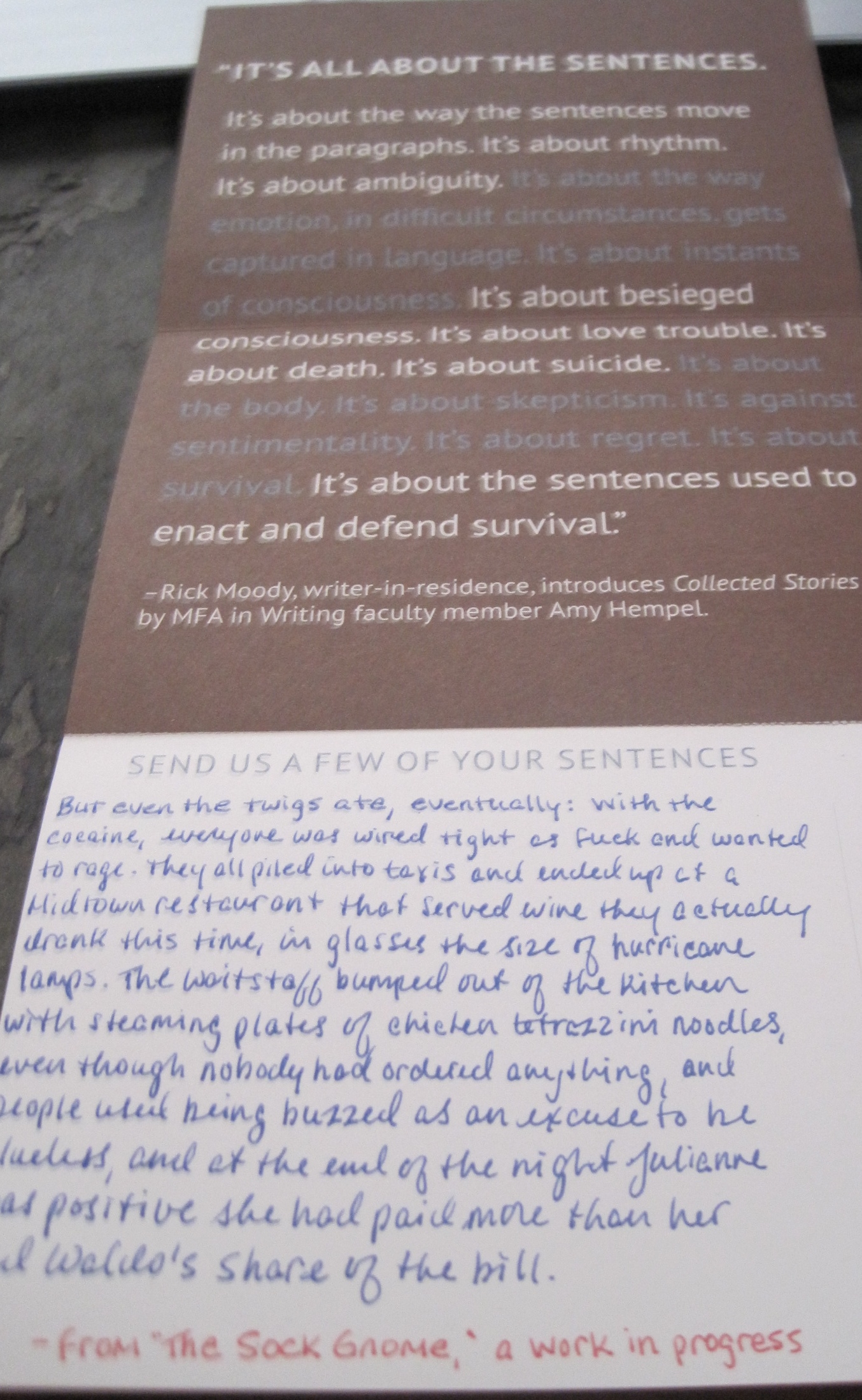
Bennington’s promotional mailer for its low-residency MFA program quotes Rick Moody’s introduction to Amy Hempel’s Collected Stories, on the importance of the sentence as a narrative unit. (“It’s about besieged consciousness. It’s about love trouble.”) The reply card asks you to send a few sentences of your own. I don’t know what they plan to do with them, but here are mine, from a work in progress.
If anything, it reminded me that the exercise of writing down (or even rewriting) my words by hand is one I should undertake more often.
Running and Keeping Up
October 12, 2013 § Leave a comment
Nicholson Baker, so modest and down-to-earth as usual, interviewed at Full Stop:
There’s something useful about being humbled by the difficulty of what you’re doing, and by the sense that you’re trying to figure it out. It’s maybe better not to know what you’re doing, or at least that’s what I tell myself, because most of the time I really don’t feel that I’ve figured it out. When I was starting out, I’d check out books from the library on how to write, and they were useful to me in that I rebelled against some of the rules.
…
Books and movies are so skewed towards action. You get fired, and that’s the inciting incident, or your wife leaves you, your husband leaves you. You come into some money. You are suddenly mistaken for a CIA operative. Something happens that is completely out of the blue, and you’re expected to have wise, thoughtful reactions to it. But actually, you’ve just become a person who is sort of running and keeping up. I don’t believe that whole thing of: Get the character in a tree and then throw stones at him. I don’t buy it. It’s a very bad piece of advice.
I met Baker when he was touring for The Anthologist. The same man who unashamedly gave us Vox and House of Holes turns flush when he speaks about his own accomplishments and influence as a writer. His novels all tunnel down into the buried circuitry of logic and memory, though lately he has turned away from explaining the miraculousness of manmade objects (matches, drinking straws, shoelaces) and more toward humans themselves and their painful limitations. The Anthologist was an instance in which the flaws of the character gave substance to the narrative, and I’m glad that Baker is bringing back Paul Chowder for Traveling Sprinkler.
A Victory for the Short Story
October 11, 2013 § Leave a comment
I would like to think that the awarding of the Nobel Prize in Literature to Alice Munro this morning is a further testament to the resurgence of the short story.
Munro’s central Canadian settings give her a vastness of frame on which to maneuver her characters, rejecting the tired idea that short stories can only surround the episodic and incidental. At The New Yorker’s Page-Turner blog, Sasha Weiss says, “Munro is one of those writers who, no matter how popular her books are, is our writer. This may have to do with the frank intimacy of her tone, which is stripped of ornament and fuss, yet also, in its plainness, contains huge amounts of terrible, sublime, and contradictory feeling.”
Among the stories featured in the New Yorker archive is “Passion,” from 2004:
Most of the waitresses left after Labor Day, to go back to school or college. But the hotel was going to stay open till October, for Thanksgiving, with a reduced staff—Grace among them. There was talk, this year, of opening again in early December for a winter season, or at least a Christmas season, but nobody on the kitchen or dining-room staff seemed to know if this would really happen. Grace wrote to her aunt and uncle as if the Christmas season were a certainty and they should not expect her back anytime soon.
Why did she do this? It was not as if she had other plans. Maury was in his final year at college. She had even promised to take him home at Christmas to meet her family. And he had said that Christmas would be a good time to make their engagement formal. He was saving up his summer wages to buy her a diamond ring.
She, too, had been saving her wages, so that she would be able to take the bus to Kingston, to visit him during his school term.
She spoke of this, promised it, so easily. But did she believe, or even wish, that it would happen?
“Maury is a sterling character,” Mrs. Travers said. “Well, you can see that for yourself. He will be a dear, uncomplicated man, like his father. Not like his brother. Neil is very bright. I don’t mean that Maury isn’t—you certainly don’t get to be an engineer without a brain or two in your head—but Neil is . . . He’s deep.” She laughed at herself. “Deep unfathomable caves of ocean bear— What am I talking about? For a long time, Neil and I didn’t have anybody but each other. So I think he’s special. I don’t mean he can’t be fun. But sometimes people who are the most fun can be melancholy, can’t they? You wonder about them. But what’s the use of worrying about your grown-up children? With Neil I worry a lot, with Maury only a tiny little bit. And Gretchen I don’t worry about at all. Because women have always got something, haven’t they, to keep them going?”
And at The Millions, Ben Dolnick offers “A Beginner’s Guide to Alice Munro,” from July 2012.
Hungry for a Slice
October 9, 2013 § Leave a comment
 The post office may still be swiftly completing its appointed rounds even in the wake of the government shutdown, but that apparently didn’t preclude it from helping itself to a little snack this week, namely my copy of Slice Magazine.
Report From the Brattleboro Literary Festival
October 6, 2013 § Leave a comment
Brattleboro, Vermont is a corkscrew of a city, with odd hillside turns and alleyways, that happens to be the city where my wife and I ducked away to get married last year. Today I returned to take in part of the Brattleboro Literary Festival, a four-day celebration that hosts readings, panels, and other events in a handful of venues around town.
First I heard readings from poets Amy Dryansky (Grass Whistle) and Joan Larkin (Legs Tipped With Small Claws) at the Hooker-Dunham Theater & Gallery. Then I moved to the Centre Congregational Church (stuffy, with pews not very conducive to tall people) to hear David Gilbert (&Sons) and Kristopher Jansma (The Unchangeable Spots of Leopards) read from their latest novels, both of which are about authors who find themselves in sticky predicaments.
In between events I popped into Brattleboro Books, where I picked up John Gardner’s On Becoming a Novelist for $7.00. I killed time reading it in a café until Flashing Lights—A Flash Fiction event hosted at Hooker-Dunham by Jacob White, editor of Green Mountain Review. Five writers shared their work: Pam Houston (Sight Hound), Bonnie ZoBell (The Whack-Job Girls), David Abrams (Fobbit), Christine Schutt (Prosperous Friends), and Megan Mayhew Bergman (Birds of a Lesser Paradise). Of these five, ZoBell is the only one I associate with flash fiction–Schutt even admitted to “misunderstanding the assignment,” and read a standalone-worthy chapter from her novel–but White did a solid job of pointing out the effective flashlike elements of each selection during his introductions.
After the event, I got to chat briefly with White, ZoBell, and Bergman, as well as Festival Committee member Jodi Paloni, whom I forgot to congratulate for winning the 2013 Short Story America Prize for Short Fiction (for her story “Deep End”).
 Neil Serven