What I Read in January
February 2, 2013 § Leave a comment
Triburbia, Karl Taro Greenfeld. A splendid, fun read to start off the year, about interconnected families living in gentrified Tribeca. The story “Fun Won,” which I read in Harper’s and wrote about here, makes up most of one chapter, and is the reason I wanted to dive right into this one after I received it as a Christmas gift.
A group of fathers meets up for breakfast each morning after dropping their kids off at the same school. Each chapter is a self-contained story centered around a different character (not just the fathers), and the web of relationships becomes more apparent after each one. My sloppy cast of characters:
Mark, sound engineer, married to Brooke, father to Cooper & Penny, affair with babysitter Sadie;
Brooke, married to Mark, mother to Cooper & Penny, at one time worked with Marni;
Brick, sculptor, married to Ava, affair with Beatrice;
Beatrice, married to Giancarlo, affair with Brick
Sumner, film producer
Giancarlo, restauranteur, married to Beatrice, fucks Shannon on his yacht;
Marni, magazine editor, married to Rick, at one time worked with Brooke;
Rick, memorist, guilty of Frey-like fabrications, married to Marni;
Barnaby, gimp photographer, works with Cooper, father of Miro, brother to Shannon;
Levi-Levy, playwright, married to Charlaine;
Cooper, daughter to Mark & Brooke, child model, crush on Miro;
Miro, son of Barnaby, object of affection of Cooper;
Unnamed avant-garde puppeteer, married to Caroline, father of Sadie;
Shannon, sister to Barnaby, fucks Giancarlo on his yacht;
Rankin, mobster, owns & manages property, married to Sydney, father of Amber & Jeremy;
Sadie, daughter of the puppeteer, babysitter to Cooper & Penny;
Amber, daughter of Rankin, bullied in school by Cooper.
And I know I am missing a few. The book is constructed in the same novel-in-stories style that defined Tom Rachman’s The Imperfectionists and Jennifer Egan’s A Visit From the Goon Squad (of which the electric prose of “Fun Won” reminded me); the picture gets sketched in from different camera angles, one chapter at a time, to portray a three-dimensional urban neighborhood once friendly to families and creative professionals with sub-moderate to above-average incomes who are soon to be priced out by wealthier types who merely want to pay for the bohemian allure.
My favorite chapter, I think, was the one that centered on child model Cooper; although written in the third person (Greenfeld switches among tenses and points of view depending on the chapter), it weaves the class insensitivity of a child made too often the center of attention, and prompted too frequently to behave as an adult (and hence, rush to have a boyfriend), with genuine prepubescent yearning impulse and confusion:
Ah, an older boy. His appearance in the loft, blond-haired, sleepy-eyed, in button-up blue shirt, slim-cut selvage denim, and Converse sneakers, seemed to Cooper a manifestation. Had he been here all along?
“Miro—Cooper goes to school with you,” Miro was told by the photographer.
Cooper looked at the photographer, with his crazy gyrating limp, his somewhat effeminate manner; he didn’t seem to her like other dads, but she guessed he was Miro’s dad.
Miro nodded, uninterested.
Cooper gazed at him hoping he would recognize her: surely even the fifth-grade boys must have noticed her. Miro, though, merely flopped on another of the many sofas in the room and started doing something on his phone. But when they were finished with her test shots, Miro asked her if she wanted to draw, and Cooper loved drawing. She looked at Sadie, who looked at the photographer, who shrugged and said sure, though he wondered if it might be weird for Cooper to see the other girls coming in for their go-sees. Sadie assured him that Cooper wasn’t the type to be bothered by that.
Other Kinds, Dylan Nice. From SF/LD, the book imprint of Hobart, comes this exquisite collection of stories the size of a prayer booklet, which makes it the perfect book for carrying in your pocket and getting caught reading on public transportation. The nine stories are grouped in threes and all have sensitive, keenly observant male protagonists whose active social spheres contrast with their inner aloneness. The plots are minimalist, almost mumblecore-like, but the narratives are not.
Nice keeps his sentences simple and short, then works up to the occasional outpour of folded-over layers with two or three ands. The effect is one of poignant ruefulness:
A year passed. Friends moved. His rent went up and the university would still not surrender its degree. He withdrew from school owing to debt and took up with a nice girl who enjoyed her work. They lived together in a well-insulated apartment for young professionals. (“A Short Essay About the War”)
That night there was a girl I was in love with. I wore a nice sweater and smoked in the car driving to her house. I had made a CD and labeled it Tonight and played it, thinking there were chord progressions that sounded like whatever it was I was pursuing. (“Thin Enough to Break”)
John Updike Review, 2011. When the John Updike Society launched in 2009, I immediately signed up and sent the required dues, even though I didn’t have much to contribute on an intellectual level other than my deep fondness for Updike’s books, at that. I was simply happy it existed. After the folding of The Centaurian, the helpful site run by James Yerkes, in 2009, there hadn’t been a sole reliable place on the Internet to turn to for information on my favorite author. For my contribution I received a lapel pin (with a drawing of Updike’s face) and a subscription to the John Updike Review, an annual peer-reviewed critical journal edited by James Schiff and published by the University of Cincinnati.
The first issue of JUR does a good job of covering varying aspects of Updike’s work—not necessarily an easy task given the man’s range of interests and sheer voluminous output. (A read through his collections Hugging the Shore or Due Considerations would lead one to think that Updike never turned down an assignment no matter how far afield.) The selections are also very readable, not weighted down by academic jargon or theory. The authors’ joy in reading Updike comes through with the questions they ask to understand his work better.
Since this is the first issue, there are a lot of Why-are-we-here moments to get out of the way, including “John Updike’s Sense of Wonder,” Ann Beattie’s keynote address delivered at the First Biennial John Updike Society Conference (in Reading, PA), as well as J. D. McClatchy’s tribute for the American Academy of Arts and Letters and a eulogy from Updike’s son David.
I enjoyed “Updike and Kerouac: Rabbit on the Road,” by Donald J. Grenier, which reminds us that Rabbit, Run was conceived by Updike in part as a response to On the Road (published the same year that Eisenhower’s Interstate Highway System was put into effect), asking the question of what happens to the people left behind when a young man puts wandering urges before his responsibilities. I also enjoyed “’The Bright Island of Make-Believe’: Updike’s Misgivings About the Movies,” by Peter J. Bailey, an argument that sources Updike’s fiction and criticism with equal weight to portray a writer’s suspicions of the Hollywood machine.
One of my someday projects is to attempt a wholesale annotation of the Rabbit novels, starting with Updike’s use of alliteration in the first line of Rabbit, Run that is meant to echo the bouncing of a basketball, as well as Janice’s sweet tooth (she puts sugar in her old-fashioneds) in contrast to her husband’s taste for salt.
The Way the World Works, Nicholson Baker. Baker’s second essay collection lacks the unity and serendipity of his first, The Size of Thoughts, but is still an enjoyable read. In fact, Baker’s essays are on the whole probably better than his fiction; for one thing, they do away with the mere shadow of a thoughtful protagonist on which to hook narrative, and rely instead on an already-established, complete, and fully reliable one: the author himself.
The book is divided into sections: Life, Reading, Libraries & Newspapers, Technology, and War, and a final essay, entitled “Mowing,” included at the end “because it didn’t seem quite right to end the book with an impressionistic article on my unsuccessful efforts to master a series of violent video games.” In Technology, one sees the sentiments of this man who once wrote a paean to the card catalog, and who spent his life savings to rescue an archive of newspapers, begin to evolve. He is unhappy with the functions of the Amazon Kindle 2, with its “greenish, sickly gray” screen and inability to mark text, but he thinks Wikipedia is “just an incredible thing” and mourns the death of Steve Jobs, “our techno-impresario and digital dream granter.” (I gotta ask: so what does he think of the Kindle Fire? Has he tried to use an e-reader in the presence of any direct light?)
The ‘War’ section includes three essays that feel like they were written in order to justify, or at least accompany, Human Smoke, Baker’s line-by-line retelling of the facts leading up the U.S.’s decision to enter World War II. A short essay near the front of the book, “Why I Like the Telephone,” may have been my favorite, not least for what it achieves in showing off Baker’s ability to bring forth the wonderment in how we visually and aurally receive things, like dial tones.
Big Fiction # 3, Fall/Winter 2012. As its name implies, this journal out of Seattle focuses on longer works of fiction, which as a submitting writer I have found to be a thin market, in that window of length beyond the threshold of Internet readability, but hard to get published in print, where space is at a premium and journals are understandably reluctant to devote so much of an issue to a single author.
Even better, the volume is published in exquisite hand-designed letterpress. Three stories make up the issue. A lot of attention will probably be paid to the longest of the three, Mylene Dressler’s novella “The Wedding of Anna F.,” as it concerns an elderly character who believes herself to have “recovered” the life of Anne Frank. Elderly characters don’t get a lot of love in fiction for a number of reasons, not least of which that they are hard to write about reliably, since the authors writing about them often haven’t reached the age of the character. How do you convincingly place yourself if the shoes of someone who’s at an age you haven’t lived at yet?
And the ones we do see get played off much younger, dynamic counterparts: I think of the Lee Krasner-modeled Hope Chafetz in Updike’s Seek My Face and Leonard Schiller in Brian Morton’s Starting Out in the Evening, both the subjects of ambitious students eager to pin down the elders’ lives and work for some boxed-off, line-item accomplishment. The common practice is to portray older folks as limited, doddering, reminiscent, and not so eager to advance the conversation. Outside of a few small moments, Dressler mostly avoids this technique, and the use of flashbacks help to break up the long conversation.
Dressler’s story should not overshadow the two smaller ones leading up to it: Eric Neuenfeldt’s “Telegraph Pine” and Molly Bonovsky Anderson’s “The Bricklayer’s Club,” both with convincing male protagonists looking to rebuild their self-worth after falling into despair.
Max Sebald on Writing
January 25, 2013 § Leave a comment
At Richard Skinner’s blog, two former students of W. G. Sebald share some of the lessons learned from the late novelist, distilled into categories (Approach, Narration, Description, Detail, Reading and Intertextuality, Style, Revision). Some of my favorites:
Approach: Fiction should have a ghostlike presence in it somewhere, something omniscient. It makes it a different reality.
Narration: The present tense lends itself to comedy. The past is foregone and naturally melancholic.
Detail: It’s good to have undeclared, unrecognized pathologies and mental illnesses in your stories. The countryside is full of undeclared pathologies. Unlike in the urban setting, there, mental affliction goes unrecognized.and
Dialect makes normal words seem other, odd and jagged. For example, ‘Jeziz’ for Jesus.
Reading: Get off the main thoroughfares; you’ll see nothing there. For example, Kant’s Critique is a yawn but his incidental writings are fascinating.
and
I can only encourage you to steal as much as you can. No one will ever notice. You should keep a notebook of tidbits, but don’t write down the attributions, and then after a couple of years you can come back to the notebook and treat the stuff as your own without guilt.
Acceptance: In the Whore’s Style
January 15, 2013 § Leave a comment
Happy to break out of my slump with an acceptance today, to Ayris, the magazine of literature and art published by the New Hampshire Institute of Art, for my flash-fiction story “In the Whore’s Style.”
Exquisite Quartet Anthology 2012
January 12, 2013 § Leave a comment

Exquisite Quartet Anthology 2012, edited by Meg Tuite, is an anthology of jointly written stories published monthly last year at Used Furniture Review. Among them is “Living Off the Man,” a story I co-wrote with Tuite, Aleathia Drehmer, and Misti Rainwater-Lites.
There is a wealth of talent in this volume, and I’m honored to be a part.
Too Much Fun
January 11, 2013 § Leave a comment


Two collections of previously published material from writers both prominently featured in The New Yorker. Both with rainbow-y covers. Released within months of each other. And of course, similar titles each connoting the distillation of particular elements of enjoyment from a larger selection.
If this is not grounds for a war, I don’t know what is.
On Moral Fiction
January 6, 2013 § Leave a comment
This is why you write. You have something to say. You feel the passion, the fire, the fury. Your work, your world, is inching up there on the ‘socially conscious’ scale. My one rule for you, or I could also say myself, is this: the story and the characters must always matter—or appear to the reader to matter—more than the moral idea.
…
Maybe we can’t all be Dickens, riling up public opinion about child labor, changing hearts and minds. But we can agitate readers. I use the word “agitate” because I like the fact that washing machines have an “agitator.” Shake things up. Pummel the fabric. Get the dirt out. Work.
At Necessary Fiction, January Writer-in-Residence Megan Mayhew Bergman writes on fiction’s responsibility to be moral without being moralizing.
I try to adhere to the rule that characters are less revealed by what they say than by the decisions they make, and those decisions are often ‘moral’ to the extent of guiding the character’s path to happiness, and weighing that happiness against the happiness of others.
This is why I’m not keen on stories that exist as little more than character sketches; where there is no pursuit and chance for fulfillment. What does the character want, and why do they want it? How much do they want it? And to what extent—and expense—will they go to attain it? The limitations of flash fiction are too often used as an excuse to avoid addressing these questions.
And yet you can have effectively egotistical, irresponsible, asshole characters. Rabbit Angstrom is my favorite by a mile. What he wants is a return to past exhilarations, the feeling of limitlessness as expressed by Pascal’s “motions of grace.” But to meet this desire means harming a lot of people. It is the motivation he finds to veer away from opportunities of redemption that keeps us reading.
Cancelling Chris Ware
January 2, 2013 § Leave a comment
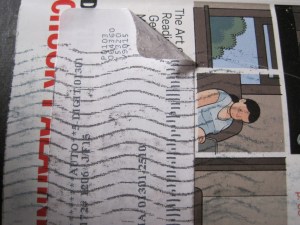

Meant to show this earlier: my November/December Poets & Writers, with the Chris Ware comic on the cover, and some hyperaggressive annotation from a central Massachusetts postage meter.
What I Read in December
December 31, 2012 § Leave a comment
Still haven’t finished the Brody book. December, as usual, has been busy with other things.
Santa Monica Review, Fall 2011. I like the modest design of this journal, with its black and white cover and single centered illustration. It publishes only fiction and essays, which lends the volume a certain heft. Animals turn up a lot in this issue, as in Michael Cadnum’s “Slaughter,” a fictional piece that finds authenticity in its detail about a man working at a slaughterhouse. The rather gruesome descriptions of the slaughtering process can only come from a writer who has worked in a slaughterhouse or done the legwork to learn what it is like. Perhaps it is intended to be a document of awareness in the vein of Upton Sinclair, but without that writer’s capital letter-muckraking.
A number of the contributors are described in their bios as “longtime supporters” of SMR, which creates the impression that it has its cache of favored regulars. Glen David Gold (Carter Beats the Devil) ends with an address, titled “Despair,” that was delivered at the Squaw Valley Summer Writing Conference in 2010. The address includes a fascinating anecdote, one heretofore unknown to me: Aldous Huxley, desperate for money late in his career, was hired by UPA Studios to write a feature adaptation of Don Quixote starring Mr. Magoo. (The project was rescinded once UPA realized that Huxley a.) had no idea who Mr. Magoo was; and b.) could see a movie screen about as well as Magoo could.)
Short Lean Cuts, Alex M. Pruteanu. A novella with attitude about a burned-out ex-academic now working as house cleaner, narrated in the first person with clipped, biting sentences informed by Heideggerian nihilism.
We learn a lot about Heidegger, as well as house cleaning:
What I really do best is remove stains from carpets.
Damp cloth. Always use a damp cloth.
Blot it. Don’t rub the stain.
If you’ve ever cleaned a stain and had it reappear a day or two later, your carpet is suffering from wicking. This means the liquid has pooled at the bottom of the carpet. Even though you may have blotted up the initial stain, you only cleaned the surface. Eventually, the liquid works its way back up the fibers to the top of the carpet, causing it to look like the stain has reappeared. To prevent wicking, cover the area with a thick cloth and weigh down with books. Leave overnight and remove the stain by blotting.
Blot. Don’t rub. Did you get that?
For stubborn protein-based stains, like semen, try rinsing with cold salt water first. Then go about tidying up the usual way.
There is not a deep plot, but the story moves along nicely, particularly by way of exchanges with the protagonist’s case worker. Dark and bright at the same time, in the manner of Henry Miller or Chunk Palahniuk (with more than a couple nods to Fight Club).
The Normal School, Fall 2012. A film-and-music-themed issue celebrating the eclectic journal’s fifth anniversary, and an unexpected find in our local bookstore. The opening essay, by Ned Stuckey-French, adheres well to the argument in the introduction to this year’s Best American Essays, that the best essays do not place their weight on introspection; they do the work of laying out researched fact and developing insight from that fact in the aim to persuade and teach us something about the human condition. Stuckey-French’s essay, a defense of Elvis Presley as an innovator of twentieth-century rock ‘n roll, rather than as a purveyor of kitsch, is placed with deserving prominence at the front of the issue.
Stuckey-French counts off seven of the most common claims that critics use to dismiss Elvis from the conversation:
Elvis was dumb
Elvis was racist, or at least a tool of racists
Elvis was pathetic, not tragic
Elvis sold out
Elvis is not Sinatra, Dylan, or the Beatles (or alternately, he’s not Jerry Lee Lewis, Carl Perkins, Johnny Cash, Chuck Berry, James Brown, or Little Richard)
Elvis is for girls (or its corollary: Elvis was sexist).
Elvis is not God.
As someone who admittedly does not treat Elvis as seriously as Dylan, Cash, or the Beatles (I do love that JXL remix of “A Little Less Conversation,” which Elvis purists probably find scandalous), and who happens to be acquainted with a female Elvis impersonator, I fall squarely into Stuckey-French’s intended audience. Arguments like this one leave me willing to be persuaded:
What concerned me more, however, was why my friends felt—why in part I still feel—the need to choose Elvis over the Beatles or Sinatra or Dylan. The choice is a false one. It is also unfair—unfair because it is based, often at least, on the assumption that there is but one Elvis—sequined jumpsuit Elvis—but many versions of the others. We parse those artists—preferring Rubber Soul to Revolver, rhapsodizing about the Capitol sessions, continuing to argue about the electrification at Newport in 1965.
The reason for this, I think, has to do once again with the belief that Elvis was passive and without irony—or, less kindly, that he was stupid or, at best, naïve. The others, we say, were not. … Elvis was a polite Christian boy, an only child from Tupelo; smark aleck wasn’t really what he did.
I hope this essay gets noticed when it is time to put together next year’s anthologies.
And so the final tally for 2012: 30 books read, not including literary journals & magazines (since I tend to skip around with those). Truman Capote (3 titles) was the only repeat author, and six books were by people I knew either in real life or virtually. For Best Book I Read This Year, I’m going to go with Chad Harbach’s The Art of Fielding (discussed here), with Jennifer Egan’s A Visit to the Goon Squad and Teju Cole’s Open City receiving the silver and bronze medals, respectively.
Happy New Year, everyone.
How to Write Posthumously
December 29, 2012 § Leave a comment
At The New Yorker’s Page Turner blog, the transcript of an address by Jeffrey Eugenides delivered to the recipients of the 2012 Whiting Award. By writing posthumously, of course, he means writing without the natural inclination to compromise one’s writing when people start paying too much attention to it. (Hasn’t been a problem for me, so far. But I wholly understand it.)
Your audience, as it grows, your need for a teaching job, the fact of being taken seriously and reviewed by people—all these things might lead you to over-analyze your words and censor them. As Adrienne Rich put it, “Lying is done with words and also with silence.”
…
To die your whole life. Despite the morbidity, I can’t think of a better definition of the writing life. There’s something about writing that demands a leave-taking, an abandonment of the world, paradoxically, in order to see it clearly. … The same constraints to writing well are also constraints to living fully. Not to be a slave to fashion or commerce, not to succumb to arid self-censorship, not to bow to popular opinion—what is all that but a description of the educated, enlightened life?
Coming shortly after this year’s ALCS, Eugenides repeats the words of a Detroit Tigers pitcher, Doug Fister: “Stay within yourself.” In other words, do not change your game in response to the expectations of an opponent, or the marketplace.
One of my problems is that I keep looking up at the top of the hole, where the daylight is, when I know the only way to get where I want to be is to keep digging.
Lunch With Poe
December 26, 2012 § Leave a comment
Aside from the books, from friends B. & I. came this:

 Neil Serven