Chatting About Words With Elizabeth McCracken
June 15, 2021 § Leave a comment
Last month I (along with my colleague Ammon Shea) had the privilege of chatting with author Elizabeth McCracken about her new collection of short stories, THE SOUVENIR MUSEUM, for the Merriam-Webster Book Thing. The chat is now loaded to YouTube for those who were unable to attend.
THE SOUVENIR MUSEUM, with its stories set in places near and far, ended up being a rich subject for this project, as it is peppered with regionalisms and dialect that felt true to the character’s universes. We talked about using thesauri, the challenge of writing in first person versus third person, and using language that is true to oneself.
There was so much I didn’t get to ask! Like her use of visual puns, as when, in “The Irish Wedding,” Sadie refers to her sleeping arrangements (a sleeping bag and an air mattress) as a “disaster sandwich,” and then we read on and meet the groom and he happens to be eating a real sandwich. Plus I learned what a swazzle was.
I became a fan of Elizabeth’s work after enjoying her last novel, BOWLAWAY, and though it is not shown here, I was particularly thrilled to get to talk to her about candlepin bowling, a subject we both love dearly.
What I Read in 2020
December 31, 2020 § Leave a comment
For the third straight year, presented in the approximate order I finished them, here is an unasked-for list of my favorite books that I read for the first time this year.
DREYER’S ENGLISH by Benjamin Dreyer. A guide to grammar, punctuation, and style written by the Random House copy chief, who approaches his subject with a keen wit and a sensibility that in the object of clarity, not every rule is meant to be steadfast.
NINTH STREET WOMEN by Mary Gabriel. Intimate in its details yet vast in its scope, this 944-page tome looks at the careers of five painters who scratched for their places in the gallery, and the conversation, amid the male-dominated world of mid-20th century American abstract art.
THE SECRET HISTORY by Donna Tartt. One of the more thrilling campus novels, with an interesting backstory, this paperback was a fun book to carry in my hoodie and read when I was out and about, back when we did such things.
MEANDER, SPIRAL, EXPLODE by Jane Alison. An analysis of plot structure and the variety of patterns that a narrative can follow, backed up by the author’s close and insightful reading of example texts, opens up a trove of strategies for the writer looking to advance their prose.
THE GREAT BELIEVERS by Rebecca Makkai. A novel about AIDS and its immediate and everlasting impact on a community. With characters seeking hope and forgiveness against a climate of dread and judgment, the friendships are some of the most believably rendered I’ve read in fiction.
NOTES OF A CROCODILE by Qiu Miaojin. A novel of intense young love and desire among Taiwanese college students, cleverly structured and freshly irreverent against the backdrop of post-martial-law Taiwan.
SONTAG by Benjamin Moser. A richly researched biography of a writer who refused to be reduced, one that elevates its subject by keeping a balanced focus on the passions that drove her: love, curiosity, and a hunger for an erotics of art.
THE GREEN HOUR by Frederic Tuten. Fluidly written novel about an art historian pursuing her romantic obsessions in Paris, cliched in just about every possible way, and yet despite its melodramatic twists I found quite an enjoyable read.
BORROWED FINERY by Paula Fox. A memoir of the novelist’s childhood and early adulthood, when she was raised by a succession of odd guardians until her volatile, wayward parents barge back into her life. The narrative looks in unexpected places and avoids tropes.
CROOKED HALLELUJAH by Kelli Jo Ford. Set against a vividly rendered landscape, this novel uses snappy language to tell about four generations of hard-bitten Cherokee women as they run from brush fires, look for escaped mules, and deal with unreliable men.
LATER by Paul Lisicky. A memoir of the writer’s years spent in Provincetown, Mass.; the friends, artists, and lovers he meets there; and the community’s response as the AIDS crisis swells in the 1990s. An honest book about the struggle to both live fully and survive.
INSIDE by Alix Ohlin. A novel about strangers and the psychology of connection, loss, forgiveness, and redemption. Set across continents and decades, it brings together a series of characters who might otherwise have nothing to do with each other in an artful and effortless way.
BROWN ALBUM by Porochista Khakpour. Frank and lyrical essays of the experiences of growing up as an Iranian-American immigrant, and the dismaying challenges that arise in a society that assigns you an identity before you are given a chance to develop your own.
YOU WILL NEVER BE FORGOTTEN by Mary South. Remarkably fresh stories that get ahead of modern trends and tropes with savage humor, pinning down uncanny situations that are familiar yet nameless, taking a razor to the kinds of real-life characters who suck the air out of the room.
NIGHTS WHEN NOTHING HAPPENED by Simon Han. A story of a Chinese immigrant family in Plano, Texas, this novel manages to evoke the silences of nighttime through its gentle register and yet artfully haunts its neighborhoods with the horrors of rumor, kid logic, and racism.
FLIGHTS by Olga Tokarczuk. Wryly observed meditations on travel, airplanes, and the spaces and headspaces that we occupy in between other spaces. This turned to be a well-timed read as it evoked the kind of feelings that were denied to those of us who stayed home this year.
My top three might be the Makkai, the Tokarczuk, and the Gabriel, all of which coincidentally have bright yellow covers.
I also dug into Shirley Jackson for the first time (apart from “The Lottery”), and Arthur Koestler, Doris Lessing, and Graham Greene. I re-read THE PILGRIM HAWK, THE JOY LUCK CLUB, and Camus’s THE STRANGER, which felt aptly lonely and disorienting.
I read 41 books in all, which is more than usual for me, though at one point it felt like I might break 50. No bowling leagues, no travelling, and I didn’t watch sports because they didn’t feel worth the stakes. So I puttered around on my novel and read books.
Our first full year owning Federal Street Books—a store whose crowded shelves and cramped aisles invite one to get lost and wander into other people’s spaces—was interrupted by a pandemic that made that very activity dangerous and irresponsible. We got a harbinger of what was coming when my wife picked up a bag of books that someone left to “donate” and got her hand bitten by a brown recluse spider. (It was very painful, but she recovered.)
Stories meant so much more this year, they provided what rare chance we were afforded to get out of our doom-clouded heads. Through books this year I got to visit Chicago, Algeria, Texas, Taiwan, Uganda, and a host of other places. I miss overhearing conversations in bars, the lacquer-scent of a bowling alley. This year’s voyage required so much imagination, and now I fear imagination has taken over in a darker direction—people are imagining their own election results, their own narratives of evil, and talking themselves into comfort with living in a different reality from the rest of us. I want the idea of fiction to return to the page and the screen, where it belongs, to remind us of what we can do, not what can happen to us. I want to go home.
Sleepwalking in Texas
November 29, 2020 § Leave a comment
I enjoyed Simon Han’s debut novel, Nights When Nothing Happened, about an immigrant Chinese family living in the suburbs of Plano, Texas, in the early aughts. I got to know Han a little when I met him at Bread Loaf in 2018, but I don’t remember if he spoke much about his project then.
As the title suggests, many scenes in the book take place at night, and the gentle register of Han’s prose evokes an effort to avoid disturbance. The Cheng family has two children, older brother Jack and younger sister Annabel. Liang is a portrait photographer and Patty works long hours in the semiconductor business. Annabel has taken to sleepwalking, and her brother must set out into the neighborhood in the wee hours to find her.
Much like Celeste Ng’s Little Fires Everywhere, the characters are trying to maneuver through a suburban landscape that promises safety on the surface, but that gloss only makes it harder to spot the dangers that lurk. A disruption occurs in the middle of Nights When Nothing Happened that amounts to the book’s only real plot point, and as in Little Fires, rumor, misunderstanding, and racism contribute to a tense confrontation with the potential to harm lives.
As though we are trying to pay mind to a sleepwalker, the book is artfully devoid of clamorous sentences. Rather, Han creates uncanny moments of silence with his language, opting for his sentences to be let down softly.
But tonight the moon was missing, and the sky had never seemed so big. Big and black and interrupted by roofs and satellite dishes and crosses. Starless and full of folds, blue-black hiding spots. Liang’s shirt clung to him with sweat. He imagined the wind ferrying warmth from the Panhandle, swirling with the evaporated salt spray of the Gulf. How long had it been since he’d breathed air with conviction. There was no such thing as a Texas sky; there was only sky.
There is also a significant amount of dialogue spoken by children—more than is typically attempted in a novel for adult readers. Many of these lines are spoken to each other, with no adult present—and it seems like each line isn’t meant to direct us anywhere, but is there to dizzy the reader with its range of interpretations heard through the sonic fuzz of kid logic.
“Not today,” she said to Elsie. “I’ll break my arm after Thanksgiving.”
“Do you… have to?”
“I got to do it before Christmas. Then Santa will give me a big and beautiful cast greener than Kermit. And you can put your stickers on it.”
Elsie was on the verge of tears. “But I wanted to put my stickers on m lunch box.”
“Hey.” Annabel was almost a heard shorter than Elsie, but when she brought her hand up to the girl’s face, Elsie winced. “It hurts so so so much to break my arm. I’ll feel better with your stickers.” Annabel gave the girl’s cheeks a light sweep. “You’re my friend, right?”
You can read the first chapter of Nights When Nothing Happened at Electric Literature.
At NPR, you’ll find Scott Simon’s interview with the author as well as this thoughtful review by Leland Cheuk. Lastly, Han has an essay at The Paris Review blog that gives context to the immigrant experience in Plano.
Story in Greensboro Review
April 22, 2020 § Leave a comment
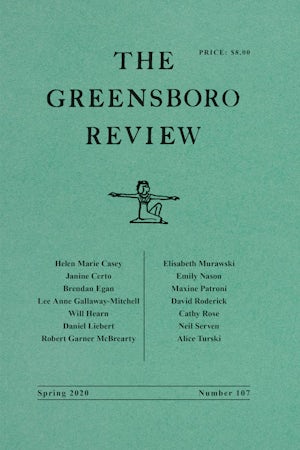
At Greenboro Review, UNC MFA candidate Chris Swensen does a deep dive into my story “Dixie Whistle,” which appeared in the Spring issue (#107). The story is not available online, but you get a pretty good idea of what it’s about from Swensen’s thoughtful reading.
I am extremely proud of the story, and received a lot of good feedback on it (in workshops and following its publication). But I have been hesitant to promote it too much given its ugly and problematic title. The very day that I received my extra contributor’s copies in the mail was the day The Dixie Chicks announced they were dropping “Dixie” from their name. That word romanticizes the confederacy and connotes segregationist policies in a way that I, a writer from the north, did not take seriously when I waggishly used it as part of Candy’s CB handle. (She thinks it up on the fly when her mother drives past a Winn-Dixie grocery store.)
The story is not about the Confederacy, nor segregation, though it is set in Georgia in 1980, the Dukes of Hazzard years, when such truculent ideas were still very much romanticized. Dixie was tossed around with a lot more abandon then, in names and brands and popular culture, and while that might make Candy’s choice of handle realistic (and fittingly and absurdly naive, as part of my intention), the writer is not excused for abandoning what he should know just because he is writing about a time in the past. To me, the name aptly pinned the clumsy ways in which we adopt false identities whenever we look for our place in a new setting–much as we do in the present day on the internet, perpetually striving to stay “on brand,” putting on personas that are meant to attract attention from strangers.
While nobody has criticized me for my use of the word yet, I am aware that to many others it is weighted with greater serious than I gave it. I hope people still read the story, and am glad that Greensboro Review took time to write about it.
The Year in Reading (and Writing) 2019
January 1, 2020 § Leave a comment
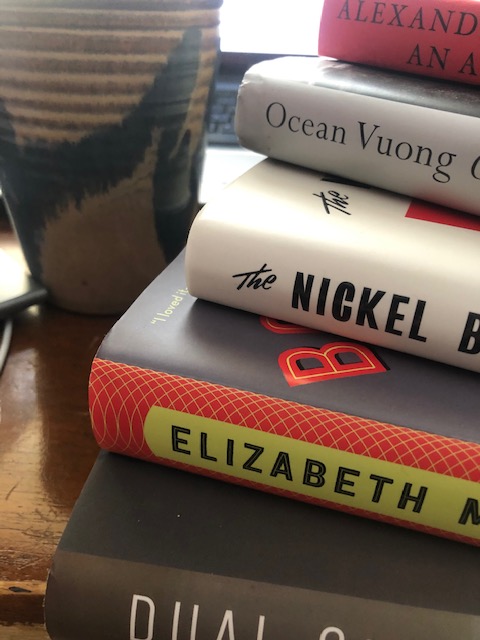
For the second straight year, my unasked-for list of books I enjoyed:
A Lucky Man by Jamel Brinkley. Graceful, complex stories about young black men in Brooklyn and the Bronx navigating the codes of masculinity and expectation that come with existing as a young man of color in the 21st century.
How to Write an Autobiographical Novel by Alexander Chee. What is disguised as a book about writerly advice shines best in personal essays about making it as a human observer in a world of glittering surfaces, and the spectacle of life experience informing art.
Less by Andrew Sean Greer. An alternately sad and hilarious novel that won the Pulitzer Prize, it uses its humor and swift narration adeptly to reveal truths about aging, love, relationships, and failure.
Bowlaway by Elizabeth McCracken. Concerning an obscure regional sport beloved by me, it finds new wonder in ascribing its invention to a fiery matriarch with a century’s worth of colorful descendants. The book is about family, and how myths and legends survive.
Music for Wartime by Rebecca Makkai. Layered, patient stories that demonstrate how art can celebrate humanity across dark eras, finding grace and beauty in the slightest folds.
Dual Citizens by Alix Ohlin. A novel of sisters and artists and the disparate paths they take, it naturally threads together compassion with cruelty, desire with sacrifice, ambition with ambivalence.
On Earth We’re Briefly Gorgeous by Ocean Vuong. A young man’s letters to his mother, who cannot read them, composed of sentences gently stirred into small miracles to evoke the shared pain of generations.
The Nickel Boys by Colson Whitehead. A tight, fierce book about institutional cruelty, written in wise and subtle language, unapologetic and never obvious where it is headed.
All told I finished the year having read thirty-four books, four of which were re-reads. I read more Roxane Gay, Lucia Berlin, and Sam Lipsyte; enjoyed digging more into Baldwin, Didion, and Modiano; tried out Tania James, Danielle Evans, and Jenny Zhang. I found myself juggling more reading toward the end of the year; at the moment I have ten in progress, which has to be a record for me. This is what happens after you buy a bookstore. I discovered that mass-market paperback novels are great to have in your hoodie pocket or to peek at during downtime. There is a concerted effort out there to keep us distracted and depressed, but when you read a book, you at least retain your agency.
Meanwhile I have a story coming out in The Greensboro Review in the spring. An actual print journal with no internet analogue, so you won’t find a link to it here. There is something remarkably fresh and concrete about that. Over the summer I attended a writers’ conference and took a wonderful workshop with Joy Williams, where she punched me in the arm and generously offered feedback on two stories in addition to the one I workshopped. One of those was the story that will be in The Greensboro Review.
I am thinking more about the decision of writing and publishing, of what my writing should say, what deserves to exist out there with my name on it, rather than just publishing for some fleeting sense of achievement. My stories are getting longer, and starting to explore comparable themes–talking to each other–which is why I haven’t been submitting anything else, and I’m comfortable with that, with not having to refresh Submittable or look for some scoreboard of acceptance and approval.
And maybe by the end of the next decade, I’ll stop trying to be perfect and get my novel written.
Our Newest Project
November 23, 2019 § 2 Comments
Following a confluence of circumstances that allowed it to happen, my wife H. and I purchased Federal Street Books, a used bookshop in our town of Greenfield, Mass. After about six weeks’ worth of reorganizing and clearing our old inventory, we reopened the store on October 12.
I am still writing and still working full-time at the dictionary. This side hustle gives me a way to contribute at the retail end of the literary community as well.
The response from the community has been encouragingly positive. You can visit the store’s site or read about our adventure in the Greenfield Recorder.

Juniper Summer Writing Institute 2019
June 14, 2019 § Leave a comment

“Pipes. I think it was broken pipes. I should have written it down so I don’t use it again.”
Next week is the annual Juniper Summer Writing Institute, held down the road at the University of Massachusetts Amherst. This will be my first year participating, and I will be workshopping fiction in a class with the incomparable Joy Williams. I can’t wait to get started.
The above is from “Flour,” from The Paris Review #224 (Spring 2018).
Against Her Mother or God Himself
March 16, 2019 § Leave a comment
Last August, at Bread Loaf, I was privileged to share a workshop with Kelli Jo Ford, a writer of sharp-edged prose about Cherokee women and families. And I got to read a portion of her novel-in-stories, Crooked Hallelujah, about a family of hard-bitten women in Oklahoma and Texas and the men who love them and let them down, balancing the older generations’ connection to things earth-bestowed against the youngers’ comfort with modern America’s blighting institutions. It’s all written in the snappy language demanded of the exhausted and the fighting, where the sentences tumble over one another like a rolling plain and divert at unexpected places like rivers. A story from that collection, “Book of the Generations,” was published last year in The Missouri Review:
Lula held herself something like together with a religion so stifling and frightening that Justine, the youngest and always the most bullheaded, never knew if she was fighting against her mother or God himself, or if there was even a difference. Still, her father was a betrayal of the knife-in-the-heart variety—something far beyond all their fighting—and here he was on a cool spring evening, right between them.
“He’s in Texas. Near Fort Worth,” Justine said. She bit her lip. “He asked me to go to Six Flags with him. Just for the weekend. He has a little boy now, I guess.”
She almost hoped Lula would hit her, but Lula stared into the hills. It wasn’t clear she had heard, so Justine’s mouth kept moving.
“Six Flags is an amusement park. With roller coasters. I know you might think it’s too worldly, but I can wear a long skirt on the rides and all. It’s sort of like a big old playground!” Justine forced a smile. She pushed a strand of hair back into her bun, waited. “I’m sorry, Mama.”
And another story from that collection, “Hybrid Vigor,” was published in The Paris Review earlier this year and was just awarded the Plimpton Prize (a merit that earned the attention of Lyle Lovett). This is going to be a sensational book, raw and honest and riveting, and important.
 Neil Serven