Besieged Consciousness
October 25, 2013 § Leave a comment
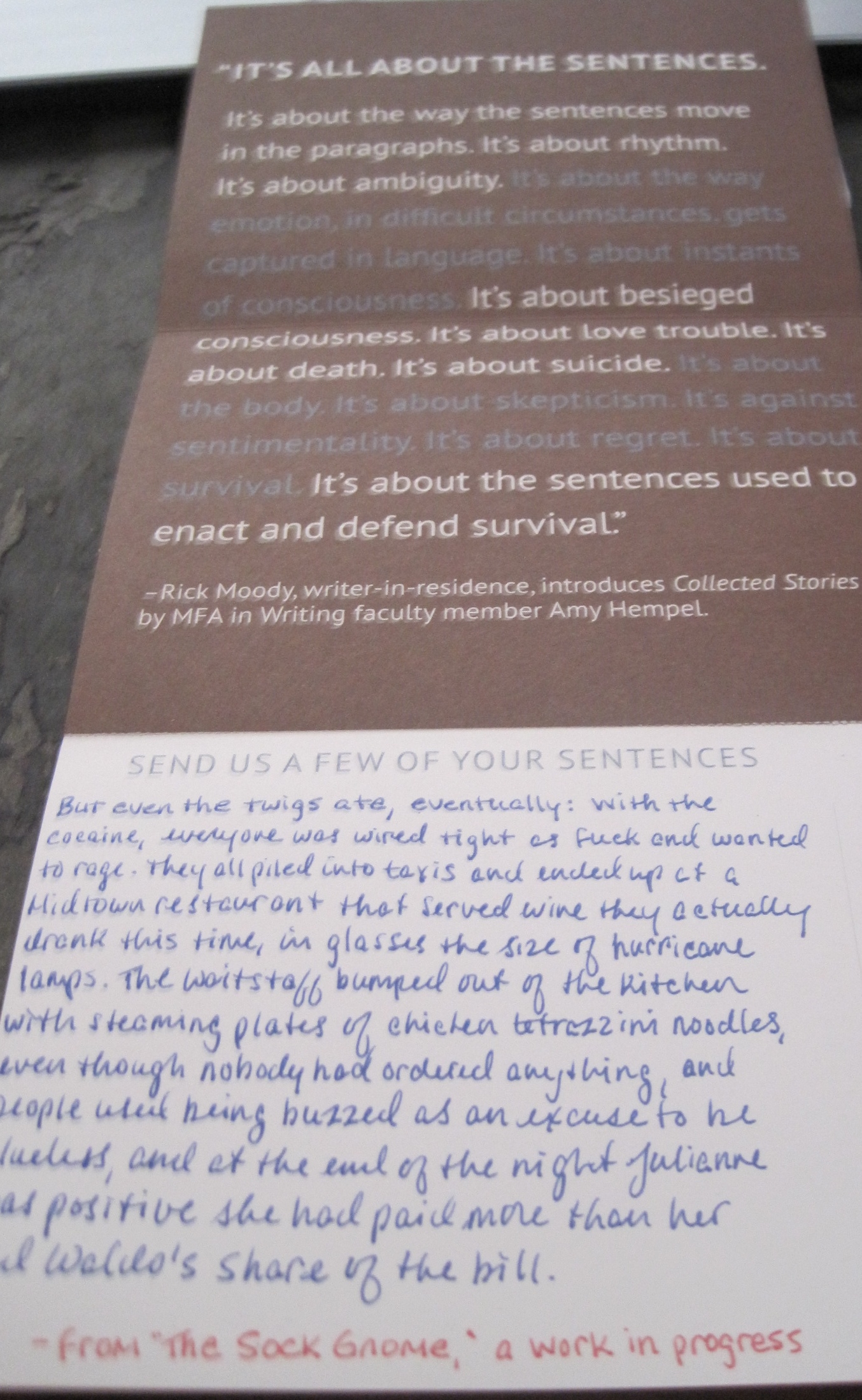
Bennington’s promotional mailer for its low-residency MFA program quotes Rick Moody’s introduction to Amy Hempel’s Collected Stories, on the importance of the sentence as a narrative unit. (“It’s about besieged consciousness. It’s about love trouble.”) The reply card asks you to send a few sentences of your own. I don’t know what they plan to do with them, but here are mine, from a work in progress.
If anything, it reminded me that the exercise of writing down (or even rewriting) my words by hand is one I should undertake more often.
The Literary Magazine in Popular Culture
October 22, 2013 § Leave a comment
At The Millions, Nick Ripatrazone writes about the cultural influence of literary magazines and their relatively scarce presence in film and television. Ripatrazone asked around for some examples where lit mags are referenced in these media, and I chimed in with a couple.
R.I.P. Oscar Hijuelos
October 14, 2013 § Leave a comment
And who should come by when his date gets up to use the ladies’ room but that brunette, and even if she’s not a blonde, she looks seriously fly in a tight pink dress and bops toward him with a drink in her hand, and Dios mío, but she looks hot from dancing, with beads of sweat rolling off her chin, and onto her breasts, her stomach damp and transparent through the clingy material of her dress. And what does she say but, “Aren’t you Cesar Castillo, the singer?” And he nods and takes hold of her wrist and says, “My, but you smell nice,” and he gets her name, cracks her up with a joke, and then, before his date returns, he says, “Why don’t you come back here tomorrow night and we can talk some more and have a little fun”…
–Oscar Hijuelos (1951-2013), The Mambo Kings Play Songs of Love
Bruce Weber’s obituary of Hijuelos, in the New York Times, praises the writer for chronicling the “conundrums of assmiliation,” and says, “His characters were not necessarily new arrivals — in Mr. Hijuelos’s books, which sometimes ranged over decades, they certainly didn’t remain so — but in various stages of absorbing the sometimes assaultive American culture while holding on to an ethnic and national identity.”
In the parts of Mambo Kings I have read, Hijuelos shows a distinctive ear for the American babble, the arrogant forward press of youth, and the critical weight of pop culture (e.g., I Love Lucy) and fame as yardsticks of achievement. You can see his influence in Junot Diaz, among others. I’m also seeing hints of Dorothy Baker, and even though I don’t think she wrote about the U.S. much, Jean Rhys (e.g., Voyage in the Dark).
Running and Keeping Up
October 12, 2013 § Leave a comment
Nicholson Baker, so modest and down-to-earth as usual, interviewed at Full Stop:
There’s something useful about being humbled by the difficulty of what you’re doing, and by the sense that you’re trying to figure it out. It’s maybe better not to know what you’re doing, or at least that’s what I tell myself, because most of the time I really don’t feel that I’ve figured it out. When I was starting out, I’d check out books from the library on how to write, and they were useful to me in that I rebelled against some of the rules.
…
Books and movies are so skewed towards action. You get fired, and that’s the inciting incident, or your wife leaves you, your husband leaves you. You come into some money. You are suddenly mistaken for a CIA operative. Something happens that is completely out of the blue, and you’re expected to have wise, thoughtful reactions to it. But actually, you’ve just become a person who is sort of running and keeping up. I don’t believe that whole thing of: Get the character in a tree and then throw stones at him. I don’t buy it. It’s a very bad piece of advice.
I met Baker when he was touring for The Anthologist. The same man who unashamedly gave us Vox and House of Holes turns flush when he speaks about his own accomplishments and influence as a writer. His novels all tunnel down into the buried circuitry of logic and memory, though lately he has turned away from explaining the miraculousness of manmade objects (matches, drinking straws, shoelaces) and more toward humans themselves and their painful limitations. The Anthologist was an instance in which the flaws of the character gave substance to the narrative, and I’m glad that Baker is bringing back Paul Chowder for Traveling Sprinkler.
A Victory for the Short Story
October 11, 2013 § Leave a comment
I would like to think that the awarding of the Nobel Prize in Literature to Alice Munro this morning is a further testament to the resurgence of the short story.
Munro’s central Canadian settings give her a vastness of frame on which to maneuver her characters, rejecting the tired idea that short stories can only surround the episodic and incidental. At The New Yorker’s Page-Turner blog, Sasha Weiss says, “Munro is one of those writers who, no matter how popular her books are, is our writer. This may have to do with the frank intimacy of her tone, which is stripped of ornament and fuss, yet also, in its plainness, contains huge amounts of terrible, sublime, and contradictory feeling.”
Among the stories featured in the New Yorker archive is “Passion,” from 2004:
Most of the waitresses left after Labor Day, to go back to school or college. But the hotel was going to stay open till October, for Thanksgiving, with a reduced staff—Grace among them. There was talk, this year, of opening again in early December for a winter season, or at least a Christmas season, but nobody on the kitchen or dining-room staff seemed to know if this would really happen. Grace wrote to her aunt and uncle as if the Christmas season were a certainty and they should not expect her back anytime soon.
Why did she do this? It was not as if she had other plans. Maury was in his final year at college. She had even promised to take him home at Christmas to meet her family. And he had said that Christmas would be a good time to make their engagement formal. He was saving up his summer wages to buy her a diamond ring.
She, too, had been saving her wages, so that she would be able to take the bus to Kingston, to visit him during his school term.
She spoke of this, promised it, so easily. But did she believe, or even wish, that it would happen?
“Maury is a sterling character,” Mrs. Travers said. “Well, you can see that for yourself. He will be a dear, uncomplicated man, like his father. Not like his brother. Neil is very bright. I don’t mean that Maury isn’t—you certainly don’t get to be an engineer without a brain or two in your head—but Neil is . . . He’s deep.” She laughed at herself. “Deep unfathomable caves of ocean bear— What am I talking about? For a long time, Neil and I didn’t have anybody but each other. So I think he’s special. I don’t mean he can’t be fun. But sometimes people who are the most fun can be melancholy, can’t they? You wonder about them. But what’s the use of worrying about your grown-up children? With Neil I worry a lot, with Maury only a tiny little bit. And Gretchen I don’t worry about at all. Because women have always got something, haven’t they, to keep them going?”
And at The Millions, Ben Dolnick offers “A Beginner’s Guide to Alice Munro,” from July 2012.
Hungry for a Slice
October 9, 2013 § Leave a comment
 The post office may still be swiftly completing its appointed rounds even in the wake of the government shutdown, but that apparently didn’t preclude it from helping itself to a little snack this week, namely my copy of Slice Magazine.
Report From the Brattleboro Literary Festival
October 6, 2013 § Leave a comment
Brattleboro, Vermont is a corkscrew of a city, with odd hillside turns and alleyways, that happens to be the city where my wife and I ducked away to get married last year. Today I returned to take in part of the Brattleboro Literary Festival, a four-day celebration that hosts readings, panels, and other events in a handful of venues around town.
First I heard readings from poets Amy Dryansky (Grass Whistle) and Joan Larkin (Legs Tipped With Small Claws) at the Hooker-Dunham Theater & Gallery. Then I moved to the Centre Congregational Church (stuffy, with pews not very conducive to tall people) to hear David Gilbert (&Sons) and Kristopher Jansma (The Unchangeable Spots of Leopards) read from their latest novels, both of which are about authors who find themselves in sticky predicaments.
In between events I popped into Brattleboro Books, where I picked up John Gardner’s On Becoming a Novelist for $7.00. I killed time reading it in a café until Flashing Lights—A Flash Fiction event hosted at Hooker-Dunham by Jacob White, editor of Green Mountain Review. Five writers shared their work: Pam Houston (Sight Hound), Bonnie ZoBell (The Whack-Job Girls), David Abrams (Fobbit), Christine Schutt (Prosperous Friends), and Megan Mayhew Bergman (Birds of a Lesser Paradise). Of these five, ZoBell is the only one I associate with flash fiction–Schutt even admitted to “misunderstanding the assignment,” and read a standalone-worthy chapter from her novel–but White did a solid job of pointing out the effective flashlike elements of each selection during his introductions.
After the event, I got to chat briefly with White, ZoBell, and Bergman, as well as Festival Committee member Jodi Paloni, whom I forgot to congratulate for winning the 2013 Short Story America Prize for Short Fiction (for her story “Deep End”).
What I Read in September
October 4, 2013 § Leave a comment
Big Fiction #4, Summer/Fall 2013. This issue includes the winner of the Knickerbocker Prize, “Sandy and Wayne” by Steve Yates, and the first runner-up, “Half-Boy” by Sandra Gail Lambert. The winners were chosen by Lauren Groff.
Both stories are alive in their directness of place and selective dialogue. The title characters in “Sandy and Wayne” are, respectively, the chief highway inspector and lead foreman on a road construction project in Arkansas. Each character has reason to put up a veneer: Wayne, defense of his men and project; Sandy, digging in to maintain her authority in a workplace dominated by men. There is a Midwestern honesty in their conversations as they shift from posturing to relaxed flirting to fear of an uncertain future as the job winds up.
“Half-Boy” resides in buggy and swampy Florida, where people keep snakes as circus pets and the legless protagonist, a female posing as a male in hopes of finding work, needs to take extra care not to get eaten by alligators.
The Fun Stuff, James Wood. Wishlisted it and received it as a Christmas present last year, which turned out to make little sense from an economic standpoint, since Wood is slinging his hash for the New Yorker now and many of the essays here I had already read in that magazine. (It seems an unfair discount to call them reviews.) But it was good to read them again. Wood is not in the business of simply evaluating authorial talent; rather, he is trying to chip away at the ice for some kind of revelation about what makes literature sublime, whether it be an underbubbling lyricism in word choice or reminiscent allusion to a past master.
It doesn’t hurt that Wood’s tastes seem to align too well with my own—he finds “a cunning combination of the quiet and the loud” in W. G. Sebald, “pungent realities” opposing “playful fictionalizing” in Aleksandr Hemon, and “shallowness” in Paul Auster (I hated The New York Trilogy). There is less of a cohesiveness here than in The Irresponsible Self, which was subtitled On Laughter and the Novel and set out, in twenty-three essays, to analyze and appreciate comic narrative and its methods: unreliable narrators, moral ambiguousness, the burnout of hysterical realism. The Fun Stuff seems more of an arbitrary collection released to please non-New Yorker subscribers perhaps looking for more of Wood’s writing after How Fiction Works. Either his thorough note-taking or incredible memory for phrase and image allows him to connect dots across generations and contextualize authorial choices apparently intended as homages (conscious or not); to take one example, Wood makes note of Hemon’s use of “blood-red fezzes,” in his story “The Accordion,” which happens to echo the same exact phrase used by Joseph Roth in his novel The Radetzky March (1932). That even a well-read critic could even think to make this association is bewildering, and might make a reader believe he is showing off his intellect, but these kinds of observations also lend the authors and their works under review a level of awareness as attempts of art, given their due place on the timeline as participants in the conversation.
After Claude, Iris Owens. An Advance Reader’s Copy that I won from NYRB Classics as part of a prize package. Lisa Zeidner, in The American Scholar, calls Harriet, the narrator of After Claude, “so unreliable she makes Humbert Humbert look like Thurgood Marshall.” Harriet tells us she has just left the boyfriend whose name is in the title, the “French rat,” though we quickly learn that he, a documentarian for French television, was the one who dumped her, the final straw being her negative reaction to a film they watched together about the crucifixion of Jesus. (“Some skinny guy schlepping a hunk of wood that weighs a ton up a steep hill for the express purpose of getting nailed to it, that was beautiful?” she tells him.) Harriet’s inability to handle any sliver of resistance leads to every stimulus being judged in absolute extremes: a cab driver speeds “as if he were rushing plasma to a beheading”; the streets are filled with “drunken bums hanging around, competing for nickels with hippies in hairshirts, rehearsing the plague”; an ice cube tray is “welded into the freezer like King Arthur’s sword.”
Meanwhile, Harriet uses all of her wit to fight her inevitable eviction from the apartment; having burned bridges with her two best friends (again, over blown-out-of-proportion annoyances), she has nowhere to go. The last third of the book takes a rather bizarre turn as Harriet, once installed by Claude in the Chelsea Hotel, immediately tries out a new target for her dependency, a counterpart more whacked that she: her Chelsea neighbor, Roger, who tries to persuade her to join his harem. Harriet’s verbal defenses lose their acuity against Roger’s conniving charisma, to which she partly succumbs by pleasuring herself in front of him. Such a sinister twist doesn’t match up with the promising energy of the narrative that brought us there. By the end, I wanted Claude back.
Domestic Apparition, Meg Tuite. A novella in stories, Domestic Apparition is the angst-filled tale of Michelle, an impressionable girl growing up amid characters she is wary not to endow with her full trust but that still comprise the targets of her fascination. Older sister Stephanie is an open lesbian who clashes with her conservative father; brother Nathan is a savant who argues with nuns in Catholic school about the infallibility of popes. A longer story, “Brenda Stantonopolis,” profiles a troublemaking friend who implicates Michelle in her misdeeds. The narrative is spiked with tossed-out revelations meant to surprise, but that on occasion get lost amid the other details, as though narrator Michelle herself is not aware of their weight:
[Nathan] was working on composing an opera about fish when he was around ten. He sat at the piano for weeks hitting random notes and putting little fishtails up and down his music sheets. It was called, “Dance of the Rainbow Trout,” and when the three sisters and a neighbor performed it in our basement it took over an hour to get through. My parents got drunk on martinis.
…
Adel had always been fragile. She threw herself in front of a truck once when we were around thirteen because a new girl from school and I had gone to basketball practice without her.
Although there are times when the book seems trapped in its own tunnel of memory, lacking the perspicacity one might expect of an adult reflecting back on her past, we do see Michelle’s character accumulate layers of complexity that make sense as products of her relationships documented in the earlier stories. By the time she is an adult installed in a hotel service job, Michelle is wise enough to see through her supervisor’s proud language and unearned sense of authority.
Kino, Jürgen Fauth. An AWP purchase from the Atticus Books table. The German-born Fauth is a film critic for About.com (as well as the founder of Fictionaut), and Kino adeptly demonstrates the author’s literacy on the subjects of film and Germany history in the 20th century by way of its themes of memory and rewritten pasts.
The novel has the tightly plotted framework of a mystery, and doesn’t waste time in laying out the important points. A newly married woman, Mina Koblitz, arrives at her New York apartment to discover that someone has left a print of Tulpendiebe (The Tulip Thief), a silent film directed by her grandfather Klaus (nicknamed Kino) and long thought to have been destroyed by the Nazis along with his other films. While her husband Sam is hospitalized with a case of dengue fever, Mina is encouraged by a local film scholar to travel to Berlin, then to Los Angeles, to piece together the fates of the remaining films and the story behind their disappearance. Kino’s journal, written in the last years of his life, turns up, and at one point Fauth alternates excerpts from the journal with current-day narrative to create a complex weave of suppression and denial amongst Kino’s surviving family, particularly his son (Mina’s father Detlef) and widow (Mina’s grandmother, the salty, distrustful, and somehow remarkable agile (even after waking up from a coma) 92-year-old Penny). The overlap between the flashbacks to the Third Reich and the lead-up to the U.S. invasion of Iraq is not a coincidence.
The book employs an ample amount of German phraseology, all covered in a glossary at the back, yet some of which is explained in concept within the text even though it doesn’t need to be (e.g., Schadenfreude). I sort of wish the author had resisted this temptation; I think leaving these phrases unglossed within the text would have lent the narrative more authenticity. Similarly, some of the paragraphs seem to linger a beat or two too long in their internal reveals:
“Oh, your father? Detlef the Dullard? That’s what Klaus and I called him, did you know that? Not when he was around, of course. Jesus, he was a boring child!”
Mina looked down at the rug, at a gob of spit that had not yet been absorbed. Her father was not whom she’d come to talk about, and the mention of him made her defensive. She wanted to protect her idea of Kino. A megalomaniac, that was fine. But maybe she didn’t want to hear the rest, after all.
R.I.P. Tom Clancy
October 2, 2013 § Leave a comment
I admit not having read any of Tom Clancy’s books, not even The Hunt for Red October.
But his best achievement might have been to get otherwise stolid, nonverbal men to enjoy reading, and that is a pretty great thing. His death, announced today, comes as somewhat of a shock given his relatively young age (66) and voluminous output up until the end. He has a new title, Command Authority, due out December 3.
Objection Lesson
September 27, 2013 § Leave a comment
Banned Books Week ends tomorrow, and this year I didn’t celebrate by reading Tropic of Cancer or Lolita like I’ve done in the past, only because my nightstand stack is already too high and I didn’t feel like switching gears.
Other than sparking an important annual discussion about censorship and free expression, and giving booksellers a marketing hook for their backlists, what does a week celebrating banned books accomplish now? Most of the time, people who object to a book nowadays know they aren’t going to see it banned. Most objectors only think that going public with their disgust is somehow a revolutionary act that will stand even with that performed by the person who wrote the book. All that does is point out how little the objectors know about how revolution works.
People want to make news and be heard. This is why we still keep hearing about school boards removing books from school libraries because they contain elements so ubiquitous in other media: sex scenes, witchcraft, heresy, or, God forbid, people comfortable in gay relationships. Interest in the book rises and kids who never planned to read it to begin with go scope it out on Amazon. Then the objector gets mocked, and in some cases, such as this week in North Carolina, the board relents and its members cover their asses after being embarrassed. But people still want to make news and be heard, so the cycle continues year after year.
There is an echo of Internet spoilage here. The objector is analogous to the commenter who thinks his or her dashed-off trolling somehow leverages off the more carefully composed work they are disparaging. It speaks to a gross distrust of readers young and old not to make their own fair critical assessments, but then the objectors are never forced to own to that. Free speech only works when it polices itself. It is a vital tool for knowing who the assholes are in this world.
 Neil Serven