Cobalt Review Print Edition
October 18, 2016 § Leave a comment


It’s been a while since I’ve had the thrill of receiving book mail with a contribution of my own between the covers.
Today’s thrill came in the form of Cobalt Review #4, featuring selected and awarded pieces published on the Cobalt website in 2015, including the latest of my baseball stories, “The Old Apple.”
One Bad Apple
October 10, 2016 § Leave a comment
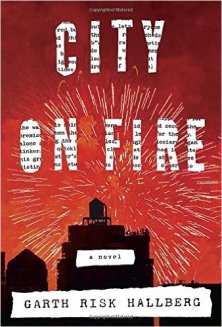
A trend that I wonder if we will be seeing in literature, if we are not already seeing it, is the pre-Internet nostalgia novel–one that eschews what I have heard referred to as the Romeo & Juliet problem: meaning that, due to the easy availability of communication devices in the modern world, a story that bases its complications on absence and distance, such as Romeo and Juliet, is impossible to portray today. A problem with nostalgia is that memory compromises itself; we remember our reactions to things better than the things themselves. Another is that we tend to project an unjustified romanticism upon the times we weren’t around for. To a child of the eighties, the sixties sounded fun. They were more likely frightening as hell to the people who lived through them.
The climax of Garth Risk Hallberg’s epic, block-thick City of Fire takes place during the heat wave and blackout that paralyzed New York City in the summer of 1977. It is a time that has been remembered elegiacally before in films like Summer of Sam and nonfiction books like Jonathan Mahler’s Ladies and Gentlemen, the Bronx Is Burning, later made into a TV-movie for ESPN. To the author of City of Fire, that summer has the added mythos of pre-existing him: Hallberg was born in 1978. One would presume that everything about that era that informs these uncrisp 900 pages was learned by the author secondhand.
Hallberg uses the summer as a backdrop against which he arranges an ensemble cast, the plot only loosely oriented around a shooting in Central Park the previous New Year’s Eve. The altered history, rendered in weaved personal narratives, is more fragmented and microcosmic, and less interesting. The ensemble is brought together precisely because its members ordinarily would have nothing to do with each other. It might be believable that the gay scion of a wealthy banking family takes on an African-American writer and schoolteacher from Georgia as a lover, but is it just as plausible that he would cultivate an alter ego as a member of a fringe punk-rock band in the heyday of the East Village punk scene? And then there’s the dynastic drama of the family patriarch getting remarried to an opportunistic gold-digger, who can install her brother into a position of influence; there’s the daughter of the family handling public relations for the family business while her marriage crumbles; there’s her husband, pursuing an unlikely affair with a zine-producing punk-rock girl, and their son, who in flash-forwards tries to piece together how and when the family seams started to pull apart.
Then there are the satellites of the New York City police detective tasked with investigating the shooting, the zine-producing punk-rock girl who takes the bullet, the suburban teenager who had fallen for her and becomes infatuated with aforesaid punk scene, the fireworks manufacturer who is the father of the victim, the depressed journalist covering the investigation of this one crime; that guy’s neighbor, a Vietnamese-American gallery assistant, and by the end of the book, the blockheaded impression, as Louis Menand points out in The New Yorker, that the life of each person in New York touches that of everyone else, just like in the moralistic tomes of Charles Dickens:
The aim of these novels is not to mimic actual city life, where people tend to be like hamsters in their own cages. It’s to dramatize a hidden interdependence, to show that we are all, each according to our abilities, turning the same big socioeconomic wheel inside the same spatiotemporal cage.
Hallberg writes with a delicate sensitivity, close to the soul of each character, even those not worthy of a soul. This eventually points toward a message: that the disparity of these niches says something about the inevitability of social consequence. New York is a city of many neighborhoods. When a Con Ed grid blows and the city goes dark, everyone—rich and poor, aboveground and below—has to find their way through the same darkness. But the disparate narratives do not invite equivalent levels of investment from the reader. There’s a minor mystery to be solved–that of who perpetrated the shooting–and an act of terror—the bombing of the eponymous skyscraper of the banking family by a punk personality turned pseudo-anarchist—to be thwarted. But the characters whom we are supposed to follow with rapt attention, due to their potential for catastrophe, are drawn the most uninterestingly, with little to say that isn’t speechified, in scenes that zoom away from the intimacy the more interesting parts of the novel somehow pull off.
In fact, the most personable characters in the book all happen to be aesthetes. I’m not sure this is a coincidence. There are scenes where City on Fire pauses to argue for its own earnestness. The journalist, Richard Groskoph, could easily have written the novel himself. He operates more or less as a lone wolf, hard-bitten and tormented, distanced from his family. offering internal discourses on Truman Capote and New Journalism (“But now, on a magazine salary, Richard could spend an entire morning taking a single sentence apart and putting it back together again … What he wanted above all to get right was the web of relationships a dozen column inches had never been enough to contain … Some of the universes he explored, as the ‘60s gave way to the ‘70s: Negro league baseball, folk rock, TV evangelism, stand-up comedy, stock-car racing”). William Hamilton-Sweeney, the black-sheep scion, plays under the nom de guitar Billy Three-Sticks for a punk band called Ex Post Facto, and later becomes a painter of canvases influenced by the scattered urban landscape. Mercer Goodman, his younger, sensitive lover, is an aspiring novelist. And there is Charlie Weisbarger, the wannabe punk from the suburbs, who finds a home in the scene in the most adolescent and un-punk of ways, by tiptoeing into the swarm and seeking approval:
Charlie gulped down half of the beer, aware that at any minute they could tire of him and ask him to leave, and then he’d no longer be fucking hanging out with Ex Whatever. The drummer, Big Mike, had now wandered in, along with the new organ player, each nodding at Charlie as if they’d been expecting to find him here. The pop-tops of Rheingolds exhaled contentedly, and another cold one found its way into his hand. He wondered where they were coming from: a fridge, a cooler, some inexhaustible aluminum tree sprouting deep in the warren of wonders that was “backstage.”
Listening to them talk about who was in the audience reminded him that this was their first real performance. That gallery fag Bruno was out there, did you see him? And Bullet’s Angels, scary dudes, man, scary dudes. Plus the dissertationists, your Nietzsche Brigade. But has anyone seen Billy? Little bastard is probably too … Hey … All the while, the girl on the sofa, sitting up again, gazed at Charlie. “So you know Sam,” she said. “You never told me that.”
This Sam is not the Son of Sam – that would be too earthy, to true to the headlines in a novel unafraid to refer to headlines (FORD TO CITY: DROP DEAD). No, David Berkowitz’s staggering Members Only frame and occulty letters earn barely a mention. In fact, many of the elements of that New York summer that made Mahler’s book an interesting read, like the feud between Reggie Jackson and George Steinbrenner during the Yankees’ pennant chase, or the Democratic mayoral primary pitting Mario Cuomo, Bella Abzug, and eventual winner Ed Koch against incumbent Abe Beame, are non-factors in Hallberg’s book. There’s no Jimmy Breslin, no Village Voice. It’s as if Hallberg went on vacation and only took pictures of his dinner plates.
Sam is Samantha Ciccario, the arty girl with whom Charlie becomes smitten, and with whom Keith Lamplighter, the husband of the Hamilton-Sweeneys’ daughter, Regan, has commenced an affair. She’s also the person who gets shot in Central Park, spending the last two-thirds of the book lying comatose in a hospital bed. One would think , through her urban guard and knowledge of the underground, that she’d have made a worthy tour guide around the mansion. But rather, we get to know her while she sleeps, by way of one of City on Fire‘s many extratextual novelties (the book, at a number of points, resembles a Douglas Coupland novel): an authentic-looking 26-page Xeroxed-and-stapled zine compiled (and mostly written) by Sam and found on the person of the last person to see her before she gets shot, Keith Lamplighter. For an insight into city life, the zine holds a rawer voice than the book. I would have ponied up the quarters for a subscription.
More importantly, the mystery of who shoots Sam, and whether she lives or dies, is not positioned to have any consequence. Nor is the threat of a midtown skyscraper being blown up. Hallberg is more interested in creating a living, sprawling portrait of New York at a time when it got by on its petulance, when the subways were terrifying to ride and the alleys reeked of piss. There are many moments where that atmosphere is conveyed believably, in enjoyable language, but I wish the author had better trusted his ability to select the right image. They say there are eight million stories in the naked city, as Jules Dassin’s 1948 film first tells us (and Breslin repeats at the end of Summer of Sam), and City on Fire tries to tell all of them.
Mix Up the Stew a Little More
September 21, 2016 § Leave a comment
Curtis Hanson romanticized the life of the modern writer as one of unending creative chaos and juicy narrative complication. A sham, but like all good fiction, sold so well.
Going the Distance
September 18, 2016 § Leave a comment
The store lifted away from us like a bell jar. The other players took their places on the field: tall, silent Ted Troy at first base, Peppy Gosselin at shortstop, Pudge Green in center field. As the players took shape, the racks of pink and blue dresses, the women’s and children’s clothes, fresh as sunshine, smelling of ironing and starch, rose like mist. The grass was emerald-green, measled with dandelions.
I learned of the deaths of W. P. Kinsella and Edward Albee within ten minutes of each other on Friday. Two careful writers who took the human psyche to widely disparate places.
Kinsella, of course, was known for his magical realist baseball fiction, especially Shoeless Joe, the novel that formed the basis of Field of Dreams. The reclusive Sixties author played in the film by James Earl Jones, Terrence Mann, is in the book the real-life reclusive author J. D. Salinger, who was still very much alive when Kinsella used him as a character in the book. As a deeper homage, the name “Ray Kinsella” was borrowed from the main character in Salinger’s story “A Young Girl in 1941 With No Waist At All.”
I read Kinsella in my early twenties, shortly after I read Salinger for the first time. Kinsella was Canadian, but Shoeless Joe was not his only baseball fiction set in Iowa. A fictional town called Onamota is the setting for many stories. He seemed to have had a preference for the Chicago teams. The 1919 Black Sox, of course, figure prominently in Shoeless Joe, and the legendary double-play combination of rhyme, (Joe) Tinker to (Johnny) Evers to (Frank) Chance, appear in The Iowa Baseball Confederacy.
In “K Mart,” included in the collection Go the Distance (1988), friends reuniting for the funeral of a woman, whom the narrator loved and treated poorly, visit the department store that now stands where their baseball field used to be. Written with simplistic grace, it’s a comical ending to a sad story that, like much of Kinsella’s fiction, celebrates the timelessness of the sport, the reliability of its structure, and the forgiveness of its myth.
The Physics of Fools at Prairie Schooner
August 31, 2016 § Leave a comment

The folks at the wonderful Prairie Schooner have been posting mini-essays on their blog as part of a series called Sports Shorts. Today I have one called “The Physics of Fools,” one of two (!) featured essays about my beloved pastime, candlepin bowling.
It’s an insular sport. You face away from your friends when you bowl, and there is no element of defense. Candlepin bowling, in particular, comes with a sense of geographic isolation, the border between candlepin country and tenpin country running roughly parallel with the Connecticut River.
At the same time, check out E. Thomas Finan’s delightful essay, “Geoffrey Crayon’s Reflections on the Puritanical Pleasures of Candlepin Bowling.”
It’s exciting to see my favorite regional sport get some love from a midwestern journal. I have another, larger essay that I’ve been shopping around that’s also about candlepin bowling, but it’s more about the game’s tenuous future in a limited regional market when people are finding other new ways to spend their leisure dollars.
The Gazers at Pine Hills Review
August 19, 2016 § Leave a comment
They were out there, ducking in and out of rec.music.rem to show off their pistol wits as artfully as the white-dot VAX graphics allowed. He imagined, from how they strung together eloquent sentences or tucked in extensive literary .sigs, that they were English majors like he was, only they blew off their classes to read Baldwin, Nabokov, and Bertrand Russell in paperbacks with their spines broken. They spun hard-to-find seven-inch vinyl at their campus radio stations. They had outsized personas and carried pocket handkerchiefs and drank whiskey in heavy glasses and dashed off verse on cocktail napkins. They got no joy from rage. They didn’t hook up, they made love.
I’m excited to have a new story, “The Gazers,” at Pine Hills Review today. Set in the mid-1990s at a college campus, it might be the most self-indulgent story I have ever written, as it touches upon pretty much every point of angst that I could remember from my days as a spoiled college brat. I’m grateful to Daniel Nester for publishing it.
Throw a Little More Thoreau
August 14, 2016 § Leave a comment

Another room at the W Boston, approximately 20 miles from Concord, and another attempt to enlighten guests with a meditation from Henry David via a jute shade. This one is from Walden (1854), to add to last year’s sampling from The Maine Woods. Our room on the 6th floor had no views of any lakes. I am now morbidly curious how many different works in the Thoreau canon are quoted throughout the rooms; if Emerson gets any love; or if they dared cut a few from Civil Disobedience.
What I Read in June and July
July 30, 2016 § Leave a comment
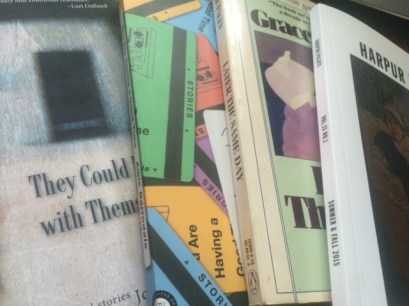
(This is not a complete list. I’ve also been reading the Complete Novels of Jean Rhys, which I will write about as a whole, once I’m finished.)
Later the Same Day, Grace Paley. This collection was given to me some 20 years ago by the nice woman who was my internship supervisor. She was an ex-nurse who had moved into a communications and development role for the VNA. She gave me the book because she knew I was an English major and had ideas of becoming a writer. After enjoying the stories of Lucia Berlin, to whom Paley is frequently compared, I decided to crack open the delicate yellowed pages of Later the Same Day.
Paley’s characters, like those of Berlin, operate under a complicated moral code with a conniving self-interest that has evolved to adapt to their uncooperative surroundings. That’s what happens in “Anxiety,” when a woman calls out from her apartment window to criticize a young father for scolding his child:
Let’s not go too far, said the young father. She was jumping around on my poor back and hollering oink oink.
When were you angriest—when she wiggled and jumped or when she said oink?
He scratched his wonderful head of dark well-cut hair. I guess when she said oink.
Have you ever said oink oink? Think carefully. Years ago, perhaps?
In “Somewhere Else,” we follow an American tour group in China. Their travel guide accuses them of taking photographs of the peasants without permission. “We hoped we were not about to suffer socialist injustice,” Paley’s narrator says, “because we loved socialism.” They put their cameras away, reluctantly: “Still, I know that any non-Hispanic white man with a camera looks like a narc.”
Many of the stories revisit the same character, the somewhat oxymoronically named Faith Darwin, who appeared in two of Paley’s earlier books, The Little Disturbances of Man and Enormous Changes at the Last Minute. Faith is divorced (her ex-husband is an explorer), a mother of two, a New Yorker, and an observer informed by her anxieties regarding these things.
The business of the domestic, its errand-based rituals and fires (especially those of other people) to put out, occupy the pages of Paley’s fiction, much like Berlin. This is no more apparent than in “Friends,” a story of visiting an older friend with cancer. They see her wobbling, bumping around in her room, steadying herself. Selena’s daughter, present in photos in her room, has died. Deferring a question about her own son, Faith narrates, “It was only politeness, I think, not to pour my boy’s light, noisy face into that dark afternoon.” Then, as the visiting friends set to leave their ailing friend, guiltily and helplessly: “We had a long journey ahead of us and had expected a little more comforting before we set off.”
You Are Having a Good Time, Amie Barrodale. Picked up this new collection on a whim at Longfellow’s Books in Portland, Maine, after happening to read a couple of positive tweets about it that morning. The relationships in You Are Having a Good Time are deliciously complicated, with lines many times crossed and stepped over; there is enough bad behavior to give off a very bright Mary Gaitskill vibe (and Gaitskill gives a blurb on the back on the book). A common thread is women seeking the wrong answers from, or being led astray by, male authority figures who do not have their best interests at heart. “Frank Advice for Fat Women” is as audacious (in the sense of sheer audacity) as its title suggests: a mother ostensibly concerned with her daughter’s depression and weight gain sets her up with a therapist as a way of spying on her, and the doctor leverages each one against the other as a way of exerting control over both.
There is also some loose interconnectedness at play. In the second story, “Animals,” an actress works under a demanding and abusive director, to whom she is attracted, on a film called “The Imp”; “The Imp” also happens to be the title of the third story, about a failing marriage. And while impishness suggests a playful innocence that drags one away from the seriousness of life’s decisions (echoed in the book’s title), there is also the suggestion of forces of destruction at work for the better, much like the damage caused by a sprite or gnome.
They Could Live With Themselves, Jodi Paloni. I know Paloni from her work with the Brattleboro Literary Festival and purchased her book after hearing her read at World Eye Bookshop in Greenfield. This collection of eleven linked stories are set in the fictional town of Stark Run, Vermont, and much like Karl Taro Greenfeld’s Triburbia, features connected characters weaving in and out of each story, but with a small-town sensibility appropriate for New England. Among them are art teacher Meredith; her former student, Sky, who lingers in the neighborhood and gets paid for odd jobs; grocery store manager Wren; and Molly, Sky’s mother, who is best friends with Wren.
The filaments of the web are sketched in, and as characters grapple with broken dreams and cluttered pasts, and the younger characters like Sky seek paths to meaningful futures, a complex portrait of Stark Run and its limitations—both social and geographic—are finely rendered. If there is an emotional center to the book, it might reside in Meredith, whose relationship to Sky is tense, visceral, and complicated and who is ambivalent about settling in Stark Run after a career as a New York artist:
He picked up the top sheet from the pile of the figure sketches she had made earlier in the week and appeared to be reading the notes in the margins, measurements and letter codes about points and angles that only she could decipher. She bit a flap of skin from a thin blister on her index finger, nervous about his actual body, located so near to the wire figures, nervous he’d call her out.
…
He stretched his arm in a gesture that swept the space above the pile of jumbled wire forms. “All of this looks super cool.”
He didn’t seem to realize they were miniatures of him, but still, Meredith felt odd to have him probing her design process. Her work hadn’t always been so private, but now it came out of loss, a study of how one lives in a body and then leaves a body.
Harpur Palate, Summer & Fall 2015. This issue includes the winner of the John Gardner Memorial Prize in Fiction, “Hourglass” by Sam Keck Scott, about a young man recalling the troublesome actions of his late older brother. While I enjoyed the issue, I am at a loss to explain why the pieces were arranged alphabetically by author. This seems a random and careless way to present a journal. It means that Scott’s piece doesn’t appear until two-thirds of the way through the issue, and even though the pages are highlighted with a green border stripe, it violates the principle of putting a store’s best merchandise where it can be found.
Carrie Messenger’s essay “My Soviet Shadow” is a fascinating account of the author’s being selected, with a group of classmates, to appear on a Russian quiz show about a year before the fall of the Soviet Union. The Russian contestants with which they are paired as teammates are regulars on the show, and it is apparent that there is a cultural contrast being sold as part of the deal: “These Russians are our essences, what we would be if you strip away our accessories, our slang, our pop music, our jeans, our ironies.” The American kids are taken under the wings of the Russian parents; the kids swap mix tapes; and friendships take time to build as they hop over the language barrier, riddled with codes and sarcasm that doesn’t translate:
Tanya keeps making everyone laugh in Russian, but tells me she can’t translate it. It’s the fundamental problem of my building a friendship with Tanya—our best selves are rooted in our languages. The parts of ourselves we don’t care about, the parts that say banal, everyday things about weather, asking and answering if we are cold, is what we have to offer each other. What we have to offer each other is kindness. All my interest is in wit. I can’t understand why Tanya would like me if we can’t follow each other into slang.
The loss in translation affects not only relationships, but the decisions of the producers, who make the kids dress in literary-themed costumes and don’t open up the avenues for understanding that Messenger seeks:
The boys are wearing partially unraveling straw hats and overalls with patches. The patches are fresh. They are there not to cover holes, but to create the Huck image. Ilya chews a piece of straw. Scott decides to mirror him. The band is dressed in leather with cowboy hats. The women in the band are wearing leather skirts with square cut out of the pattern. They’ve been given holes to approximate some kind of image of daring cowgirls. Chenel says, “Where did they get the idea that is ever okay fashion?”
The Russian judge with the attitude no longer cares if we don’t understand suffering. He doesn’t see Jim at the heart of the book. The band plays twangy bluegrass for the second dancing competition, the hoe-down. Nobody knows how to dance to it.
I want to talk about the end of Huckleberry Finn, about Huck’s decision to light out to the territory. I’m at an age where I think heading off to the college will be my way to light out. But being in Moscow makes me wonder if there is any territory to go to. Identification is easy—you learn new street names, new food. It’s the big questions that follow you around, history, fate, and suffering.
Humanity Is Not Concerned With Us
July 2, 2016 § Leave a comment
“Poor devils, you’re going to the crematory.”
He seemed to be telling the truth. Not far from us, flames were leaping up from a ditch, gigantic flames. They were burning something. A lorry drew up at the pit and delivered its load – little children. Babies! Yes, I saw it – saw it with my own eyes…those children in the flames. (Is it surprising that I could not sleep after that? Sleep had fled from my eyes.)
So this is where we were going. A little farther on was another ditch for adults.
I pinched my face. Was I still alive? Was I awake? I could not believe it. How could it be possible for them to burn people, children, and for the world to keep silent? No, none of this could be true. It was a nightmare….Soon I should wake with a start, my heart pounding, and find myself back in the bedroom of my childhood, among my books….My father’s voice drew me from my thoughts:
“It’s a shame….a shame that you couldn’t have gone with your mother….I saw several boys of your age going with their mothers…..”
His voice was terribly sad. I realized that he did not want to see what they were going to do to me. He did not want to see the burning of his only son.
My forehead was bathed in cold sweat. But I told him that I did not believe that they could burn people in our age, that humanity would never tolerate it….
“Humanity? Humanity is not concerned with us. Today, anything is allowed. Anything is possible, even these crematories…..”
Elie Wiesel found a weapon in the first person singular. I read Night for a history class in eleventh grade. It was the first horror novel I ever read.
R.I.P. Michele Cliff
June 19, 2016 § Leave a comment
The New York Times is reporting that the Jamaica-American novelist Michele Cliff has died at the age of 69.
Earlier this year, after I enjoyed Marlon James’ A Brief History of Seven Killings, I completely forgot about an earlier Jamaica-set book I had read: Cliff’s Abeng, published in 1984. I had first read it in college, in a course on Caribbean authors, a course that also introduced me to Jean Rhys, whose novels I am reading now.
Abeng is the first of two novels by Cliff about Clare Savage, a light-skinned girl of mixed race born to a dark-skinned mother and white father. (The second, No Telephone to Heaven, was published in 1987.) In Abeng Clare is twelve, on the cusp of discovering powers both sex- and class-related in an environment that seeks to pull her in opposing directions, her name itself an indicator of the clash between her dark African heritage and the forces of white British imperialism:
“Emotionally, the book is an autobiography,” Ms. Cliff told the reference work Contemporary Authors in 1986. “I was a girl similar to Clare and have spent most of my life and most of my work exploring my identity as a light-skinned Jamaican, the privilege and the damage that comes from that identity.”
The action is set in motion when Clare steals a gun to hunt a wild boar but instead, startled by a gawking cane-cutter while sunbathing nude with her dark-skinned friend Zoe, she fires a warning shot that accidentally shoots her grandmother’s prized bull. She precedes the shot by yelling at the man: “Get away, you hear. This is my grandmother’s land.” Cliff’s narrator explains the significance of Clare’s switching of code: “She had dropped her patois—was speaking buckra—and relying on the privilege she did not have.”
 Neil Serven